Pixel Flow Level 100 Solution Walkthrough | Pixel Flow 100

How to solve Pixel Flow level 100? Get instant solution for Pixel Flow 100 with our step by step solution & video walkthrough.

Share Pixel Flow Level 100 Guide:
Pixel Flow Level 100 Gameplay
Pixel Flow Level 100 Solution 1
Pixel Flow Level 100 Solution 2
Pixel Flow Level 100 Solution 3

Pixel Flow Level 100 Overview

The Board Layout and Color Layers

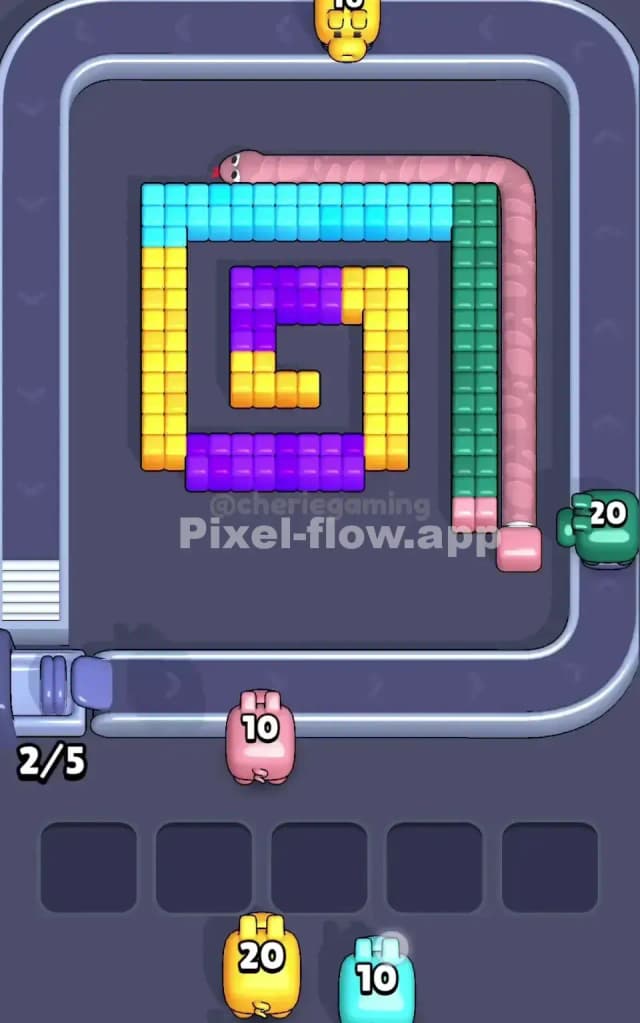
Pixel Flow Level 100 presents a challenging concentric square puzzle with multiple color layers stacked in a deliberate, deceptive arrangement. The outermost ring is dominated by pink voxels that form a thick border around the entire play area, creating an immediate visual barrier. Beneath that pink shell sits a vibrant cyan (light blue) layer along the top and a forest green stripe down the right side, flanked by sections of yellow cubes that create bridges between regions. Moving inward, you'll encounter purple voxels clustered in the middle-left and bottom sections, with yellow patches interrupting the pattern throughout. At the absolute center lies a small gray square—this is your visual goal marker, not a destructible element. The overall design is deceptively geometric; it looks simple at first glance, but the color distribution and layer depth will punish careless sequencing.

Win Condition and Determinism in Pixel Flow Level 100

Your job is straightforward: eliminate every single colored voxel cube on the board until only empty space remains. What makes Pixel Flow Level 100 so demanding is that the pig order and their ammo counts are completely fixed and deterministic. You can't change which pigs arrive or how many shots each one carries—you can only control when you deploy them. This means success hinges entirely on understanding the queue, counting remaining ammo, and planning your moves three or four pigs ahead rather than reacting to each pig as it arrives. You'll notice two pink pigs at the bottom of your screen, each carrying 40 ammo. These bookend pigs are your heaviest hitters, and wasting even a few shots on either one can cascade into failure later.

Why Pixel Flow Level 100 Feels So Tricky

The Pink Bottleneck and Waiting Slot Overflow

The single biggest threat in Pixel Flow Level 100 is the sheer volume of pink cubes scattered across the outermost ring and the bottom conveyor section. Pink is your most abundant color, and if you don't manage it carefully, you'll fill up your five waiting slots with stuck pink pigs that have nowhere left to shoot. Imagine this scenario: you fire off one of your two starting pink pigs, it clears maybe half of the visible pink cubes, and then a second or third pink pig rolls down the conveyor before you've exposed enough of the next layer. That second pink pig drops into the waiting area with 40 ammo and nothing to shoot at—now you're one full slot deeper into trouble. The moment all five waiting slots are occupied by pigs with unspent ammo, you've lost. This is why you absolutely cannot dismiss pink as a "do it anytime" color; it demands respect and careful timing.

The Yellow-Purple Sequencing Trap

Pixel Flow Level 100 hides a nasty surprise once you start clearing the outer layers: yellow and purple cubes are intermixed in ways that leave you with isolated patches. Yellow appears in small corner sections and bridging strips, while purple clusters in the middle-left and bottom areas. The problem is that a yellow pig might arrive with enough ammo to destroy all visible yellow cubes in one or two shots, only to have it drop into the waiting area with 38 ammo still loaded—because the remaining yellow cubes are hidden behind the purple or pink layers. Similarly, a purple pig might get stuck waiting because there's a thin wall of yellow blocking access to its target. You'll need to deliberately expose these inner colors in the right order, or you'll create situations where pig ammo can't be spent and your buffer becomes a graveyard.

The Cyan-Green Outliers

At the top and right edges of Pixel Flow Level 100, cyan and green cubes form relatively small regions compared to pink, yellow, and purple. This scarcity is actually dangerous because cyan and green pigs might arrive early in the queue with moderate ammo counts, only to find their targets immediately and drop into waiting with nothing left to do. That's dead space in your buffer. On the flip side, if a cyan or green pig arrives when its color is completely hidden, you'll waste the same precious waiting slot. The trick is to sequence your deployments so that cyan and green pigs arrive after you've opened up access to them—but the queue doesn't always cooperate.

When It Clicked For Me

Honestly, Pixel Flow Level 100 frustrated me for a while because I kept treating it like a standard puzzle where you just react to what's in front of you. I'd fire pigs willy-nilly, watch my buffer fill up, and feel panicked as I ran out of room. The turning point came when I sat back and actually counted the ammo on each pig in the queue and mapped out the color layers. Once I realized that those two 40-ammo pink pigs at the bottom were the lynchpins of the entire solution, and that I needed to save them for endgame to clean up the thickest zones, everything fell into place. It shifted from feeling like chaos to feeling like a puzzle I could actually solve.

Step-by-Step Strategy to Clear Pixel Flow Level 100

Opening: Establish Control with Cyan

Your first move in Pixel Flow Level 100 should be to deploy a cyan pig early. Cyan has a modest presence on the board—it occupies the top region in a clean, contiguous block—and clearing it early does two things: it frees up waiting slots and begins to expose the inner yellow layer beneath. By removing cyan first, you're not committing either of your heavy 40-ammo pink pigs, and you're creating visual clarity for what comes next. After cyan falls, you'll want to monitor the queue and grab your first yellow pig when it arrives. Yellow is scattered enough that you'll likely need two or three yellow pigs over the course of the level, but the first one should chip away at the visible yellow sections in the corners and bridging areas. As you're deploying these early pigs, keep your eye on the waiting slots—you want at least two of them empty at all times. This buffer is your safety margin; lose it, and you lose the entire level.

Mid-Game: Expose Layers and Park Half-Spent Pigs Strategically

Once you've cleared cyan and started on yellow, Pixel Flow Level 100 shifts into its most delicate phase. A green pig will likely roll down the conveyor sometime in the middle of your run. Green occupies a narrow stripe on the right edge, so this pig should dispatch its ammo quickly and cleanly. Don't overthink it—just fire the green pig and move on. Now comes the critical part: you'll encounter purple and more yellow in rapid succession, often appearing before their targets are fully exposed. Here's where you need patience. If a yellow pig arrives and you've only partially cleared yellow zones, let it sit in the waiting area for a bit. Yes, it takes up a slot, but it's not yet stuck because you know you're going to clear more yellow cubes eventually. The trick is to deploy your pigs in an order that exposes new colors steadily, so that waiting pigs gain new targets over time. One effective pattern is: when a purple pig arrives with full ammo but limited visible targets, deploy a yellow pig first to carve away the yellow pieces blocking access to purple. This cascades the colors, exposing more targets and preventing a total waiting area lockup.

End-Game: The Pink Finale and Clean Buffer Exit

By the time you're three-quarters through Pixel Flow Level 100, you should still have at least one of your two 40-ammo pink pigs in reserve. This is your endgame weapon. Pink forms the bulk of the remaining cubes at this stage, especially in the outermost ring and the thick bottom section. Deploy your first reserved pink pig now, and let it demolish the exposed pink zones. If all 40 ammo runs out and there's still pink remaining in the inner layers, your second 40-ammo pink pig will finish the job. The final push requires absolute discipline: count ammo carefully, make sure each pig you deploy will have valid targets, and avoid dropping a pig into waiting with no path to its color. On your last few pigs, you might have a situation where a yellow or purple pig arrives with moderate ammo but faces a small number of visible cubes. Fire it anyway—the goal is to empty the waiting slots and the conveyor queue in tandem, leaving zero dead weight. If you've planned correctly, your second pink pig will be the final piece, clearing the last voxels and triggering your victory.

The Logic Behind This Pixel Flow Level 100 Plan

Predictability Over Improvisation

Pixel Flow Level 100 rewards players who treat the puzzle as a math problem rather than an action game. Every pig has a fixed identity and ammo count; the conveyor queue is fully predetermined. This means you can predict when problems will arrive if you look ahead. The strategy I've outlined exploits this predictability by deploying pigs in an order that keeps your waiting slots from ever filling completely and ensures that each pig, when fired, has a clear path to its target color. You're not improvising on the fly; you're executing a sequence you've mentally rehearsed based on the colors you can see and the ammo counts you've noted. This removes the panic factor and replaces it with methodical progress.

Pressure Management and Two-Pig Lookahead

The final key to mastering Pixel Flow Level 100 is staying calm and thinking two pigs ahead instead of one. When a pig arrives and drops into waiting, resist the urge to fire the next pig immediately. Instead, check the incoming queue: what's the pig after that? If it's a color you can now expose, hold your current pig and deploy the next one first to open up new targets. This disciplined lookahead creates a domino effect where each pig's removal opens paths for the next one, and your waiting area never becomes a trap. By combining this with your ammo counts and a mental map of the color layers, you transform Pixel Flow Level 100 from a frustrating gauntlet into a solvable logic puzzle. You've got this.