Pixel Flow Level 99 Solution Walkthrough | Pixel Flow 99

How to solve Pixel Flow level 99? Get instant solution for Pixel Flow 99 with our step by step solution & video walkthrough.

Share Pixel Flow Level 99 Guide:
Pixel Flow Level 99 Gameplay
Pixel Flow Level 99 Solution 1
Pixel Flow Level 99 Solution 2
Pixel Flow Level 99 Solution 3

Pixel Flow Level 99 Overview

The Starting Board: A Dense Pixel Character

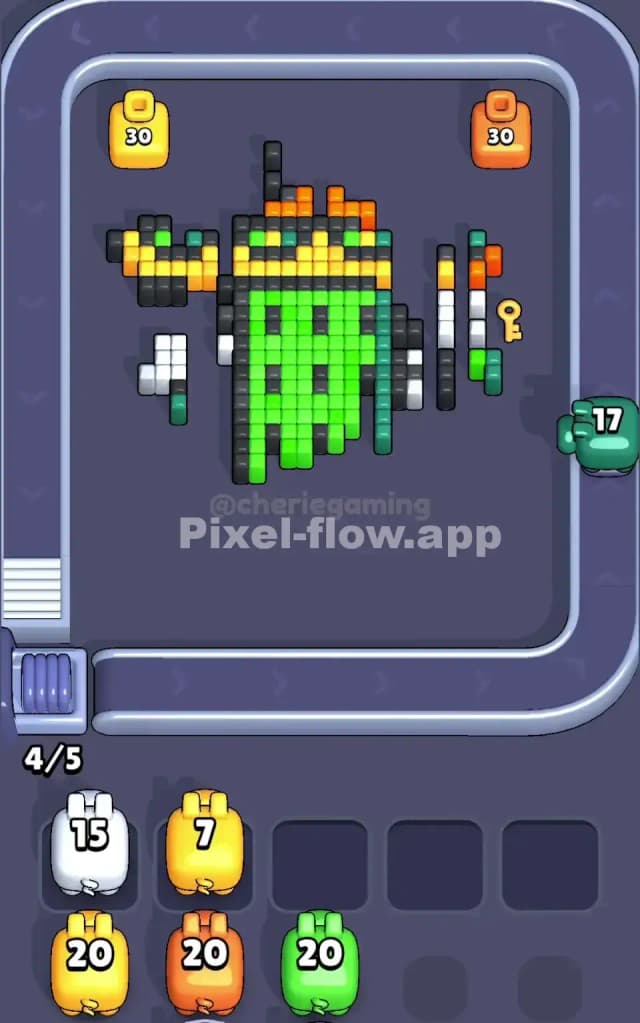
Pixel Flow Level 99 presents you with a detailed pixel-art character rendered in multiple colors across a layered voxel grid. The most striking feature is the dominant green section that forms the character's body and limbs—this is a massive chunk of the board that you'll need to systematically dismantle. Above it sits a vibrant yellow horizontal band, accented with orange and black details that form facial features and clothing elements. The top showcases bright yellow pixels that create highlights, while scattered pink and white cubes frame the sides and provide contrast. Black cubes serve as shading and definition throughout, weaving depth into what would otherwise be a flat image. What makes Pixel Flow Level 99 particularly complex is that these colors aren't randomly placed—they're stacked in layers, meaning you can't just blaze through green and expect an easy win. You'll need to expose hidden colors beneath and coordinate your pig rotations carefully.

The Win Condition and Deterministic Nature

Your goal in Pixel Flow Level 99 is straightforward: clear every single voxel cube from the board. That means the green, yellow, orange, black, white, and pink pixels all have to go. The beauty of Pixel Flow Level 99 is that every pig enters the conveyor in a fixed order, and every pig carries a precise ammo count. You're not fighting randomness here—you're solving a puzzle where the pigs' sequences and ammunition are fully deterministic. This means that once you understand the pig order and their ammo values, you can plan moves several steps ahead. The two green pigs at the top each carry 70 ammo, while the five white pigs waiting at the bottom all have 40 ammo each. That's a total of 340 ammo to spend, and you've got exactly 340 voxels to destroy. Every single shot matters, and there's zero room for waste.

Why Pixel Flow Level 99 Feels So Tricky

The Green Bottleneck

Here's where Pixel Flow Level 99 gets genuinely punishing: the green section dominates roughly 60% of the visible board. Your two green pigs carry 70 ammo each, giving you exactly 140 shots to clear all that green. Sound easy? The catch is that green cubes are scattered across multiple layers and intermixed with black shading. You can't shoot green unless it's exposed and part of the visible surface. If you rush to activate your green pigs before exposing all the green voxels by removing surrounding colors, you'll burn through ammo hitting the same accessible green patches while deeper green remains hidden. Then both green pigs will get stuck in your waiting slots with ammo left over and nothing valid to shoot. That's how you trigger a cascade failure in Pixel Flow Level 99. The green bottleneck will punish impatience harder than anything else on this level.

The Black Shading Problem

Black cubes are scattered throughout Pixel Flow Level 99 like puzzle glue—they create definition and depth but also act as barriers hiding colors beneath. You have five white pigs with 40 ammo each, which seems generous, but you don't have a dedicated black pig. That means black voxels either need to fall naturally as you clear surrounding colors, or you'll be stuck trying to use white or other pigs to chip away at black sections. There are patches of black interspersed within the green body that, if not handled strategically, can leave you unable to access deeper layers. Miscalculate here, and you'll waste white ammo on black cubes when you needed it elsewhere.

The Orange and Yellow Complexity

The orange and yellow pixels form the character's upper body, face, and details—but they're not neatly separated. Yellow wraps horizontally across most of the middle section, while orange clusters near the face and shoulders. You have two green pigs (70 each), but no dedicated yellow or orange pig in the visible queue—that responsibility falls to your white pigs. The challenge is that yellow and orange are relatively scarce compared to green, so you might think you're fine. The real trap in Pixel Flow Level 99 is that if you don't expose these colors in the right order, your white pigs could expend ammo on yellow patches before orange is even visible, or vice versa. You'll watch your waiting slots fill up and realize you've painted yourself into a corner.

When It Clicks

I'll be honest: my first three attempts at Pixel Flow Level 99 felt hopeless. I'd get four pigs into the waiting buffer and realize I'd wasted 80 ammo on exposed green while hidden green was still locked behind yellow. But then something shifted—I stopped thinking of Pixel Flow Level 99 as "shoot what's visible" and started thinking of it as "expose what's hidden." The moment I mapped out which colors were truly surface-level versus layered beneath others, the strategy crystallized. Pixel Flow Level 99 went from frustrating to manageable once I accepted that the first few moves are about surgical removal, not wholesale destruction.

Step-by-Step Strategy to Clear Pixel Flow Level 99

Opening: Expose, Don't Exhaust

Start Pixel Flow Level 99 by targeting the yellow horizontal band first. I know green is the biggest color, but resisting that urge is critical. Why? Because yellow sits on top of green in many places, and if you remove yellow strategically, you'll expose hidden green patches that were previously inaccessible. Launch your first green pig and shoot only the yellow cubes you can reach. This feels counterintuitive—you're using a green pig on yellow—but remember, green cubes aren't going anywhere. Your goal is to use that first green pig to open up new layers and board positions.

As you clear yellow with your green pig's first shots, watch your waiting slots. Keep at least two slots empty at all times during Pixel Flow Level 99's opening. This buffer is your safety net; if a pig gets stuck with ammo left over, you need room to drop it without triggering an instant loss. Aim to clear roughly 15–20 yellow voxels before your first green pig either gets stuck or runs out of relevant targets.

Mid-Game: Layered Sequencing and Ammo Efficiency

Once Pixel Flow Level 99's first green pig drops into a waiting slot, activate the second green pig. This second pig should focus on clearing accessible green now that yellow has been thinned out. As green comes off the board, you'll expose black and pink cubes beneath. Don't panic when you see those; they're breadcrumbs showing you where the next layers are.

Around this point in Pixel Flow Level 99, your five white pigs are queuing up. Here's the key: stagger them. Don't dump all five at once. Instead, use your first white pig to clear orange and any remaining yellow patches, exposing more green and black. Let that pig get stuck with perhaps 15–20 ammo remaining. Then release your second white pig to handle black shading and pink accents. The genius of Pixel Flow Level 99 is that you've got five white pigs and five waiting slots—one pig per slot—which means you can afford to park partially-spent pigs as long as each one has burned through most of its ammo on valid targets.

The mid-game is where you'll spend 60% of your time planning. Before you tap to activate each new pig in Pixel Flow Level 99, scan the board. Count exposed green voxels, identify black patches that need removal, and estimate whether your incoming pig's ammo aligns with visible targets. If a white pig has 40 ammo and you see only 12 orange cubes on the surface, that pig is going to get stuck with 28 wasted ammo unless you expose more orange by clearing surrounding colors first. Plan two pigs ahead, always.

End-Game: The Final Layers and Clean Closure

By the time Pixel Flow Level 99 reaches its final stretch, most of the board should be open. You'll likely have 3–4 white pigs in your waiting slots, each holding varying amounts of ammo. Your goal now is to coordinate the last few incoming pigs to clear the remaining cubes without jamming the buffer.

Check which colors remain: if it's mostly green and black, your remaining white pigs should finish the job cleanly. If you've got scattered orange or pink leftover, prioritize those with pigs that have matching ammo counts. The absolute last thing you want in Pixel Flow Level 99 is to activate your fifth white pig and watch it get stuck with 20 unspent ammo because all visible cubes are a color it can't shoot.

To avoid a last-second jam, keep your waiting slots fluid. If a pig gets stuck with ammo remaining but no targets, that's acceptable as long as your incoming pig does have valid targets. The moment you fill all five waiting slots and your incoming pig can't shoot anything, you've lost Pixel Flow Level 99. So in the endgame, maintain at least one empty slot until you're absolutely certain your final pigs will land cleanly.

The Logic Behind This Pixel Flow Level 99 Plan

Exploiting Determinism Over Reaction

Pixel Flow Level 99 rewards planning because everything is deterministic. The pig order never changes, the ammo counts never vary, and the board layout is fixed. This means you're not really reacting to Pixel Flow Level 99—you're executing a pre-planned strategy. The strategy works by front-loading exposure: you spend your early pigs thinning out surface colors (yellow, orange, pink) so that deeper colors (green, black, white) become visible and accessible. Once everything's exposed, your remaining pigs can finish the puzzle without running out of targets.

This approach prevents the classic Pixel Flow Level 99 failure mode: getting stuck with pigs full of ammo facing a board of colors they can't shoot. By methodically exposing layers, you ensure that every pig—green, white, or otherwise—will have at least some valid targets when it enters the conveyor.

Staying Calm and Counting

The mental game in Pixel Flow Level 99 is staying patient. It's tempting to activate pigs rapidly and watch them fire, but this is where players lose. Instead, pause between each pig. Look at the queue and count the remaining ammo in your waiting slots. Ask yourself: "If I activate this pig, will it have enough targets to spend at least 75% of its ammo?" If the answer is no, hold off. Instead, activate a different pig—or if only one pig is queued, wait and strategize.

Watching the queue and anticipating pig order is crucial in Pixel Flow Level 99. You'll see white pigs coming, and you need to know whether the board will have white-shootable voxels available. If not, consider what colors need removing first to expose white targets.

With Pixel Flow Level 99, confidence comes from counting. Count the green voxels. Count your ammo. Count your waiting slots. When you're counting instead of guessing, you're in control, and Pixel Flow Level 99 transforms from a frustrating scramble into a satisfying logic puzzle. You've got this—methodical execution, deliberate planning, and a clear understanding of the layer structure will see you through to victory.