
Pixel Flow Level 102 Solution | Pixel Flow 102 Walkthrough
How to beat Pixel Flow Level 102: Video solution & walkthrough. The fastest way to pass Pixel Flow 102.
Is this the wrong level layout?🤔
Pixel Flow randomizes levels for different players. Don't worry, just upload a screenshot of your board, and our AI will find the correct video instantly.


Pixel Flow Level 102 Walkthrough
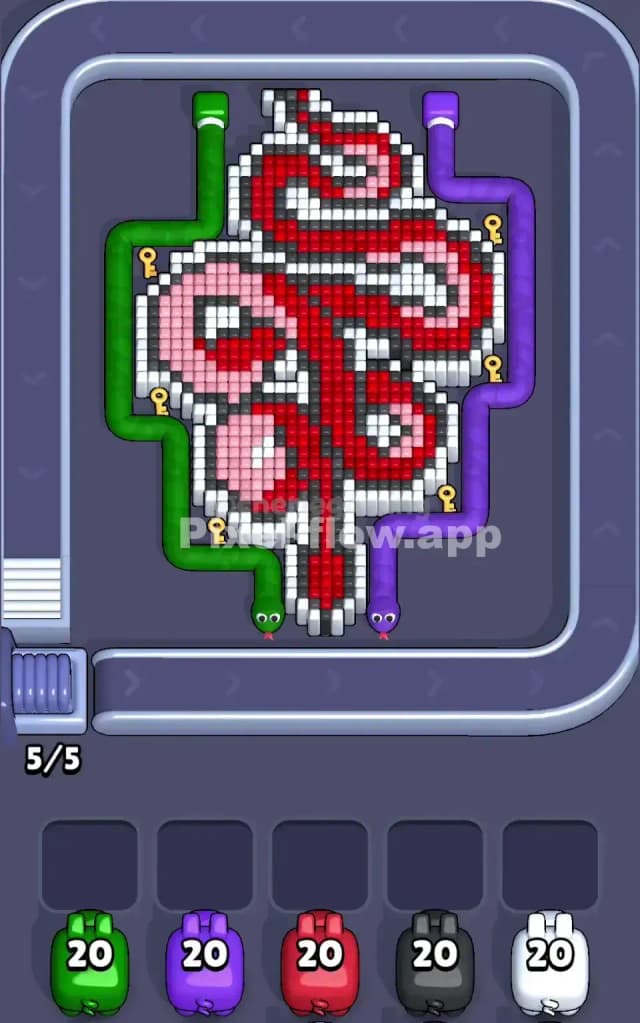
This level is a visual trap. You are looking at a complex, twisted knot of Red, Pink, and White pixels that looks like a medical Caduceus symbol or a fancy candy cane swirl, but none of that matters initially. The board is dominated by two massive "snakes"—a Green pipe-snake on the left and a Purple pipe-snake on the right—that physically sit on top of the artwork.
To beat Pixel Flow Level 102, you have to understand layer priority. You cannot touch the main artwork until you remove the guardians. The Green and Purple snakes aren't just background decoration; they are valid voxel targets that block your shots from hitting the Red and Pink core. If you ignore the snakes, your waiting slots will clog with useless pigs, and you will fail. This is a very hard level because it forces you to hold "useless" colors in your slots while you desperately wait for the specific pigs needed to clear the top layer.
Pixel Flow Level 102 Overview
The artwork here is dense and frustratingly layered. Picture a vertical, twisted structure. It has a heavy Black outline and a core filled with swirls of Red, Pink, and White. It feels a bit like a playing card design or a heraldic crest.
However, the real story of Pixel Flow 102 is the asymmetry of the "locks."
- The Left Flank: Guarded by a long, winding Green Snake. It curves around the pink sections and blocks access to the left edge keys.
- The Right Flank: Guarded by a Purple Snake. This one is even more intrusive, winding tightly around the red and white sections on the right side.
The board creates a claustrophobic feeling. The pixel art is tall and narrow, meaning you don't have a lot of horizontal space to work with. If a pig misses its tiny window of opportunity, it hits the back wall and costs you a slot. The keys visible on the board are misleading—you might think you need to "unlock" the snakes, but actually, the snakes are the lock. You simply destroy them with brute force using the correct colors.
Step by step solution walkthrough for Pixel Flow Level 102
First Color Zone to Erase in Pixel Flow Level 102
Your absolute priority must be the Green and Purple zones.
Narratively, think of this as a demolition job. You have to tear down the scaffolding before you can paint the building. Logically, the Green and Purple pigs are the only ones that can do any work at the start of the level.
Here is the trap: The game might give you a Red or Black pig early on. You will look at the board, see Red blocks peeking out from under the snakes, and think, "I'll save this Red pig for later." Do not do this carelessly.
If you fill your five waiting slots with Red, White, or Pink pigs, but the Green and Purple snakes are still covering the board, those pigs will never get a clear shot. You will soft-lock the game.
Focus entirely on the Green Snake first if possible, as it seems slightly less dense than the Purple one. Grab every single Green pig that comes down the belt and fire it immediately. You need to strip that green layer off the left side to expose the white and pink blocks underneath. Once the Green Snake is gone, the left side of the board opens up, giving your other pigs (White/Pink) valid targets.
How to pass Pixel Flow Level 102 without power ups or boosters
The mid-game of Pixel Flow 102 is dangerous. You’ve likely cleared one snake (probably Green), but the Purple one on the right is still hanging on, and the main "Candy Cane" structure is half-exposed.
At this stage, you have to manage your "trash" pigs. You will start seeing a lot of Pink and Red pigs.
- Prioritize the White Blocks: The White pixels usually form the border between the outer shell and the inner colors. Clearing White often opens up the most surface area for other colors.
- The Purple Problem: If the Purple Snake is still alive on the right, you must keep one waiting slot open exclusively for a Purple pig. Do not let your slots get filled with 5 Red pigs while the Purple snake still blocks the red pixels. If a Purple pig appears, prioritize it over everything else. You cannot win until that right-side blocker is gone.
- Shooting the Core: Once both snakes are dead, you deal with the Red and Pink swirls. These are usually clustered in vertical stripes. Try to align your Red pigs with the long vertical columns of red pixels. This maximizes their ammo efficiency. If you shoot a Red pig at a horizontal row, it might only hit one block before running out of targets in that lane. Vertical shots are king here.
Last Details You Clean Up in Pixel Flow Level 102
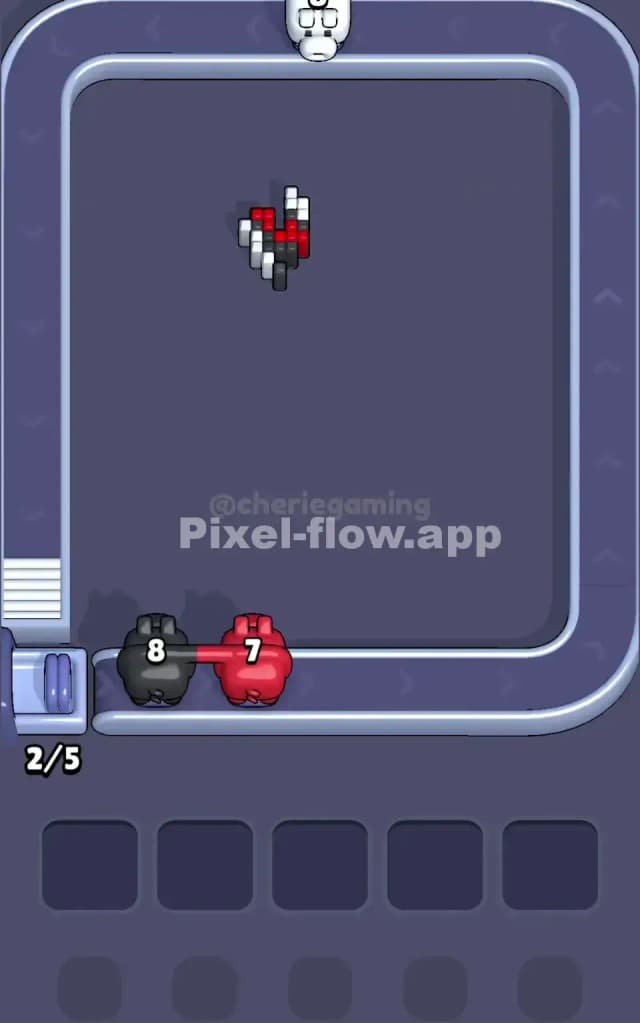
The final few moves of Pixel Flow Level 102 are usually messy. You are left with the Black outline blocks and stray Pink pixels that were hiding deep in the center.
The Black pixels are tricky because they frame the entire shape. They are thin, single-block lines. It is very easy to waste a Black pig’s ammo by firing it at a column where only one black pixel exists. Wait until the board rotates or shifts so you can line up a shot that takes out 3 or 4 black pixels in a row.
Finally, check the bottom corners of the main shape. Often, a single White or Red pixel hides near the "tail" of the design, obscured by the waiting slot UI. Make sure you don't overlook these crumbs, or you’ll be stuck waiting for a specific color while your slots fill up with garbage.