Pixel Flow Level 104 Solution | Pixel Flow 104 Walkthrough
How to beat Pixel Flow Level 104: Video solution & walkthrough. The fastest way to pass Pixel Flow 104.
Is this the wrong level layout?🤔
Pixel Flow randomizes levels for different players. Don't worry, just upload a screenshot of your board, and our AI will find the correct video instantly.
Pixel Flow Level 104 Overview
The Board and Its Visual Challenge
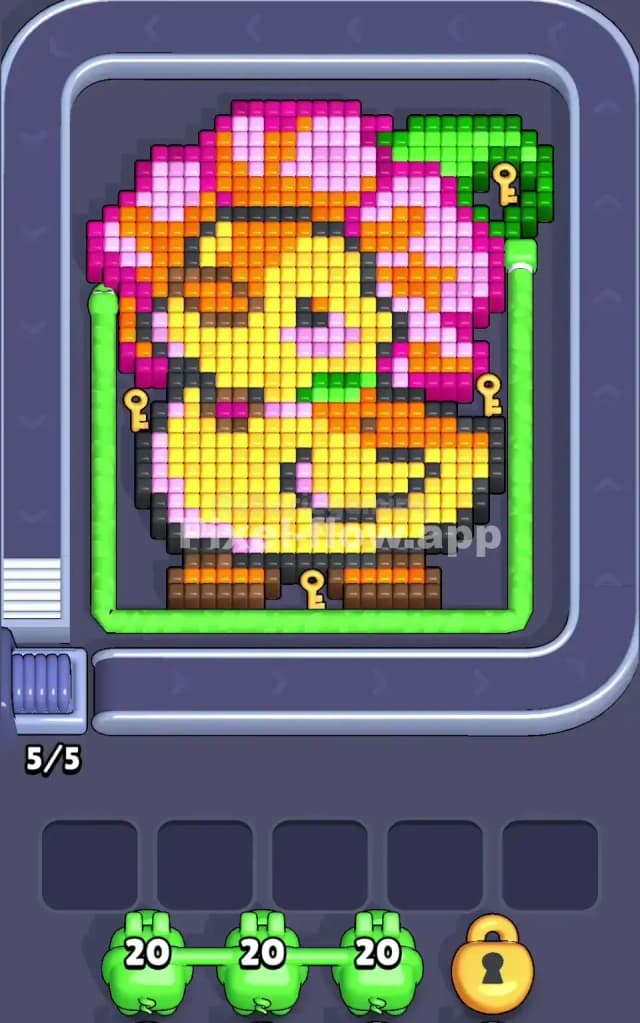
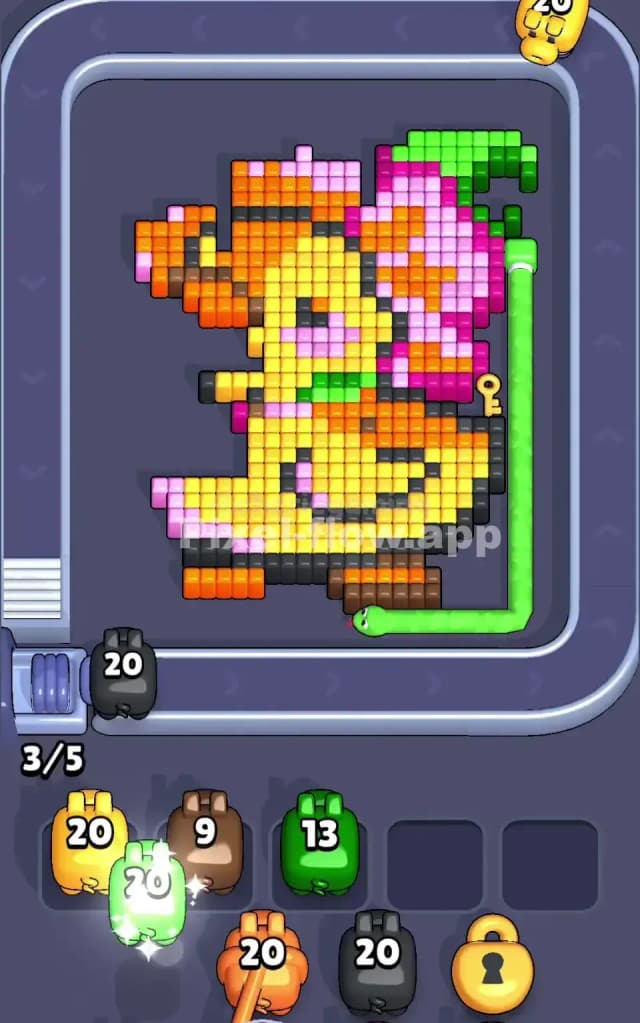
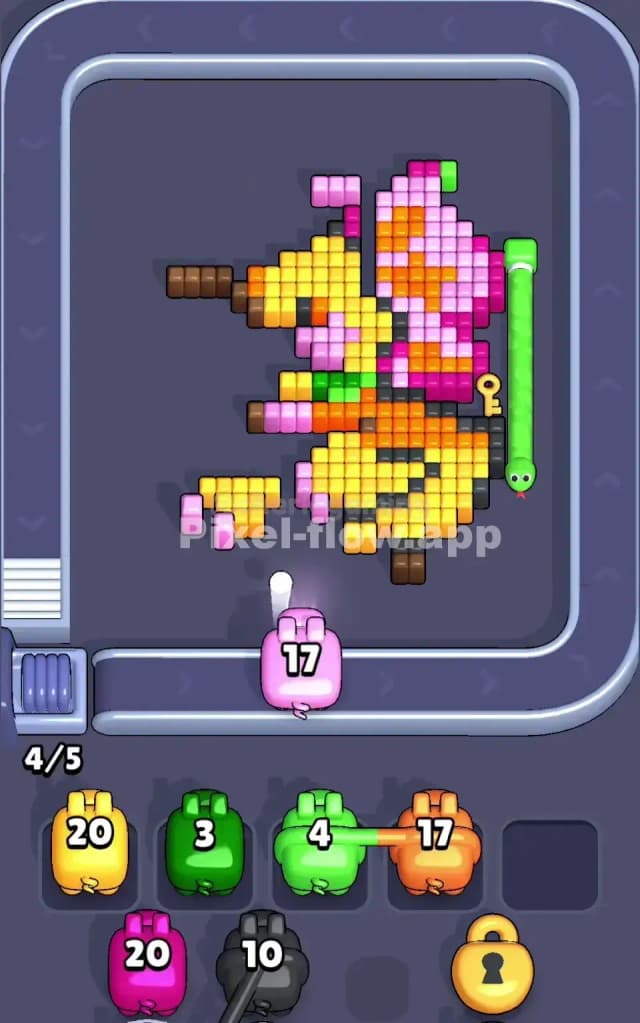
Pixel Flow Level 104 presents you with a vibrant, intricate voxel portrait that demands careful color sequencing. The board is dominated by warm tones—yellow, orange, and magenta—layered with bright green accents and deep black shadows that create depth. The pixel art itself looks like a stylized creature or character face, with the yellow forming the central feature, surrounded by magenta and pink highlights. You'll notice green blocks clustered on the right side and scattered throughout, while brown and darker orange cubes form a foundation near the bottom, suggesting multiple buried layers waiting to be exposed.
Your starting setup shows three green pigs lined up in the conveyor queue, each carrying 20 ammo. This deterministic ammo count is crucial—it means every move you make has been planned by the level designer, and your job is to discover the intended sequence. The five waiting slots below the board are currently empty, giving you breathing room to maneuver, but that safety buffer will shrink quickly if you're not strategic. The win condition is straightforward: clear every single cube on the board by firing pigs in the right order and exposing deeper layers as you progress.
Understanding the Win Condition and Deterministic Nature
Clearing Pixel Flow Level 104 means eliminating all voxel cubes without jamming your waiting slots. Since each pig fires automatically at matching-colored cubes and consumes exactly one ammo per hit, your three green pigs with 20 ammo each will fire a combined 60 shots. That's your total firepower, and it must account for every green cube on the board—both visible and hidden. The level designer has ensured that if you sequence the pigs correctly, their ammo will align perfectly with available targets, and no pig will ever be left stranded with unspendable ammunition. Your challenge is to decode that sequence before running out of waiting slots.
Why Pixel Flow Level 104 Feels So Tricky
The Green Ammo Bottleneck
Here's where Pixel Flow Level 104 becomes frustrating: you're holding three identical green pigs, each with 20 ammo, but the board doesn't seem to have 60 visible green cubes in the upper layers. That's the trap. Most of the green cubes are buried beneath yellow, orange, magenta, and black layers, invisible until you've cleared the overlying colors. If you fire a green pig too early, it'll exhaust its ammo on the few visible greens, then drop into a waiting slot with ammunition still remaining—a wasted slot. If all five waiting slots fill with partially-spent pigs and no matching cubes expose, you've locked yourself into failure. The level designer is betting you'll panic and send green pigs too soon.
Hidden Color Patches and Exposure Sequencing
Another sneaky aspect of Pixel Flow Level 104 is that the yellow and orange blocks are deceptive. They're not evenly distributed; entire regions of the board are packed with yellow in ways that don't match the visual pattern you'd expect from the pixel art. There's a stretch of black cubes in the center that acts as a divider, and you'll need to clear specific color zones to expose what's underneath. The magenta blocks are scattered somewhat erratically, and some of them sit in front of green or other colors. This means you can't simply "clear all yellow" and move on—you must remove colors in a precise order to avoid trapping green (or any future color) behind an obstruction.
Orange presents a similar problem. There's a concentration of orange cubes in the middle layers, and while you can see some at the surface, many more lurk beneath. Without knowing exactly how many orange cubes exist, it's tempting to assume you won't have an orange pig at all, then get surprised when one arrives in the queue and finds no targets.
The "Click" Moment and Emotional Arc
I'll be honest: Pixel Flow Level 104 frustrated me for several attempts. I kept firing greens early, watched them drop into the buffer with leftover ammo, and felt the panic rising as slots filled up. The frustration peaked when I had four pigs in waiting and still had two colors to clear—obviously an impossible state. But then I realized I was playing reactively instead of strategically. Once I stepped back and counted all the colored blocks methodically (even rough estimates help), accepting that I couldn't see everything, the level clicked. I understood that the pigs arriving at the conveyor are the answer key. If three greens arrive, there are exactly 60 green cubes to hit somewhere on the board. My job wasn't to find every green visually—it was to trust the sequence, keep waiting slots open, and fire pigs only when their color had active targets.
Step-by-Step Strategy to Clear Pixel Flow Level 104
Opening: Smart First Moves and Slot Preservation
When you launch Pixel Flow Level 104, resist the urge to immediately fire your first green pig. Instead, watch the full queue and count how many of each color you have coming. You should see three greens lined up. Before you make your first move, ask yourself: which non-green color should I clear first to expose more green targets?
Your opening should target yellow. Yellow is abundant and visible across the board, particularly in the central region. However, don't blindly assume you'll receive a yellow pig first in the queue—look at what's actually arriving. If yellow isn't coming soon, start with orange instead, since you can spot orange cubes scattered throughout the surface. The key strategy here is to remove one or two layers of surface colors while keeping at least three waiting slots free. Fire pigs deliberately and watch where exposed gaps appear; those gaps reveal the next color level and tell you which pig to call next.
As you clear your first 20 to 40 cubes, track the waiting slots obsessively. You want to maintain at least three empty slots through this opening phase. This means you're firing pigs whose ammo fully depletes or comes very close. If a pig exits the conveyor and has valid targets, it will shoot automatically until its ammo runs out or no matching cubes remain. Let it finish before sending the next pig.
Mid-Game: Layered Sequencing and Calculated Parking
Once you've cleared the surface colors and the board starts to show depth, Pixel Flow Level 104 enters its strategic phase. You'll now have a clearer picture of where green cubes live—potentially a significant cluster in the lower-middle region or hidden beneath the magenta. This is where you send your first green pig. If it has 20 ammo and you can only see 15 green targets, don't panic; more will reveal as you clear blocking colors. Fire the green, let it exhaust fully, and immediately observe what new layer appears.
The mid-game is also when you'll likely encounter "partial firing." A pig arrives, fires at its matching color until there are no more visible targets, then enters a waiting slot with unused ammo. This isn't always a disaster—it's actually intentional design. For example, if a magenta pig arrives with 18 ammo and only 12 magenta cubes are visible, it'll drop into waiting with 6 ammo left. Don't fill waiting slots with other pigs yet. Instead, send whatever pig comes next, and only after clearing more colors will new magenta targets appear, allowing you to recall that parked magenta pig to finish its ammunition.
Your mid-game mantra for Pixel Flow Level 104 is: fire deliberately, watch the layers, and park pigs thoughtfully. Never fill more than two waiting slots without a clear plan to reactivate them.
End-Game: The Final Color Push and Buffer Clearance
As you approach the final cubes of Pixel Flow Level 104, you'll have one or two colors left (likely green and possibly a small remnant of yellow or magenta). By this point, you should have a very clear picture of remaining ammo and remaining cubes. Your end-game priority is to empty the waiting slots while finishing the board. If you have two pigs in waiting with combined ammo that exceeds remaining cubes, you're in trouble—but if you've played mid-game correctly, that shouldn't happen.
Fire your remaining active pigs (those in the queue) in an order that exposes and clears the last color zones. Typically, you'll want to finish one secondary color completely, then let your remaining green pigs clean up the deeper layers. As the green pigs fire, watch for the final visual collapse—all blocks disappearing, revealing the cleared board beneath. Once the visible board is empty, check your waiting slots. If any pigs remain parked, they should have zero ammo left (or be impossible to activate because no matching cubes exist anywhere). That's the victory state: all cubes cleared, all pigs either exhausted or unable to fire.
The Logic Behind This Pixel Flow Level 104 Plan
Pig Order, Ammo Alignment, and Buffer Management
The brilliance of Pixel Flow Level 104 lies in its deterministic structure. Every pig arrives in a predetermined order with a fixed ammo count, and the board contains exactly as many cubes of each color as there is ammo to spend. This isn't random or chaotic—it's a puzzle disguised as an action game. By respecting the buffer slots (not overfilling them), you create opportunities to reactivate parked pigs later when their targets become visible. This transforms the problem from "I'm stuck with three pigs in waiting" to "I've strategically parked two pigs until I expose their color zones."
Your strategy leverages the fact that layers of voxels block deeper colors. By targeting surface colors first, you expose intermediate layers. By exposing intermediate layers, you create new targets for pigs already in waiting. This cascading exposure is the level designer's intended solution path. Fighting against it—trying to force green pigs to fire when no green targets are visible—is where most players fail.
Staying Calm, Counting Ammo, and Planning Ahead
The emotional control required for Pixel Flow Level 104 is just as important as the tactical knowledge. When a pig enters the board and finds no targets, it immediately drops into waiting. That's not a failure state; it's information. That pig's arrival tells you its color exists somewhere on the board. Rather than panicking, calmly note which color it represents, estimate where its targets might be hidden, and plan which other pigs to fire first to expose them.
Count ammo ruthlessly. Keep a mental tally (or even jot notes on paper) of which colors you've fully spent, which colors have fired partially, and which colors haven't arrived yet. This external memory prevents the cognitive overload that leads to bad decisions. When you know you've fired 40 of 60 green shots and you've only cleared 35 visible green cubes, you immediately understand that 25 more green cubes are buried—and you need to expose them before firing your third green pig.
Planning two or three pigs ahead rather than reacting to the immediate queue is what separates a smooth run of Pixel Flow Level 104 from a frustrating deadlock. Before you fire a pig, glance at the next two pigs waiting. If the next pig is also green, you probably shouldn't fire your first green yet. But if the next pig is yellow, and yellow will expose more green targets, then firing your first green now sets up a perfect sequence.
Pixel Flow Level 104 rewards patience, observation, and methodical thinking. Treat it not as a fast-paced shooter but as a layered logic puzzle, and you'll clear it decisively.