Pixel Flow Level 124 Solution Walkthrough | Pixel Flow 124

How to solve Pixel Flow level 124? Get instant solution for Pixel Flow 124 with our step by step solution & video walkthrough.

Share Pixel Flow Level 124 Guide:
Pixel Flow Level 124 Gameplay
Pixel Flow Level 124 Solution 1
Pixel Flow Level 124 Solution 2
Pixel Flow Level 124 Solution 3

Pixel Flow Level 124 Overview

The Starting Board and Layered Structure

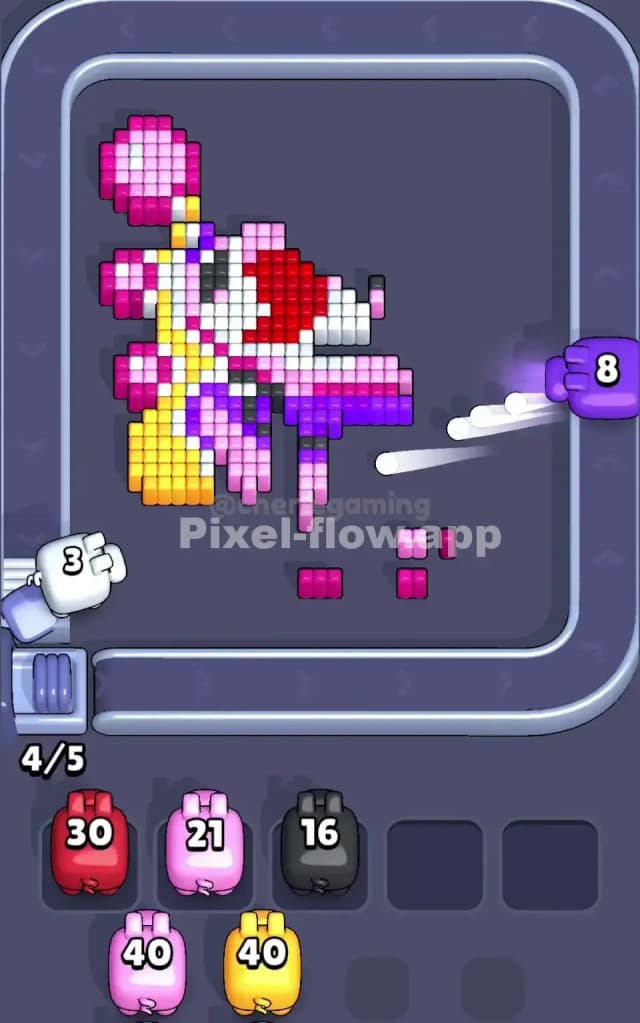
Pixel Flow Level 124 presents you with a vibrant, multi-colored pixel art composition dominated by bright yellows, magentas, purples, whites, and reds. The board is densely packed with overlapping color regions that form a complex character or creature illustration. You'll notice the yellow cubes create a substantial border around much of the playfield, while magenta and purple zones dominate the central areas. There's also a striking red cluster nestled in the upper-middle section that immediately catches your eye. This isn't just visual noise—every color block represents a strategic layer that must be cleared in the right sequence. The white cubes scattered throughout act as connectors and transition zones between major color regions, making them critically important for understanding depth and layering.

Win Condition and Deterministic Puzzle Design

Your goal in Pixel Flow Level 124 is straightforward: clear every single voxel cube from the board. You've got four pigs in the queue, and I can see from the counter that you're starting with 5/5 waiting slots available—meaning you have room to queue up pigs before things get tight. Each pig carries a fixed ammo count (in this case, you're looking at two yellow pigs with 40 ammo each and two pink pigs with 40 ammo each), and every matching cube they destroy costs exactly one ammo. The beauty of Pixel Flow Level 124 is that the puzzle is completely deterministic: the pig order never changes, their ammo never varies, and the board layout is fixed. This means there's always a correct solution waiting for you—you just need to find the sequence that prevents your waiting slots from filling up with stuck pigs.


Why Pixel Flow Level 124 Feels So Tricky

The Yellow and Pink Ammo Bottleneck

Here's what makes Pixel Flow Level 124 so frustrating at first: you've got a massive yellow presence on the board, and your pig queue delivers two yellow shooters back-to-back, each packing 40 ammo. That's 80 yellow cubes to clear, and honestly? It looks like there are plenty of them visible in the border zones and scattered throughout the composition. The real trap is that if you fire your yellows too early, you might clear surface-level yellows without exposing the colors underneath—and then your second yellow pig arrives with nothing to shoot. When that happens, it gets dumped into a waiting slot, still holding ammo it can't spend. The same logic applies to your pink pigs: they're powerful, but if their target zones are locked behind other colors, you're in trouble. You start with five available slots, but fill even three or four with idle pigs, and suddenly you've got nowhere to park new arrivals. That's when Pixel Flow Level 124 transitions from challenging to nearly impossible.

Color Sequencing and Hidden Layer Problems

The magenta and purple zones in the middle of the composition represent some deceptively tricky layering. You can see bright purple cubes clearly, but there's also a deeper purple or darker shade mixed in, which suggests multiple layers. If you blast away surface purples without a strategy, you might expose areas that don't align with your upcoming pigs—leaving you with wasted ammo slots and no way to progress. The white cubes scattered around the board are another subtle trap. They look decorative, but they're often the "glue" holding front layers together. If you target them too early, you collapse entire regions and expose mismatched color clusters underneath. The red cluster in the upper-middle is particularly nerve-wracking because it's so localized and visible. There's no red pig in your queue, so those red cubes must be cleared by one of your other colored pigs. That means they're probably a deeper layer, and exposing them too soon could leave you staring at orphaned reds with no shooter to finish them.

The Personal Friction Point

I'll be honest: my first few attempts at Pixel Flow Level 124 were chaotic. I saw all that yellow and thought, "Let's just clear the borders and see what happens." Spoiler alert: what happened was my second yellow pig got stuck with 30+ ammo left, watching an empty board mockingly. The moment it clicked for me was when I stopped thinking about "clearing colors" and started thinking about "exposing layers in pig order." Once I mapped out which colors were surface-level versus nested underneath, and once I forced myself to plan two or three pig deployments ahead, Pixel Flow Level 124 suddenly made sense. It's not a brutal level—it's a lesson in patience and foresight.


Step-by-Step Strategy to Clear Pixel Flow Level 124

Opening: Safely Exposing the First Layers

Start by firing your first yellow pig, but with a clear purpose: target the yellow cubes that are definitely on the surface and that will expose new colors when removed. In Pixel Flow Level 124, you want to focus on the yellow border zones first, particularly around the edges and corners where yellow dominates without hiding critical colors underneath. Don't go after every yellow you see—be selective. Your goal is to burn maybe 15–20 of your first yellow's 40 ammo, clearing enough surface yellows to expose the magenta, white, and purple layers that live beneath them. Watch as you shoot: each destroyed yellow should reveal at least one new color option. If you're destroying yellows and seeing only more yellows underneath, you're going too deep too fast. Keep at least three waiting slots free after this phase. When your first yellow pig runs out of targets (and it will, because you're being disciplined), let it drop into a waiting slot. Don't worry—you've set yourself up perfectly for the next phase.

Mid-Game: Sequencing Pigs and Exposing Inner Layers

Now your second yellow pig arrives, and this is where Pixel Flow Level 124 demands careful thinking. By now, you've exposed some magenta and white cubes, plus pockets of the red cluster. Your second yellow should target only those newly exposed yellows and the ones that are directly adjacent to non-yellow zones. You're not trying to clear all yellow—you're carving pathways. The key insight is that by removing strategic yellows, you're opening corridors that let your pink pigs reach their targets later. Spend another 20–25 ammo with your second yellow, then let it sit in a waiting slot when it has nothing productive left to shoot.

Once both yellows are parked, your first pink pig enters the field. Here's where Pixel Flow Level 124 gets interesting: the pink cubes you can now see are probably a mix of surface-level and nested pinks. You want to prioritize the pinks that are surrounding or adjacent to whites, purples, and especially reds. Every pink you remove should open up new sight lines for your second pink pig. Spend about 25–30 of your 40 pink ammo in this phase, focusing on high-impact removals that expose magenta or deeper layers. Save your remaining ammo for the end-game push.

Your second pink pig is critical for Pixel Flow Level 124's victory condition. When it arrives, the board should be significantly more open. You'll have cleared yellow borders, some surface magentas, and maybe exposed the red cluster fully. Your second pink should finish off remaining pinks, clean up any residual surface colors, and leave the board in a state where only a few scattered cubes remain—ideally in tight clusters you can verify against your remaining ammo count.

End-Game: The Final Push and Buffer Management

By the time your pigs are running on fumes, Pixel Flow Level 124 should show a mostly empty board with maybe 10–20 cubes remaining, all of them in easy-to-target clusters. This is your moment of truth. If you've executed the mid-game correctly, you'll have at least 10–15 ammo spread across your parked pigs, and those last few cubes will fall perfectly. Count carefully: if you see 12 red cubes remaining and you have exactly 12 remaining ammo across both pink pigs, you're golden. Fire them methodically, watching each cluster disappear.

The absolute key to avoiding a last-second jam in Pixel Flow Level 124 is ensuring no pig ends up holding ammo when the board is visually cleared. If you miscounted and you've got one pig in a waiting slot with 5 ammo and only 3 cubes visible, you've failed. So before you commit to those final shots, pause and count. Verify that your remaining ammo equals your remaining cubes plus whatever ammo you're comfortable parking in waiting slots (ideally zero). If the numbers don't match, you've made an error earlier, and you might need to restart and adjust your mid-game pig sequencing.


The Logic Behind This Pixel Flow Level 124 Plan

Exploiting Determinism and Slot Management

The genius of this strategy for Pixel Flow Level 124 is that it treats the puzzle as a resource-allocation problem, not a reflex game. Your pigs arrive in a fixed order with fixed ammo—that's your constraint. Your five waiting slots are your resource pool—that's your buffer. By deliberately parking pigs early and controlling the pace, you're ensuring that no pig arrives to find a completely full waiting queue with nothing to shoot. You're also giving yourself time to see what layers are actually underneath, so you can adjust your next pig's targeting accordingly. This isn't about speed; it's about clarity and sequence.

The secondary logic is layer exposure: every color in Pixel Flow Level 124 exists in a 3D stack, and your job is to reveal them in an order that matches your pig queue. By removing strategic surface cubes with your early pigs, you're not just clearing colors—you're unlocking the next layer for your subsequent pigs. It's like peeling an onion, except the onion shoots back if you peel it wrong.

Staying Calm and Counting Ahead

The most practical advantage of this Pixel Flow Level 124 strategy is psychological. When you stop reacting and start planning, you escape the panic loop. Instead of firing a pig as soon as it arrives and watching horror unfold, you take five seconds to count: "I see 28 yellows on the board right now. My first yellow has 40 ammo. I'll shoot 20, then wait and reassess." That discipline prevents the accidental over-commit that leads to stuck pigs. Watching the queue is equally critical—you always know which pig is next, so you can position your current pig's fire to maximize options for the incoming one. And ammo counting? It's not tedious; it's your early-warning system. If you're halfway through Pixel Flow Level 124 with two pigs parked and you've only cleared 60% of the board, you know something went wrong, and you can course-correct before you hit an unrecoverable state. Stay calm, count cubes, plan two pigs ahead, and Pixel Flow Level 124 transforms from a wall into a satisfying logic puzzle.