Pixel Flow Level 137 Solution | Pixel Flow 137 Walkthrough
How to beat Pixel Flow Level 137: Video solution & walkthrough. The fastest way to pass Pixel Flow 137.
Is this the wrong level layout?🤔
Pixel Flow randomizes levels for different players. Don't worry, just upload a screenshot of your board, and our AI will find the correct video instantly.
Pixel Flow Level 137 Overview
The Starting Board and Visual Puzzle
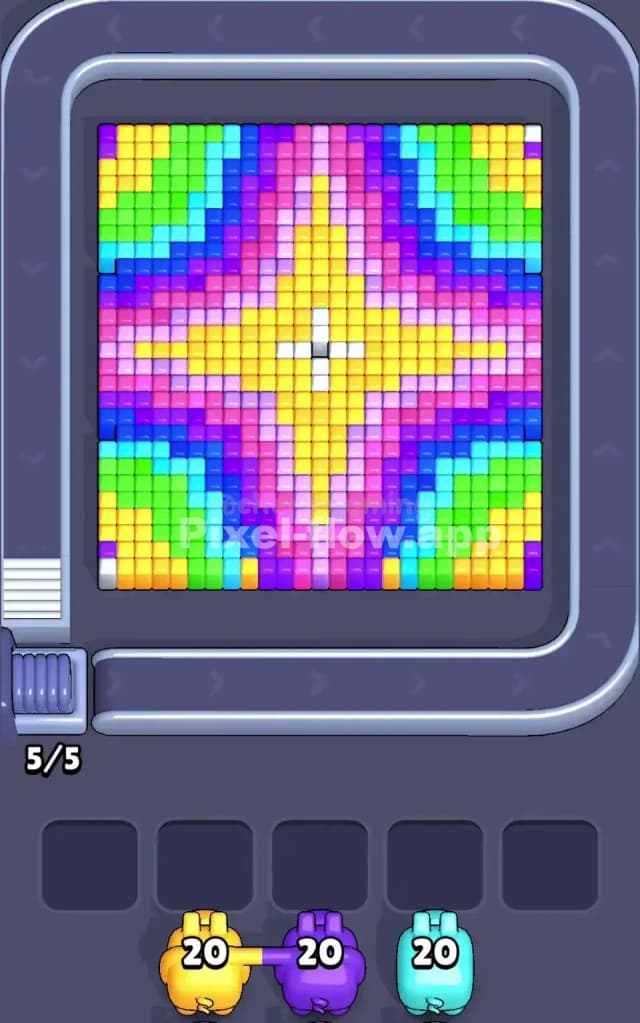
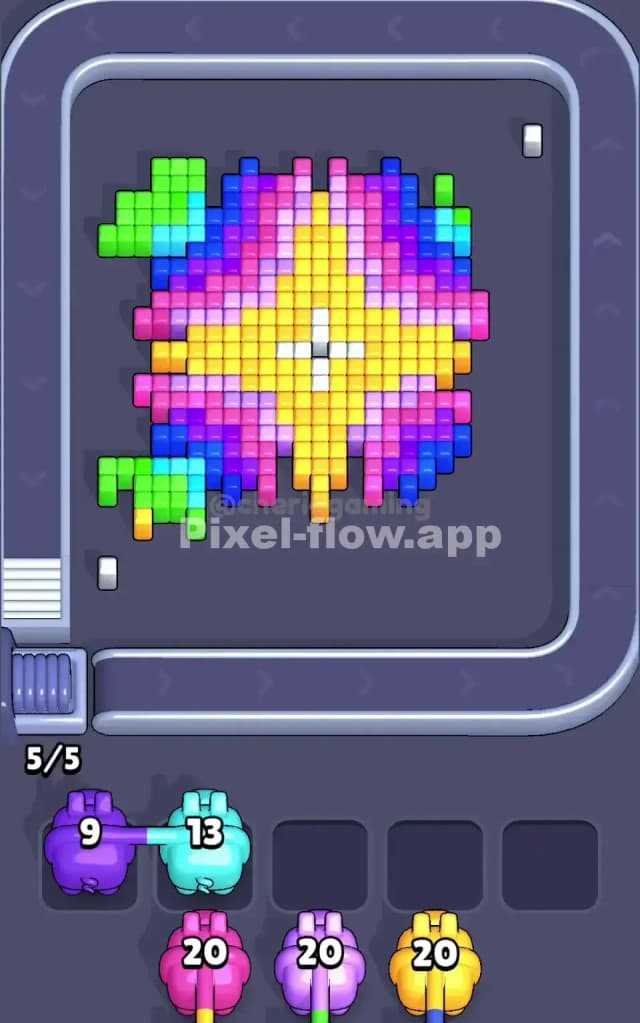
Pixel Flow Level 137 presents a stunning symmetric pixel art design dominated by a vibrant cross or plus-sign pattern in the center, made up of bright yellow and light pink cubes that immediately catch your eye. The outer regions layer in purple, magenta, cyan, green, and blue tones in a carefully balanced arrangement, creating what feels like a mandala or abstract butterfly when you step back and look at the whole picture. You'll notice the board is packed almost completely full—there's very little breathing room, which means the puzzle demands precision and strategic planning rather than improvised moves.
Understanding the Win Condition
Your objective in Pixel Flow Level 137 is straightforward: clear every single voxel cube on the board by launching color-matched pigs from the conveyor belt. You're looking at a fully deterministic puzzle, meaning the order and ammo counts of your pigs never change—they're fixed from the start. The three visible pigs at the bottom of Pixel Flow Level 137 are an orange pig with 20 ammo, a purple pig with 20 ammo, and a cyan pig with 20 ammo, and they'll arrive in that exact sequence every time you play. Your job is to land each shot perfectly so that no pig ends up stranded in the waiting slots without valid targets.
Why Pixel Flow Level 137 Feels So Tricky
The Dominant Yellow-Pink Bottleneck
The biggest threat to clearing Pixel Flow Level 137 lies in that massive yellow and light pink central cross. These two colors make up a huge visual and spatial footprint, and here's the problem: you don't have dedicated yellow and light pink pigs visible in your starting queue. That means the colors you can shoot—orange, purple, and cyan—need to carefully dismantle the outer layers so that yellow and pink cubes eventually become accessible to future pigs rolling down the conveyor belt. If you rush in without exposing the right colors first, you'll burn through your 20 ammo on colors that don't actually clear critical blocks, and those waiting slots will fill up with frustrated pigs that have nowhere productive to aim.
Hidden Color Pockets and Awkward Placement
Pixel Flow Level 137 hides some genuinely tricky color patches that aren't immediately obvious at first glance. The blue regions, for instance, are scattered across both the upper and lower halves of the board in ways that feel disconnected—you might shoot your first blue pig and suddenly realize there's still a stubborn cluster of blue cubes hiding behind what you thought was a fully cleared zone. Similarly, the cyan blocks are distributed in a way that tempts you to overcommit ammo early, leaving you short-handed later when a strategic cyan pig could have solved a jam. These subtle spatial traps are what transform Pixel Flow Level 137 from merely hard into genuinely frustrating.
When the Level Clicks
I'll be honest: my first four attempts at Pixel Flow Level 137 felt like chaos. I'd shoot the orange pig, watch it carve out some space, feel confident, and then the purple pig would arrive to find absolutely no valid targets because I'd cleared the wrong purple cubes in the wrong order. It was only when I stopped and mapped out the entire color structure—literally counting how many of each color I could see and estimating which pig should target which zone—that Pixel Flow Level 137 transformed from a frustrating mess into a solvable logic puzzle. The "aha moment" came when I realized that the outer rings needed to be stripped away methodically, and that sometimes parking a pig with 5 ammo remaining was actually the right call, not a failure.
Step-by-Step Strategy to Clear Pixel Flow Level 137
Opening: Establish Control and Preserve Buffer Space
Start Pixel Flow Level 137 by sending your orange pig straight for the orange cubes on the perimeter—there's no debate here. You'll find orange blocks scattered along the bottom edges and corners, and clearing them immediately does two critical things: it gives you a first win (psychologically important), and it opens up some of the interior architecture without risking a jam. Your goal is to spend roughly 12–14 of your orange pig's 20 ammo on pure orange targets, then let it drop into one of the waiting slots with 6–8 ammo remaining. Don't overthink it; orange is abundant enough that you can't really go wrong.
After the orange pig settles, your purple pig arrives. Now things get interesting in Pixel Flow Level 137. You need to scan the board for purple cubes that are blocking other colors from being reached. Notice that purple forms some of the interior rings and corners—if you clear purple strategically here, you'll expose pathways for cyan and future pigs. Spend about 14–15 ammo on purple targets that open up the board, and plan to have your purple pig drop into a second waiting slot with roughly 5–6 ammo left in the tank. This is crucial: you want to keep slots 3, 4, and 5 empty heading into the mid-game.
Mid-Game: Layer Stripping and Ammo Precision
Once your orange and purple pigs are parked, the cyan pig rolls out onto the conveyor belt. Cyan in Pixel Flow Level 137 is your workhorse for mid-game disruption because it's scattered enough that you'll have multiple valid targets in almost every situation. Here's where you need to start counting: identify roughly 18–20 visible cyan cubes and plan to spend 18–20 of your cyan pig's ammo on them. The beauty of cyan is that it often appears in structural positions—clear cyan strategically and you'll expose the yellow and pink zones that your future pigs (still in the queue, but coming) will absolutely need.
As your cyan pig finishes, look at what's been exposed. Are there now gaps in the outer layers? Can you see deeper colors starting to peek through? Pixel Flow Level 137 rewards this kind of observation because it tells you whether you're on pace or falling behind. If you still see 5+ waiting slots empty and the board is visibly thinning, you're in good shape. If all 5 slots are full and you're staring at a tightly packed board, you may have made a critical error—but don't panic; most players recover by being more selective with the pigs that follow.
End-Game: Finish Strong Without Jamming
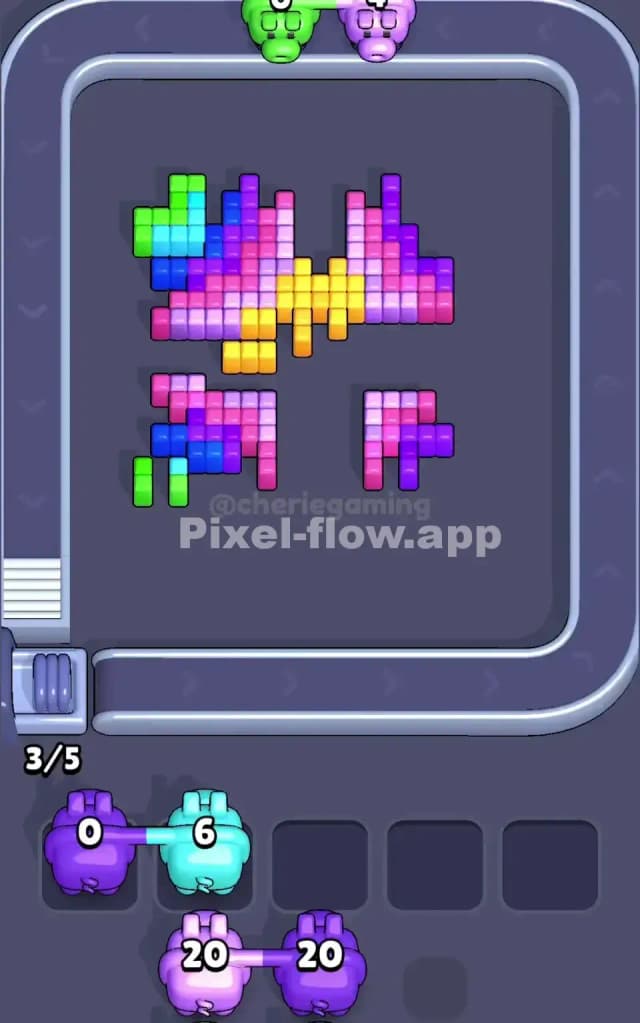
The final pigs in the Pixel Flow Level 137 queue (and remember, only three are visible initially, but more arrive as you clear) should arrive to a partially exposed board where yellow, pink, blue, and any remaining secondary colors are visible and targetable. Here's your end-game mantra: count remaining ammo against remaining cubes of that color. If a pig has 15 ammo and you count only 12 visible cubes of its color, park it immediately in a waiting slot rather than forcing random shots. Those 3 extra ammo points will come back to haunt you if a future pig has no valid targets.
The very last cubes of Pixel Flow Level 137 are usually a mixed bag of whatever colors managed to hide in the deepest layers. You'll want to sequence your final pigs so that your most flexible color (usually cyan, due to its scattered distribution) goes last. This gives you a safety net if other pigs couldn't quite finish their colors cleanly. Empty your waiting slots by calling in reserves strategically, and watch the board collapse into a satisfying clear.
The Logic Behind This Pixel Flow Level 137 Plan
Why Order Matters More Than Luck
Pixel Flow Level 137 isn't a random puzzle—it's a constraint satisfaction problem dressed up as a pixel art game. Every pig has a fixed ammo count, and every cube needs to be destroyed by a matching color. The only variable you control is when you fire each pig. By sending orange first, you're not guessing; you're systematically removing the easiest layer so that purple and cyan can access harder-to-reach blocks. This deterministic structure means that a perfect run of Pixel Flow Level 137 is absolutely achievable once you understand the color distribution.
Patience, Buffer Management, and Two-Pig Lookahead
The single biggest mistake players make in Pixel Flow Level 137 is filling all five waiting slots too quickly. Each empty slot is a safety valve; if you can see two pigs ahead in the queue and you know they're coming, you have flexibility. But if all slots are full and a pig with no valid targets arrives, you lose immediately. That's why the strategy emphasizes parking half-spent pigs deliberately—it's not waste, it's insurance. Stay calm, count ammo like you're budgeting your paycheck, and look at the next two pigs in the queue before committing your current pig's shots. Pixel Flow Level 137 rewards slow, methodical play far more than it rewards aggressive blasting.