
Pixel Flow Level 139 Solution | Pixel Flow 139 Walkthrough
How to beat Pixel Flow Level 139: Video solution & walkthrough. The fastest way to pass Pixel Flow 139.
Is this the wrong level layout?🤔
Pixel Flow randomizes levels for different players. Don't worry, just upload a screenshot of your board, and our AI will find the correct video instantly.


Pixel Flow Level 139 Walkthrough
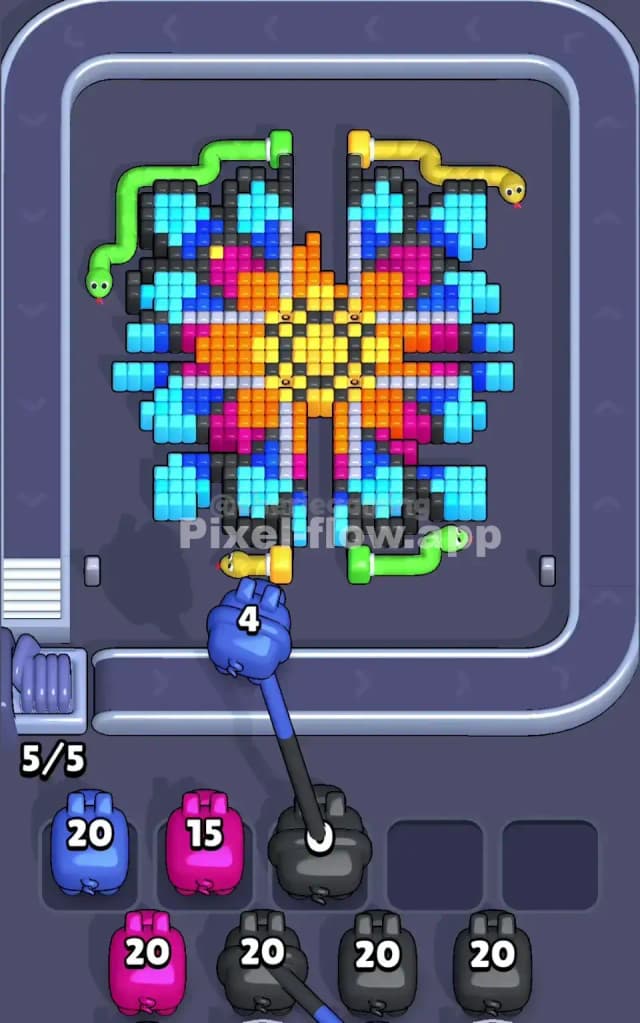
This level features a complex, multi-layered "Neon Mandala" or flower pattern, heavily guarded by two distinct pipe structures on the perimeter. The core logic here is "outside-in" destruction, but with a twist: physical barriers prevent your pigs from accessing the sides of the artwork. You must dismantle these barriers before you can effectively peel the layers of the flower. Because the color layering is deep (Black > Cyan > Magenta > Orange > Yellow), and the outer pipes block clear shots, this is a very hard level. One mistake with slot management early on will leave you deadlocked.
Pixel Flow Level 139 Overview
Think of the artwork in Pixel Flow Level 139 as a stained-glass flower protected by two snakes. The flower itself glows with radial symmetry. The outermost tips are bright Cyan, bordered by thick Black voxels. Moving inward, the colors shift to Magenta, then Orange, and finally a burning Yellow core.
However, the most critical visual elements are the "snakes" wrapping around the flower. A Green Pipe hugs the entire left and bottom edge of the design. A Yellow Pipe hugs the right and top edge. These pipes are not just decoration; they are physical shields.
The asymmetry here lies in your attack angles. The conveyor belt runs around the whole board, but as long as those pipes exist, any pig riding the left or bottom rail cannot shoot the flower—they will only hit the Green Pipe. Similarly, pigs on the right or top are blocked by the Yellow Pipe. Until those pipes are gone, your pigs are effectively blind on 50% of the track.
Step by step solution walkthrough for Pixel Flow Level 139
First Color Zone to Erase in Pixel Flow Level 139
Your absolute priority must be the Green Pipe and the Black Borders.
Looking at your starting queue, you have a Black pig, a Cyan pig, and a Green pig. This order is a trap.
- The Black Pig: Use this immediately. It will travel the belt and shave off the exposed black blocks at the very top and bottom of the flower (the only spots not fully blocked by pipes). This exposes the cyan tips.
- The Cyan Pig: This one is risky. If you deploy it now, it might snipe a few cyan blocks at the top/bottom, but it will largely be useless on the sides because of the pipes. If it drops into a slot, that’s fine.
- The Green Pig: This is your key to the level. You must deploy the Green pig as soon as it appears. It will target the long Green Pipe wrapping the left and bottom.
Why this matters: Until the Green Pipe is destroyed, no other color can hit the left or bottom side of the mandala. The pipe acts as a wall. By clearing it early, you open up two entire sides of the board for your Black and Cyan pigs to do their work. If you let the Green pig sit in a slot while you try to force other colors, you will run out of space.
How to pass Pixel Flow Level 139 without power ups or boosters
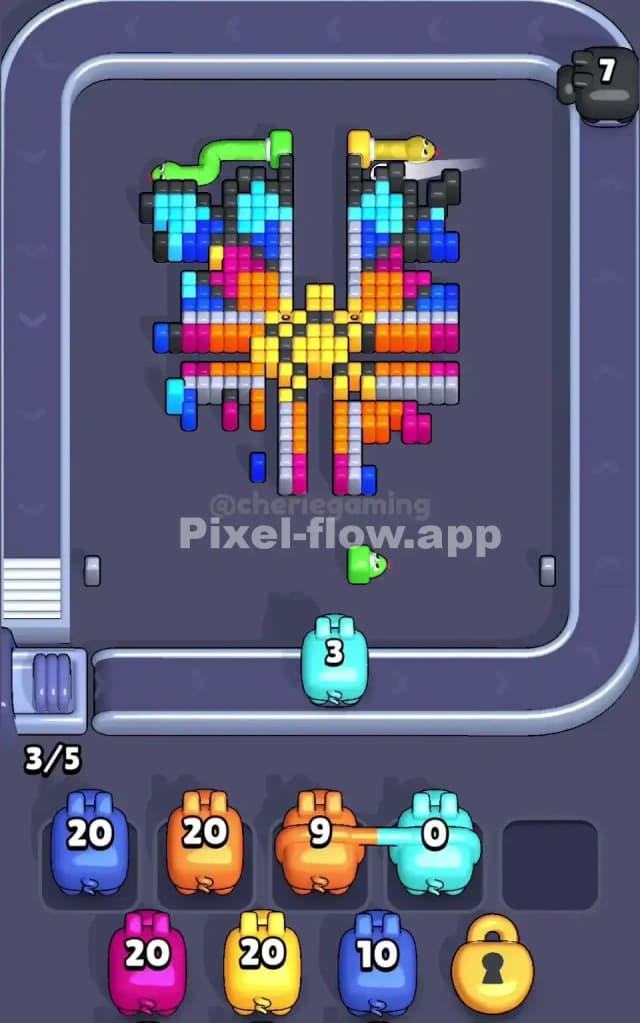
The mid-game of Pixel Flow Level 139 is where most players lose. Once the outer pipes (Green and Yellow) and the black borders are gone, the flower looks ragged. You will see a vertical "spine" of blocks remaining while the sides get eaten away.
At this stage, the picture is usually a mix of Magenta and Orange, with the Yellow core just starting to peek through. The danger here is the hidden Blue blocks. Deep inside the structure, mixed in with the structural columns, are dark Blue voxels.
Your strategy for a no-booster run relies on strict slot discipline:
- Ignore the Core Colors: You will likely receive Orange and Yellow pigs before the outer Magenta layer is fully gone. Do not panic and fill your board with them. Let them sit in the waiting slots, but only if you have 2 or fewer slots filled.
- Flush the Magenta: You must aggressively clear the Magenta ring. This is the "middle" layer. If you have a Magenta pig, play it immediately. Every Magenta block destroyed exposes the Orange layer underneath.
- The Blue/Silver Trap: Often, a few Grey or Dark Blue blocks act as structural supports near the center. If you see a Blue pig in your queue but no blue blocks are visible, check the very center vertical line. If you can't see the target, keep that pig in the queue. Spawning it will just clog a slot.
You win this phase by refusing to deploy inner-color pigs (Yellow/Orange) until the outer-color pigs (Cyan/Magenta) have completely finished their jobs. If you have a Cyan pig with 5 ammo left and no targets, and 4 slots full, you are in trouble. Ideally, you want your pigs to die (reach 0 ammo) on the board, not fall into the slots.
Last Details You Clean Up in Pixel Flow Level 139
The end of Pixel Flow Level 139 is a vertical showdown. The side petals will be gone, leaving a tall, thin tower of Orange and Yellow blocks in the center of the screen, likely flanked by those stubborn Dark Blue structural pillars mentioned earlier.
The Yellow core is the final boss. It is buried deepest. You will need your Yellow pigs to be fresh. If you wasted Yellow ammo earlier hitting the Yellow Pipe (the snake on the right), you might be short. Hopefully, you used specific Yellow pigs for the pipe and saved a fresh one for the core.
Watch the corners of the central tower. Sometimes a single Orange pixel hides behind a Yellow one, preventing you from clearing the layer. Ensure your Orange pigs do a full loop to catch these stragglers before you unleash the final Yellow barrage to clear the heart of the flower.