
Pixel Flow Level 14 Solution | Pixel Flow 14 Walkthrough
How to beat Pixel Flow Level 14: Video solution & walkthrough. The fastest way to pass Pixel Flow 14.
Is this the wrong level layout?🤔
Pixel Flow randomizes levels for different players. Don't worry, just upload a screenshot of your board, and our AI will find the correct video instantly.


Pixel Flow Level 14 Walkthrough
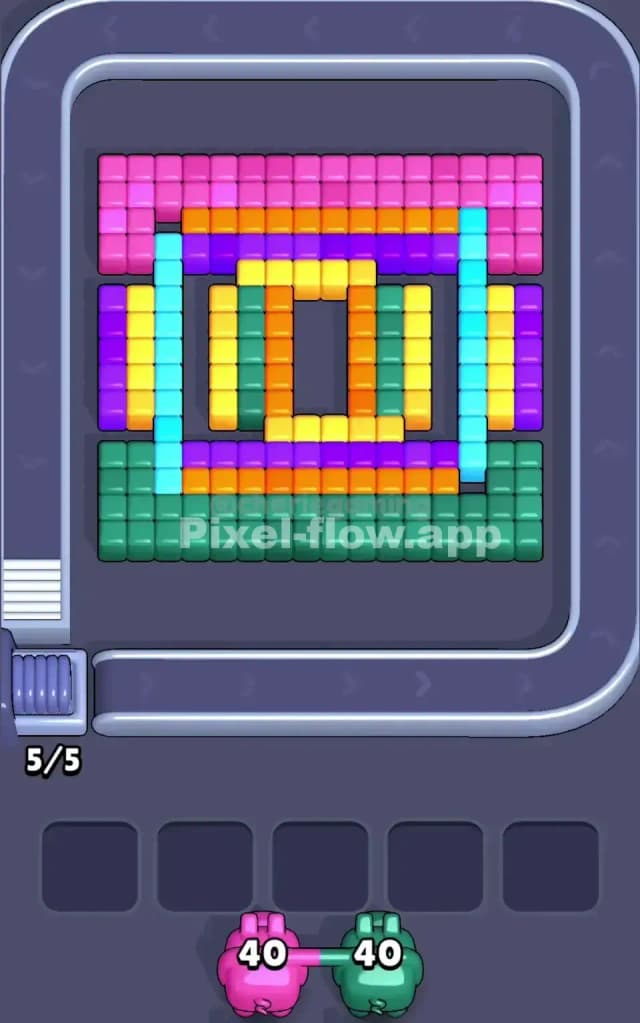
This level is a dense, geometric fortress. You are looking at a layered rectangle that resembles a neon industrial gate or a retro cassette tape. The structure is built with a massive Pink Arch on top and a solid Dark Green Foundation on the bottom. These two huge chunks sandwich a complex inner mechanism. Two tall Cyan Pillars stand vertically on the left and right, acting as gatekeepers.
The rule here is layer discipline. You cannot simply shoot at the middle. The Cyan Pillars and the top/bottom blocks physically shield the inner colors (Purple, Yellow, Orange). You must strip the outer armor first. Because the waiting slots fill up incredibly fast with useless inner colors, I judge this to be a very hard level. One mistake in prioritizing the outer shell will clog your slots and end the run.
Pixel Flow Level 14 Overview
Imagine a heavily armored door. The Pink blocks at the top form the lintel, and the Dark Green blocks at the bottom form the doorstep. These are the "heavy" layers—they contain the most cubes and require the most ammo to remove.
However, the real structural nuisance is the pair of Cyan Pillars. These light blue vertical bars run almost the full height of the image. They sit on top of the inner Purple frame. Until you break these pillars, your pigs cannot access the sides of the picture.
Inside this shell sits a Purple Rectangle frame. Inside that is the core: a mix of vertical Yellow stripes and a central Orange loop. The level is perfectly symmetrical, but that doesn’t make it easy. The danger comes from the density; there are no gaps. Every shot hits something, but if you hit the wrong layer (like chipping at the Yellow core while the Cyan bars are still up), you waste ammo on hard-to-reach pixels while your waiting slots overflow with pigs you can't use yet.
Step by step solution walkthrough for Pixel Flow Level 14
First Color Zone to Erase in Pixel Flow Level 14
I start by attacking the Pink Arch at the very top. There is a specific logic to this. The Pink area is wide, uninterrupted, and sits on the outermost layer. It is the easiest target to hit without accidentally striking a color you aren't ready for.
Grab any Pink pigs immediately. Do not put them in the waiting slots; keep them on the belt if possible until they line up with the top rows. Clearing the Pink top does two things:
- It removes a massive amount of "health" from the board, freeing up visual space.
- It exposes the top edge of the Purple Frame and the top of the Cyan Pillars.
If Pink pigs aren't available, go for the Dark Green Foundation at the bottom. It serves the same purpose. You need to remove the "bun" of this sandwich before you deal with the "meat."
How to pass Pixel Flow Level 14 without power ups or boosters
Once the top Pink and bottom Green are roughly 50% gone, the game tries to trap you. You will start seeing Purple and Yellow pigs. This is the danger zone.
You must prioritize the Cyan Pillars (light blue vertical bars) now. Even if you have a clear shot at the inner Yellow core, ignore it. If you leave the Cyan bars standing, they block the Purple pigs from hitting the sides of the frame. You will end up with a slot full of Purple pigs that have no valid targets because a thin strip of Cyan is blocking them.
When a Cyan pig appears, use it immediately to slice down those vertical side bars. Once the Cyan is gone, the "side doors" open. Now your Purple pigs can clean up the rectangular frame.
If you are forced to slot a pig, prioritize slotting the Orange or Yellow ones. Keep your active belt clear for Cyan and Purple. You need the outer guards dead before you worry about the center.
Last Details You Clean Up in Pixel Flow Level 14
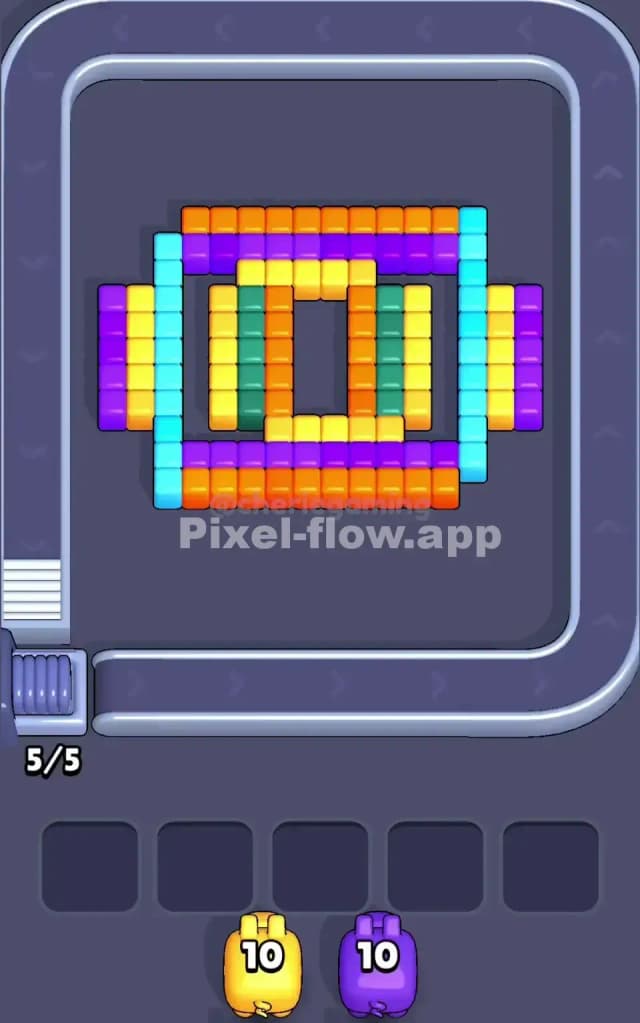
After the Pink roof, Green floor, Cyan pillars, and Purple frame are smashed, you are left with the Core.
This is usually a mix of Yellow vertical lines and an Orange ring. At this stage, the board looks messy. The symmetry is gone.
- Watch out for the Central Columns. The Yellow blocks here often hide a single Orange block behind them.
- Your pigs will shoot automatically, but be careful with Orange pigs. They often run out of ammo exactly one cube short of finishing the loop.
- If you have a choice between a Yellow pig and an Orange pig in your final two slots, play the one that targets the widest remaining cluster. Don't snipe single pixels yet; clear the bulk to ensure you don't get stuck with a full tray and 5 HP left on the board.