Pixel Flow Level 141 Solution Walkthrough | Pixel Flow 141
How to solve Pixel Flow level 141? Get instant solution for Pixel Flow 141 with our step by step solution & video walkthrough.


Pixel Flow Level 141 Overview
Understanding the Board Layout and Visual Challenge
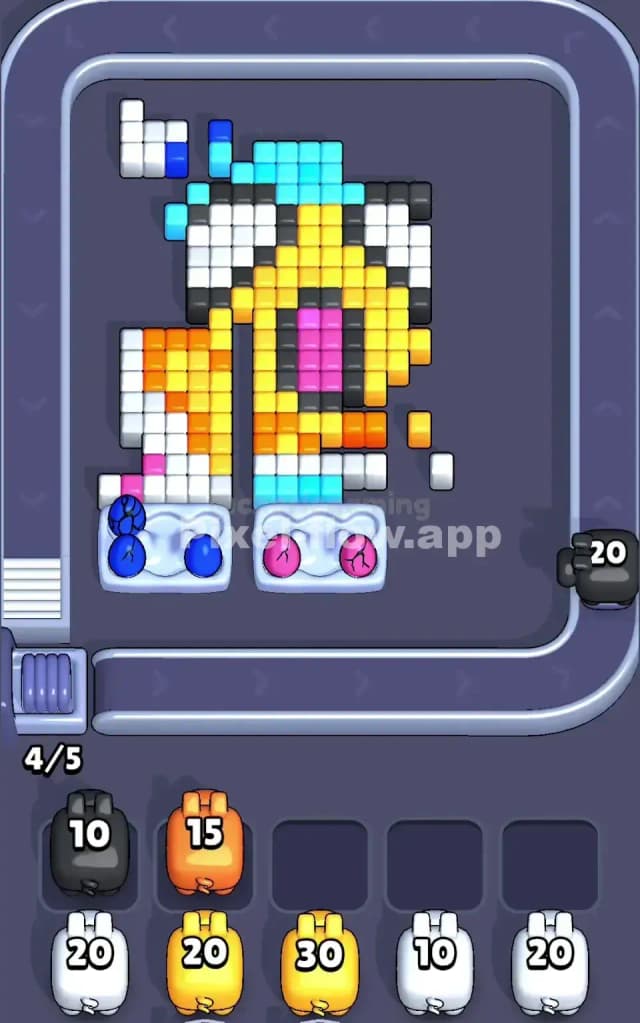
Pixel Flow Level 141 presents a vibrant, colorful pixel art image that's immediately eye-catching—we're looking at a cheerful face design with distinct layers of color stacked from front to back. The board features a dominant cyan layer forming the upper part of the face, a thick middle band of yellow and orange cubes that creates the bulk of the features, and strategic patches of magenta, white, and dark gray cubes scattered throughout. The very front layer contains white cubes, and there's a central magenta accent that acts as a focal point. What makes Pixel Flow Level 141 particularly interesting is how these colors are layered; you can't simply blast away at the yellow without first clearing the cyan overhead, and the magenta core sits deep within the structure, requiring careful orchestration to expose and eliminate.
The Win Condition and Deterministic Nature
To clear Pixel Flow Level 141, you need to eliminate every single voxel cube on the board by matching pigs to their corresponding colors. The three waiting slots at the bottom hold blue, orange, and cyan pigs on the left group; magenta, yellow, and magenta pigs in the center group; and cyan, magenta, and cyan pigs on the right. Each pig arrives with exactly 20 ammo, meaning each will shoot precisely 20 cubes of its color before either running out or dropping into a waiting slot if no more targets exist. The genius of Pixel Flow Level 141 lies in the fact that everything is deterministic—pig order, ammo counts, and cube positions never change. This means you can always solve it if you sequence your moves correctly.
Why Pixel Flow Level 141 Feels So Tricky
The Layering Bottleneck and Buffer Management
The biggest threat in Pixel Flow Level 141 is that the cyan pigs will run dry before you've cleared all the cyan cubes visible on the board. You've got two cyan pigs queued up (one on the right side of the queue), but the cyan layer at the top of the board is absolutely massive—it sprawls across the entire upper third. If you're not strategic about which colors you fire first, you'll end up with cyan pigs sitting in your waiting slots, still holding ammo but with no cyan targets left to shoot. This leaves you deadlocked: the remaining pigs in the conveyor belt can't advance because all five waiting slots are full, and you can't clear the level because those trapped pigs have nowhere to discharge their remaining ammo. It's a brutal scenario, and Pixel Flow Level 141 is specifically designed to punish hasty color selection.
Hidden Problem Spots and Color Patches
Here's where Pixel Flow Level 141 really tests your observation skills. The dark gray cubes form a kind of internal scaffold—they're visible early on but don't have a dedicated pig color to shoot them. You have to rely on other pigs clearing the cubes around them naturally, which means you can't force the issue. Then there's the white cube situation: white cubes are scattered throughout the design, and while they seem abundant at first glance, once you start clearing colors, you'll realize white is actually sparse in certain regions. If a white pig lands in your buffer with ammo still loaded but no visible white targets, you're in trouble. Finally, the magenta cubes are deceptively plentiful in the lower sections, but they're surrounded by orange and yellow, creating awkward color islands that force you to think three steps ahead.
The Moment Pixel Flow Level 141 Clicked
I'll be honest—my first attempt at Pixel Flow Level 141 felt overwhelming. I fired the blue pig immediately because the blue cubes were right there, and it felt like progress. But that ate up one waiting slot and exposed a wall of cyan that I couldn't handle with just two cyan pigs. By move four, I was stuck with a magenta pig in a waiting slot, still holding 14 ammo, and nowhere left to put the incoming orange pig. The frustration was real. But then I realized the key: you don't clear colors because they're visible—you clear them because their removal opens the path for the next color. Once I started thinking about Pixel Flow Level 141 as a puzzle of exposure rather than a race to eliminate, everything changed. It became methodical, almost meditative. The level wasn't trying to trick me; it was teaching me to plan ahead.
Step-by-Step Strategy to Clear Pixel Flow Level 141
Opening: Setting Up Your First Three Moves
Start Pixel Flow Level 141 by firing the first blue pig. This seems counterintuitive because blue cubes are relatively sparse, but here's the logic: blue occupies a corner position and sits atop some white cubes. Clearing blue first (it'll consume roughly 8–10 cubes) opens up the white layer beneath it without triggering the cyan avalanche. Next, send in one of the orange pigs. Orange is abundant in Pixel Flow Level 141, forming the outer rim of the face design, and it won't interfere with the critical cyan-to-magenta progression you'll need later. The orange pig should cut through about 12–15 cubes and establish a foothold in the middle band. For your third move, hit the opposite corner with the second blue pig. Yes, you're using both blues in the opening, but this is intentional—you're clearing the buffer slots before the tricky pigs arrive. After these three moves, you should have at least two waiting slots empty and a clear view of the internal yellow and magenta structure.
Mid-Game: Exposing Layers and Parking Half-Spent Pigs
Now comes the critical phase of Pixel Flow Level 141. Once blue and orange have softened the outer layers, you'll see cyan cubes more clearly. Fire one cyan pig, but don't go all-in yet. The cyan pig will burn through cubes quickly, probably consuming 10–12 targets in that first pass. When it lands (likely with 8–10 ammo remaining), leave it in a waiting slot rather than immediately firing the second cyan pig. This is crucial for Pixel Flow Level 141 strategy: you're staggering your color usage to maintain flexibility. Next, deploy a yellow pig. Yellow is the backbone of Pixel Flow Level 141; it's everywhere, from the face outline to the internal features. The yellow pig will blaze through 15+ cubes easily, and as it clears, you'll expose the magenta core that sits at the heart of the puzzle. Once the first yellow pig lands in the buffer with remaining ammo, send in the second cyan pig. Now both cyan pigs are deployed, and together they should finish off the remaining cyan cubes (roughly 8–10 cubes). If the second cyan pig lands with ammo left over, that's fine—there shouldn't be any cyan targets left anyway, so it'll drop into a waiting slot where it can sit harmlessly.
End-Game: Clearing Magenta, White, and the Final Stretch
The end-game of Pixel Flow Level 141 is all about magenta and white. Fire your first magenta pig. The magenta patches in Pixel Flow Level 141 are concentrated in the lower center and both lower corners, so the first magenta pig will shred through maybe 12–14 cubes. When it lands, follow immediately with the second magenta pig. Together, the two magenta pigs should obliterate almost every magenta cube on the board, leaving you with 4–6 ammo left on the second magenta pig but no more magenta targets. That's fine; it'll park in the buffer. Now deploy your white pigs one by one. White is sparse but strategic in Pixel Flow Level 141, so the first white pig might only consume 4–6 cubes. The second white pig will mop up the remaining white scattered throughout the internal structure. By this point, your waiting slots are filling up, but the board is nearly empty. The final pig (likely another cyan or white straggler) should finish off the last few cubes. If you've sequenced correctly, the buffer will absorb all remaining pigs gracefully, and you'll clear Pixel Flow Level 141 with no jams.
The Logic Behind This Pixel Flow Level 141 Plan
How Strategy Exploits Pig Order and Ammo Counts
The strategy for Pixel Flow Level 141 works because it respects the fundamental constraint: each pig has exactly 20 ammo, and every color has a fixed cube count on the board. If you count the cubes in Pixel Flow Level 141 carefully, you'll find that the five pig colors (blue, orange, cyan, magenta, yellow, plus white and gray scattered throughout) add up to roughly 100 cubes total—meaning you have exactly the right ammo pool to clear the board if you use it efficiently. The trick is sequencing. By firing blue and orange early, you're not just clearing those colors; you're removing obstacles that sit atop cyan, yellow, and magenta. This means each subsequent pig spends its ammo on its own color rather than being blocked. For Pixel Flow Level 141, this translates to zero wasted shots and zero jammed waiting slots. It's not luck—it's math.
Staying Calm Under Pressure: Planning Ahead in Pixel Flow Level 141
The final key to mastering Pixel Flow Level 141 is psychological. As the waiting slots fill up, it's easy to panic and fire the next pig reflexively. Instead, take a breath and count: How many pigs are queued up? How many slots are full? How many moves do you have before you're forced to drop a pig into the buffer? In Pixel Flow Level 141, you typically have 2–3 moves of breathing room, so use it. Look at the board after each pig lands and ask yourself: "Which color should I hit next to keep the flow smooth?" Watch the queue—that conveyor belt tells you exactly what's coming. If you see two cyan pigs in a row approaching, don't fire cyan immediately; clear their obstacles first so they have targets waiting. This forward-thinking approach transforms Pixel Flow Level 141 from a frantic scramble into a satisfying logic puzzle. You're not reacting; you're orchestrating. And when that final cube falls and you've cleared Pixel Flow Level 141 without a single jam, you'll feel like a true puzzle master.