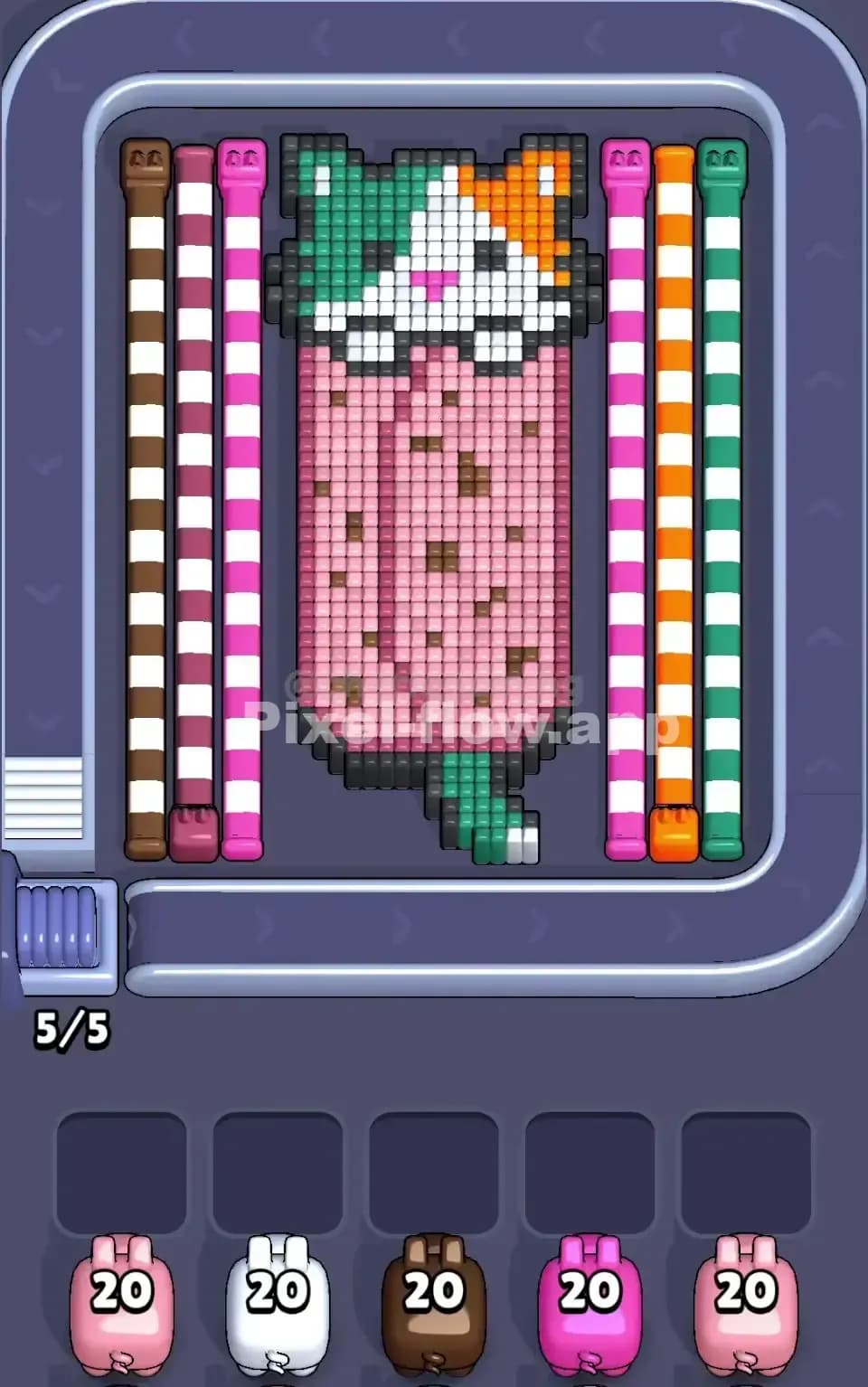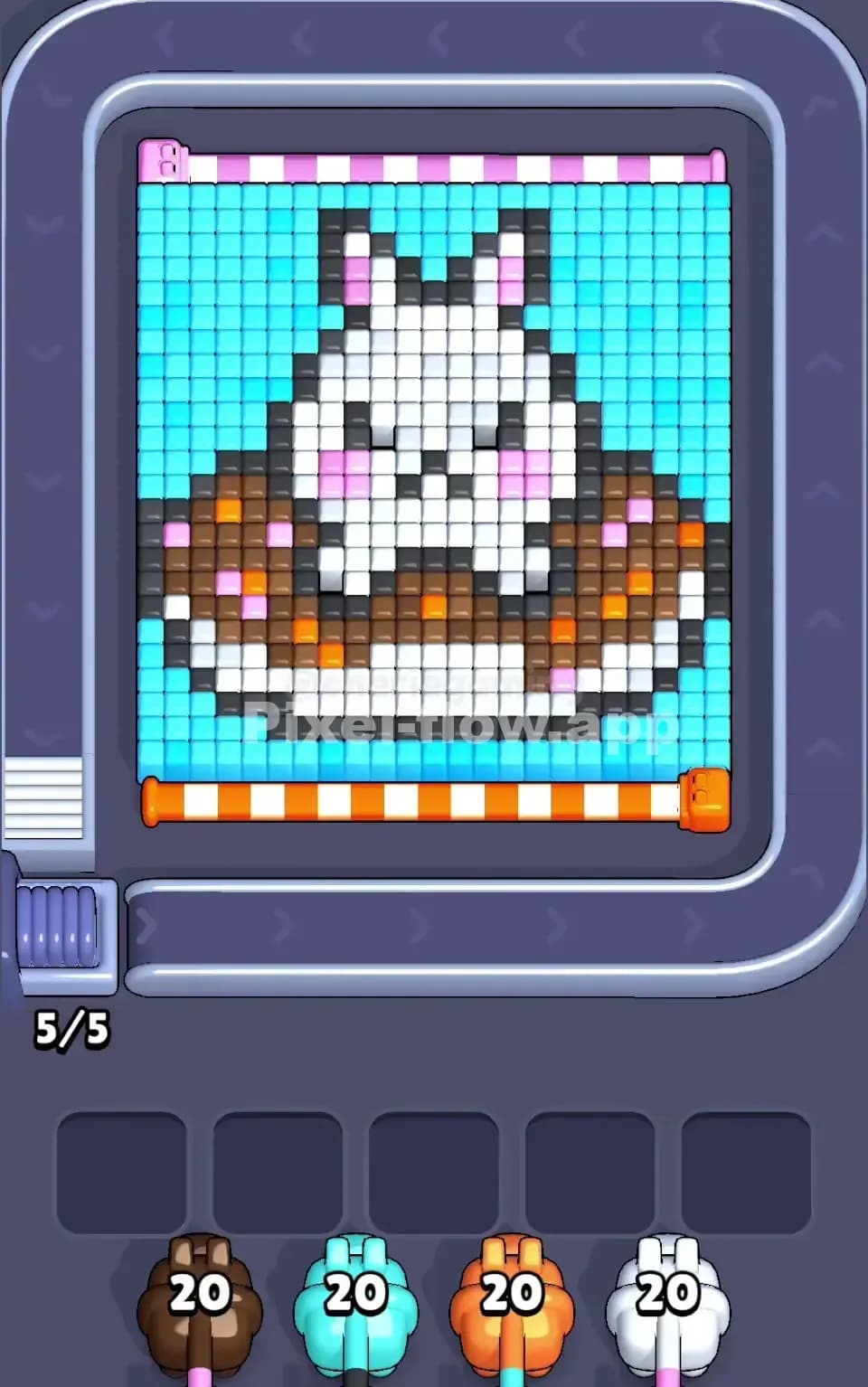
Pixel Flow Level 145 Solution | Pixel Flow 145 Walkthrough
How to beat Pixel Flow Level 145: Video solution & walkthrough. The fastest way to pass Pixel Flow 145.
Is this the wrong level layout?🤔
Pixel Flow randomizes levels for different players. Don't worry, just upload a screenshot of your board, and our AI will find the correct video instantly.



Pixel Flow Level 145 Overview
The Board Layout and Subject Matter
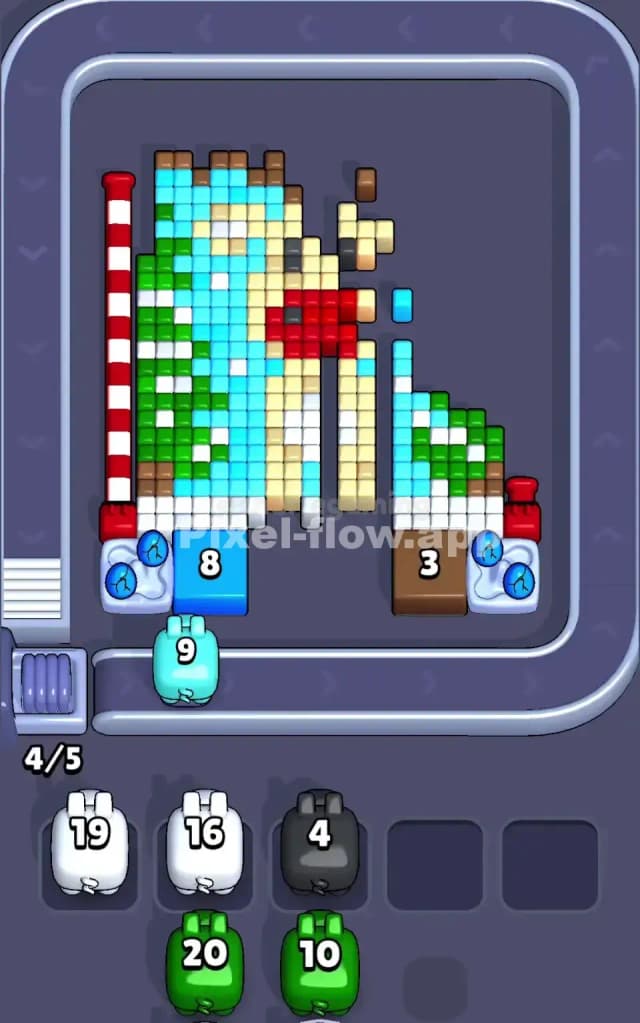
Pixel Flow Level 145 presents a charming pixel-art face with a warm, gentle expression dominating the center of the board. The subject features a cream-colored face, dark eyes, and a distinctive red smile that immediately draws your attention. What makes Pixel Flow 145 visually complex is how the designers layered multiple colors across the board: cyan forms much of the background and upper regions, green creates a frame-like border on the left and right sides, white accents appear throughout, brown forms hair at the top, and red concentrates in the mouth area. These colors aren't scattered randomly—they're stacked in layers, meaning you'll need to clear outer colors strategically to expose and eventually eliminate the deeper tones underneath.
The Win Condition and Deterministic Nature
Your goal in Pixel Flow Level 145 is straightforward: clear every single voxel cube from the board by systematically eliminating color-matched groups. The game gives you five pigs in a fixed order, each with 20 ammo, and the conveyor belt will deliver them in sequence. Here's the critical part: the order is fully deterministic, and every pig's ammunition count is locked in. That means once you understand which colors arrive when and how much firepower each pig has, you can plan your moves with precision. There's no randomness to blame—only your ability to sequence pigs intelligently and manage the waiting slots without jamming yourself into a corner.
Why Pixel Flow Level 145 Feels So Tricky
The Cyan Bottleneck
Cyan dominates the board in Pixel Flow 145, making up roughly 40% of all visible cubes across the background and scattered patches. The challenge isn't just the volume—it's that cyan appears in awkward, dispersed clusters that don't always form obvious groupings. When your cyan pig arrives and starts firing, you'll often find that after clearing the densest clusters, you're left with isolated cyan cubes hiding behind other colors or tucked into corners. This forces your cyan pig to either burn ammo on scattered cubes or, worse, run out of valid targets and drop into a waiting slot still carrying unspent ammo. If your buffer fills up with stuck pigs before you've had a chance to expose and clear their remaining targets, you lose immediately.
The Red Concentration and Inner Layers
Red feels like it should be easy—there's a concentrated block right in the middle of the face that practically begs to be eliminated. But here's where Pixel Flow 145 punishes impatience: that red cluster is partially protected by cream-colored cubes positioned in front and around it. You can't just fire at red immediately; you need to clear enough of the lighter shades first to give your red pig a clean line of fire. Worse, if you eliminate red too early, you might expose a layer of brown or white cubes that no remaining pig in your queue is equipped to handle efficiently. The order matters enormously in Pixel Flow 145, and rushing the obvious target often backfires.
Green's Deceptive Spread
Green forms a thick border on both sides in Pixel Flow Level 145, and while 20 ammo might seem adequate, the color's distribution is deceptive. Green cubes aren't tightly clustered—they're woven throughout the border region with white cubes interspersed, creating pockets of inefficiency. Your green pig might fire at a green cube, but the board's geometry means the next green cube isn't always directly adjacent, forcing you to watch ammo disappear faster than expected. I'll admit: the first time I played Pixel Flow 145, I watched my green pig burn through 15 ammo and still have cubes left over. That's when I realized the level wasn't being unfair—I was simply attacking in the wrong order.
Personal Reaction and the "Click" Moment
Honestly, Pixel Flow Level 145 frustrated me initially. I'd clear cyan somewhat efficiently, then red would jam because I hadn't exposed enough cream cubes, and suddenly my buffer was full with stuck pigs and no way forward. I spent several attempts reacting to whatever was on screen rather than planning ahead. But then it clicked: I stopped thinking "which pig should I use next?" and started thinking "which pigs do I need to park in waiting slots, and in what sequence will their remaining ammo eventually matter?" That shift in perspective—from reactive to proactive—transformed Pixel Flow 145 from annoying to solvable.
Step-by-Step Strategy to Clear Pixel Flow Level 145
Opening: Establish Control with Cream and White
Your first move in Pixel Flow 145 should target cream-colored cubes, even though they're not the most visible color. Here's why: cream cubes form the face itself and act as a gateway to the red cluster in the center. By starting with cream, you accomplish two things at once. First, you reduce visual clutter and make the board feel less overwhelming. Second, and more importantly, you expose the red mouth region while also potentially giving yourself clear sightlines to other colors. Aim for the cream pig to burn through roughly 12–15 of its 20 ammo during the opening phase, leaving 5–8 ammo in reserve.
Next, deploy your white pig strategically. White cubes form accent patches throughout Pixel Flow Level 145, particularly around the eyes and scattered across the green border. Use your white pig's 20 ammo to clean up these accent areas, but do so deliberately—don't spray wildly. The goal is to create a clean board state where the remaining colors (red, green, cyan, brown) are more exposed and isolated. If you manage this correctly, you should still have at least 2–3 waiting slots free after white pig fires, giving you breathing room for the harder pigs.
Mid-Game: Sequence Red and Brown with Precision
Once cream and white are mostly cleared, your board reveals more structure. Now it's time for your red pig to shine in Pixel Flow Level 145. Red is concentrated enough that your 20 ammo should handle it comfortably, but here's the critical detail: fire red before tackling green if possible. Why? Because red sits in the center surrounded by now-exposed space, and firing red early prevents it from becoming a secondary bottleneck later when you're running low on waiting slots.
Brown presents an interesting challenge in Pixel Flow Level 145. It appears in the hair region at the top, and while not voluminous, brown cubes are often paired with cyan cubes in complex patterns. Don't fire your brown pig until you've cleared enough cyan from the upper portion of the board to give your brown pig clean targets. If you fire brown too early, you'll watch it waste ammo on scattered cubes while deeper cyan layers remain untouched. Ideally, park your brown pig in a waiting slot with 8–12 ammo left, then use your cyan pig to clear the exposed upper section before retrieving brown.
End-Game: Cyan Cleanup and Buffer Management
Cyan is your finisher in Pixel Flow Level 145, and it's also your most dangerous. By the time cyan fires, you should have cleared most other colors, meaning cyan's 20 ammo is pointed at a much sparser board. The trick is not to panic when you see cyan ammunition remaining after all visible cyan cubes are gone. This happens because hidden layers or partially obstructed cubes still exist. Fire cyan strategically, watching for the moment when your pig runs out of valid targets. When that happens, cyan will drop into a waiting slot.
Here's where calm observation saves you in Pixel Flow Level 145: count your waiting slots as you go. If you reach a state where four slots are full and cyan just dropped, you have one slot left. Any additional pig that runs out of ammo will jam you, causing instant failure. To avoid this, ensure that one of your earlier pigs (ideally brown or one of your reserve colors) has already been fully depleted and has moved out of the buffer, freeing that final slot before cyan drops.
The absolute last step in Pixel Flow Level 145 is eliminating any remaining stuck pigs from the waiting slots by finding their matching colors on the board. Often, a quick rescan will reveal a hidden red, green, or brown cube tucked somewhere on the board—fire the corresponding stuck pig to clear it and win the level.
The Logic Behind This Pixel Flow Level 145 Plan
Exploiting Deterministic Pig Order and Ammo
Pixel Flow Level 145 doesn't require luck—it demands understanding. Every pig arrives in the same order, with the same ammunition, every single time. That's not a limitation; it's a framework for strategy. The plan outlined above works because it respects this determinism: by targeting cream early, you guarantee that red has clean firing angles later. By parking brown in reserve until cyan clears the upper board, you ensure that brown's ammo isn't wasted on obscured targets. This isn't improvisation; it's deliberate sequencing based on how the board physically transforms as you clear colors.
The waiting slots are your most precious resource in Pixel Flow Level 145. Unlike many puzzle games where you have unlimited moves, your five slots can fill instantly if you're careless. By planning which pigs you'll park and when, you turn the buffer from a threat into a tool. A pig sitting in a waiting slot isn't a failure—it's a temporary storage system for ammo you'll eventually spend once deeper layers expose new targets.
Staying Calm and Planning Two Pigs Ahead
Success in Pixel Flow Level 145 comes from resisting the urge to fire pigs reactively. Instead, as each pig enters the conveyor belt, ask yourself: "If this pig runs out of ammo right now, will a waiting slot fill up? If it does, do I have a plan to empty it?" Watch the pig queue constantly, and keep a mental count of which colors remain on the board. If you notice your cyan pig is next but red still has isolated cubes scattered around, you know you need to adjust earlier pigs' firing patterns or park them strategically.
The moment you stop playing move-to-move and start playing turn-to-turn, Pixel Flow Level 145 becomes manageable. Plan for your current pig and the next two in line. Ask whether clearing a particular color right now serves your endgame or creates new problems. That forward-thinking mindset transforms frustration into control, and control into victory.