Pixel Flow Level 161 Solution | Pixel Flow 161 Walkthrough
How to beat Pixel Flow Level 161: Video solution & walkthrough. The fastest way to pass Pixel Flow 161.
Is this the wrong level layout?🤔
Pixel Flow randomizes levels for different players. Don't worry, just upload a screenshot of your board, and our AI will find the correct video instantly.




Pixel Flow Level 161 Walkthrough
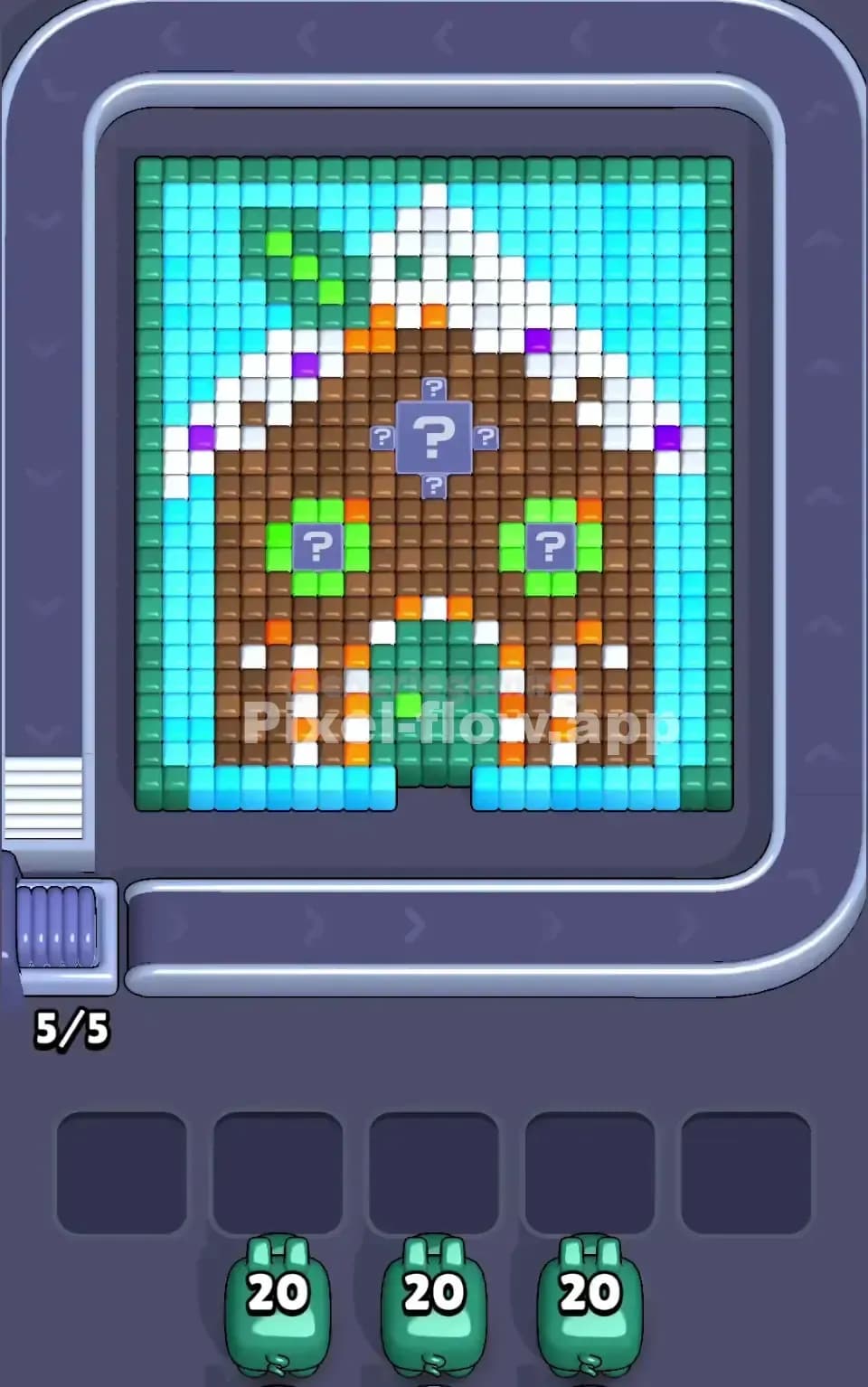
This level looks like a giant, mechanical sunflower or a radioactive gear. You are staring at a radial pattern with eight distinct "petals" surrounding a dense core. The primary colors facing you are bright Yellow on the rims, White in the inner rings, and a deep Purple skeleton holding it all together.
Here is the kicker for Pixel Flow Level 161: almost every section of this flower contains a grey ? Box. These aren't just bonuses; they are load-bearing parts of the structure that hide difficult, high-health blocks underneath.
To beat this, you need to strip the outer colors (Yellow and White) to expose the Mystery Boxes, crack them open, and then deal with the heavy layers hiding beneath. Is this a very hard level? Yes, it is very hard. The hidden layers require specific, high-ammo pigs that you might not have ready if you rush.
Pixel Flow Level 161 Overview
Imagine a vault door made of voxels. That is what Pixel Flow 161 feels like. The design is perfectly symmetrical. You have eight lobes (or petals) extending from the center. Each lobe is bordered by a thick Yellow wall. Inside that wall is a ring of White. Inside the White is the Purple core. And dead center in each lobe sits a ? Box.
The center of the board is a bullseye: Purple outer ring, White inner ring, Yellow center, and one final ? Box right in the middle.
While the board looks the same on all sides, the danger isn't symmetrical. The danger is Time and Queue Space. Because the structure is so dense, your pigs will waste time traveling around the loop if you don't clear a specific "entry wound" on one side. Also, the hidden layers underneath (revealed later to be Pink and Red) act as ammo sponges. You will see blocks requiring 14 or 20 hits. If you aren't prepared for that sudden spike in difficulty, your slots will clog up instantly.
Step by step solution walkthrough for Pixel Flow Level 161
First Color Zone to Erase in Pixel Flow Level 161
You have to start with the Yellow Rims. Look at your starting lineup. You likely have Yellow (20) and White (20) pigs.
Do not try to shoot the White inner rings yet. They are partially protected by the Yellow, and your firing angles will be trash. Instead, focus entirely on peeling the Yellow skin off the petals on the left side of the board.
Why the left? Your pigs spawn from the bottom left. By clearing the left-side petals first, you shorten the travel time for your projectiles. The sooner a pig shoots, the sooner it empties its ammo and leaves the board. If you target the top-right petals, your pigs have to ride the belt all the way around, risking a queue jam.
Use the Yellow pigs to shave off the outer edges. This does two things:
- It removes the "shield" protecting the White and Purple layers.
- It exposes the corners of the ? Boxes, making them easier to hit accidentally (which you actually want to do, but slowly).
How to pass Pixel Flow Level 161 without power ups or boosters
Once the Yellow rim is gone, the level gets ugly. You will start hitting the ? Boxes. When these break, they don't just disappear; they usually turn into a new, harder block.
In Pixel Flow 161, these boxes often hide Pink blocks (20 Health) and Red blocks (14 Health). You can see this in the mid-game: massive, solid chunks of Pink and Red suddenly appear where the petals used to be.
Here is the trap: You might have a queue full of Purple or White pigs, but now you are staring at a giant Pink wall that needs 20 hits.
The Strategy: Don't break all the ? Boxes at the same time. If you crack open five boxes and they all turn into Pink (20 Health) blocks, but you only have one Pink pig, you are dead. The other slots will fill with useless pigs, and you will lose.
Focus on cracking one or two petals completely open at a time. Let the box break, see what color spawns (likely Pink or Red), and prioritize grabbing the matching pig immediately. If you see a Pink Pig (20) coming down the chute, save it. Do not waste it on stray pixels. You need that heavy ammo for the revealed hidden blocks.
Also, ignore the center bullseye for now. It’s too protected. Work from the outside in. Clear the debris of the petals (the Green and Red shards that appear) before you even look at the center.
Last Details You Clean Up in Pixel Flow Level 161
By the end, the "flower" is gone. You are likely left with the central core and maybe the bottom stumps of the petals.
The final obstacle is usually the Purple Skeleton. The purple blocks form the spokes connecting the petals to the center. They are thin and hard to hit because they are often obstructed by the leftover junk from the hidden layers.
You will often find a single Red (14) or Pink (20) block sitting alone in the center, the last remnant of the middle ? Box. Save a high-capacity pig for this. If you use a pig with only 4 ammo on a 14-health block, it will take up a slot, shoot 4 times, and then sit there clogging your board because it has 0 ammo but the target is still alive. Ensure your last few pigs have enough ammo to finish the job in one go. Clear the Purple spokes, smash the final center block, and you’re done.