Pixel Flow Level 162 Solution | Pixel Flow 162 Walkthrough
How to beat Pixel Flow Level 162: Video solution & walkthrough. The fastest way to pass Pixel Flow 162.
Is this the wrong level layout?🤔
Pixel Flow randomizes levels for different players. Don't worry, just upload a screenshot of your board, and our AI will find the correct video instantly.

Pixel Flow Level 162 Overview
The Board Setup
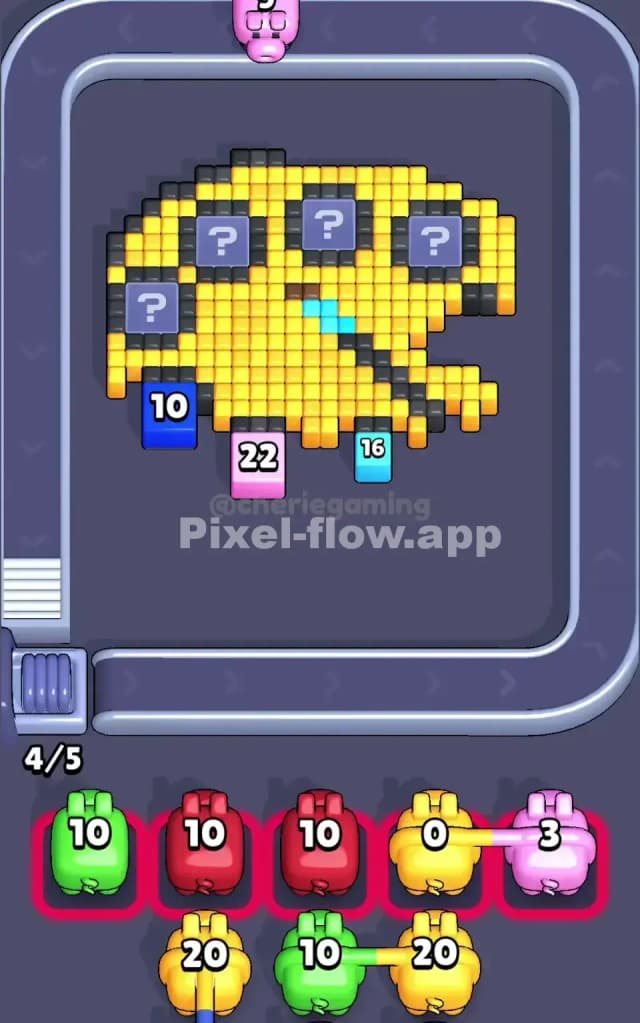
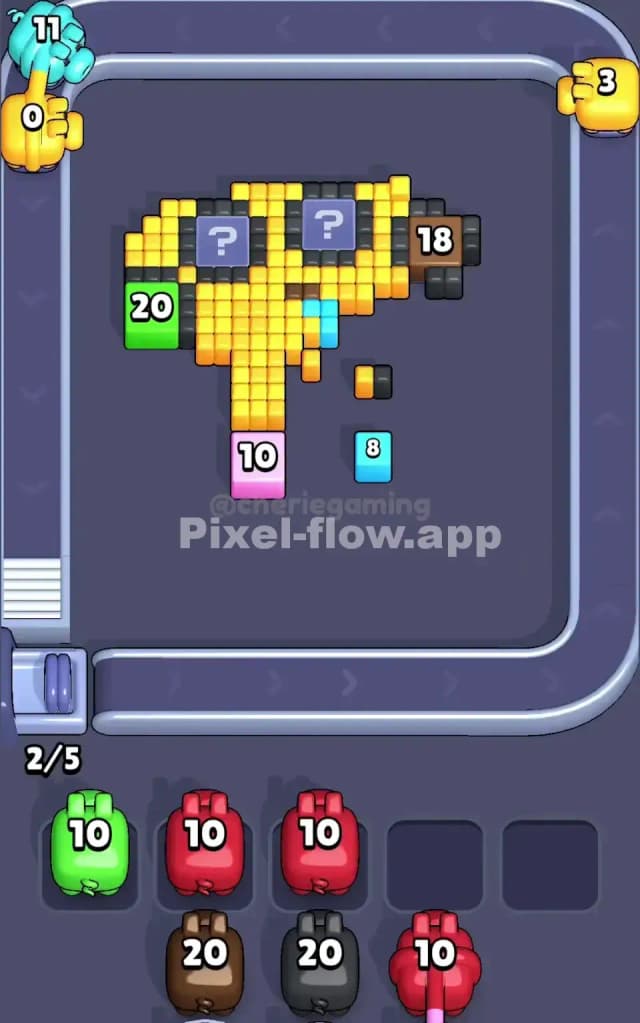
Pixel Flow Level 162 presents you with a quirky, smiley-faced pixel art character dominating the playfield. The board is overwhelmingly yellow—easily 70–80% of all visible cubes are bright yellow, with dark gray/charcoal cubes forming the outline and interior details that give the face its personality and expression. Scattered throughout are several cyan cubes that sit right in the center of the design, acting as a small but critical accent color. You'll also notice six blue question-mark blocks embedded in the yellow field, which represent hidden layers or bonus content waiting beneath the surface. The board feels densely packed, with very little empty space, which means you're managing a genuinely substantial voxel structure from start to finish.
Win Condition and Determinism
To clear Pixel Flow Level 162, you must destroy every single cube on the board by directing your color-coded pig shooters to destroy all matching voxels. Your three pigs arrive in a fixed order with specific ammo counts: two yellow pigs with 20 ammo each, flanking a single dark/black pig with 20 ammo in the middle. This rigid sequence is completely deterministic—every run plays out identically unless you change your targeting strategy. You succeed only when the board is completely empty and you've never filled all five waiting slots with stuck pigs simultaneously. The challenge is sequencing your pig releases and planning your shots so that each pig's ammo depletes just as the matching colors on the board vanish, never leaving a pig stranded with nowhere useful to shoot.
Why Pixel Flow Level 162 Feels So Tricky
The Yellow Bottleneck
Here's where Pixel Flow Level 162 gets genuinely nasty: yellow is everywhere, and you have two yellow pigs with 20 ammo each. That's 40 shots of yellow ammo available, which sounds like plenty until you actually count the yellow cubes on the board and realize you're dealing with well over 40 targets. The yellow cubes form the bulk of the face's interior and outer structure, so you absolutely cannot avoid them. The real trap is that yellow cubes don't exist in isolation—they're intermingled with black outline cubes and hidden beneath those blue question marks. If you fire your first yellow pig too early and it runs out of ammo before it's fully exposed all the layers, you'll park a half-spent pig in the waiting slots with nowhere left to shoot. That wasted slot is a death sentence because your second yellow pig will follow, and if it also can't find enough targets, you're jammed.
The Hidden Layers Problem
Those blue question-mark blocks are hiding something, and Pixel Flow Level 162 won't let you ignore them. They're sitting right in the middle of the board where yellow cubes are thickest, so you need to destroy surrounding yellows and blacks to expose what's beneath. If you don't plan for this exposure sequence carefully, you might destroy all the visible yellow and then realize you can't reach the deeper yellow cubes hiding under those mystery blocks. Meanwhile, your yellow pigs are already parked and helpless. The question-mark blocks themselves don't seem to be shootable targets—they're just barriers—so you have to work around them strategically.
The Black Pig's Awkward Position
Your middle pig is dark/black with 20 ammo, but the dark cubes on Pixel Flow Level 162 form only the outline and sparse interior details. There's nowhere near 20 dark cubes visible on the surface. This means the black pig is either going to run out of targets immediately and get parked, or you need to very carefully time its release so it comes out only after you've exposed hidden black layers. Releasing it too early is a trap—you'll burn a waiting slot for nothing. Releasing it too late risks using up yellow pig ammo on structures you should've let the black pig handle, throwing off your entire sequencing.
When It Clicked for Me
I'll admit, Pixel Flow Level 162 frustrated me for a solid fifteen minutes. I kept firing pigs in intuitive order and watching them pile up in the waiting slots, utterly stuck. The turning point came when I stopped thinking about the visual board and started counting cubes by color, then checking my pig queue. Once I realized the black pig needed to stay parked until mid-game and that I had to expose layers deliberately rather than reactively, the puzzle suddenly made sense. It's not a hard level mechanically—it's a sequencing puzzle wearing a cute pixel face.
Step-by-Step Strategy to Clear Pixel Flow Level 162
Opening: Start Aggressive with Your First Yellow Pig
Release your first yellow pig without hesitation and let it rake across the entire board. Don't hold back or second-guess; yellow cubes are your primary target, and you've got two pigs for them. Aim to clear large contiguous patches of yellow in the face's cheeks, forehead, and nose area. Your goal in these first 15–18 shots is to expose the black outline cubes and start chipping away at the hidden layers beneath. Watch for the cyan cubes in the center—they're small, but don't forget they exist. Once your first yellow pig burns through its ammo or gets genuinely stuck (meaning it's searched the entire board and found zero valid targets), let it drop into a waiting slot. At this point, you should still have at least three open waiting slots, which gives you breathing room.
Mid-Game: Sequence Carefully and Expose Layers
Now release your black pig. This is your moment to clear the outline and any interior black voxels you've exposed by removing yellow. Be selective—fire at black targets that open up new areas or clear the path toward those blue question-mark blocks. Ideally, the black pig should exhaust its ammo partway through its second sweep, giving you a sense that you're making progress. Once the black pig drops, release your second yellow pig. By now, the board should look noticeably more carved up, with gaps and hollows where you've cleared sections. Your second yellow pig is the cleanup specialist—it finishes off remaining yellow patches, works deeper into the exposed layers, and most importantly, it should handle any yellow cubes that were hidden beneath the black outline or mystery blocks.
End-Game: The Cyan Finish and Slot Management
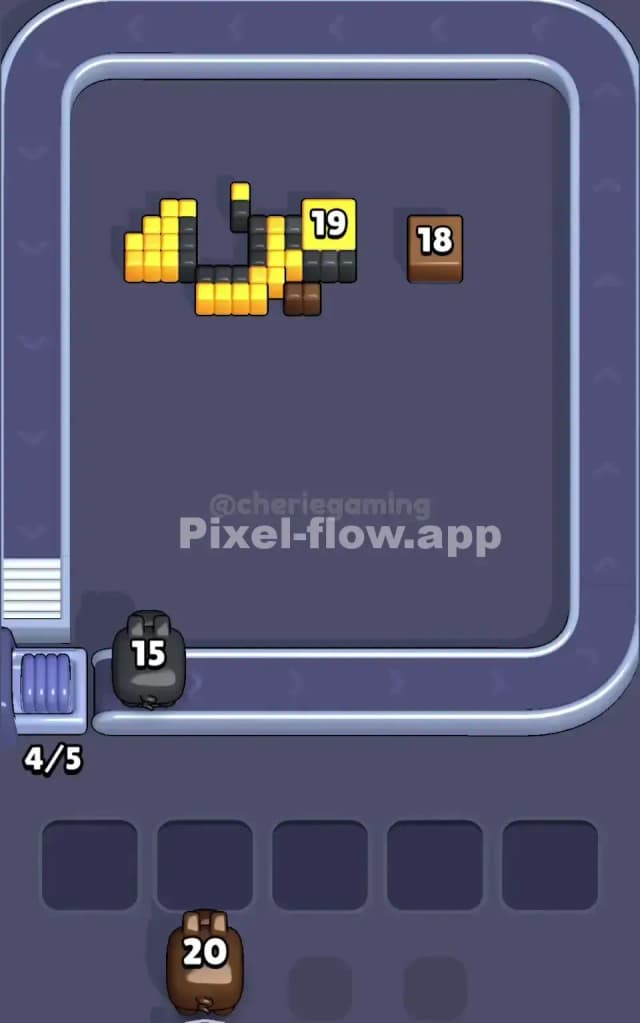
The cyan cubes in the center are your final target. Here's the tricky part: you don't have a cyan pig. Those cyan cubes have to be destroyed by one of your existing pigs burning ammo on them—either your second yellow pig if any ammo remains, or you're hoping the black pig had some ammo left. Plan for this by leaving 2–3 shots on your first yellow pig or reserving black pig ammo for the cyan cubes if the geometry forces it. Once you've cleared cyan, verify the board is truly empty. If your second yellow pig still has ammo and no valid targets remain, it will drop into a waiting slot, which is fine as long as you haven't already filled four of the five slots. Check your waiting slots before triggering any final pig releases.
The Logic Behind This Pixel Flow Level 162 Plan
Why Sequence Matters More Than Reflexes
Pixel Flow Level 162 isn't about reaction time or wild guessing—it's about predicting the board state two or three pigs ahead. Every pig's ammo is fixed, and every cube's position is fixed, so the entire puzzle is solvable via pure logic. The sequence I've outlined works because it prioritizes clearing large color blocks with pigs that have enough ammo, then uses remaining ammo to expose and finish hidden layers. Releasing your black pig early wastes a waiting slot; holding it too long means your yellow pigs exhaust their ammo before reaching all yellow targets. The sequencing respects the hard constraint that you have only five waiting slots and three pigs to work with.
Staying Calm and Counting Ahead
When you're playing Pixel Flow Level 162, resist the urge to panic-fire. Instead, glance at the queue—you always know which pig is coming next and how much ammo it has. Before releasing a pig, scan the board and ask yourself: does this color have enough visible targets to justify the ammo count? If not, wait and think about whether hidden layers might expose new targets. Watch your waiting slots like a hawk; if you've got four pigs parked and your queue shows a fifth pig about to arrive, that's your warning to succeed with the current pig or lose the level. This calm, analytical mindset turns Pixel Flow Level 162 from a frustrating guessing game into a solvable puzzle. You're not battling the game—you're cooperating with its deterministic rules to engineer a perfect solution.