Pixel Flow Level 163 Solution | Pixel Flow 163 Walkthrough
How to beat Pixel Flow Level 163: Video solution & walkthrough. The fastest way to pass Pixel Flow 163.
Is this the wrong level layout?🤔
Pixel Flow randomizes levels for different players. Don't worry, just upload a screenshot of your board, and our AI will find the correct video instantly.

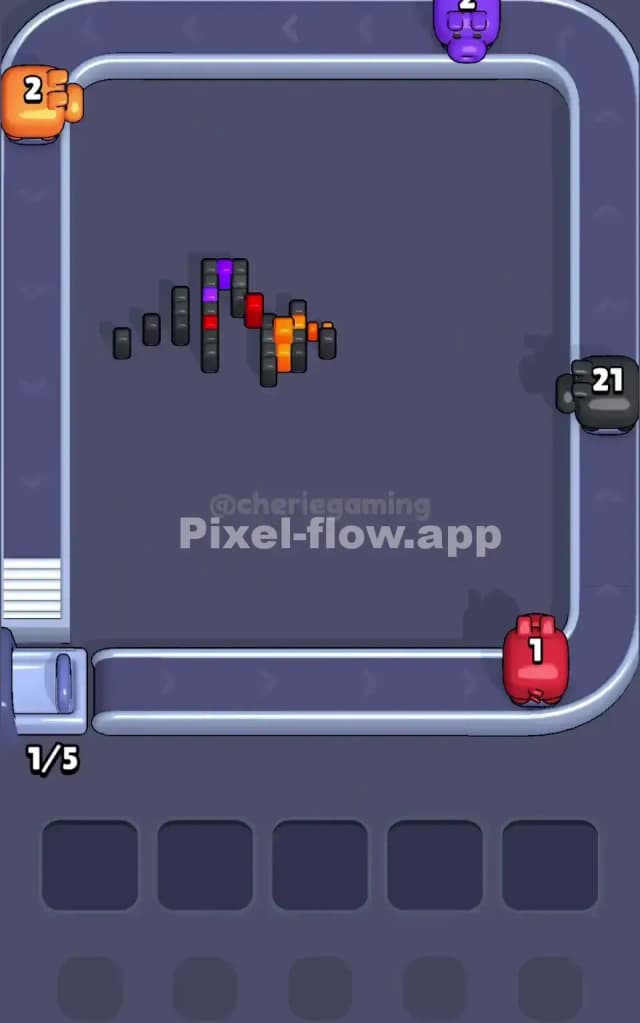
Pixel Flow Level 163 Walkthrough
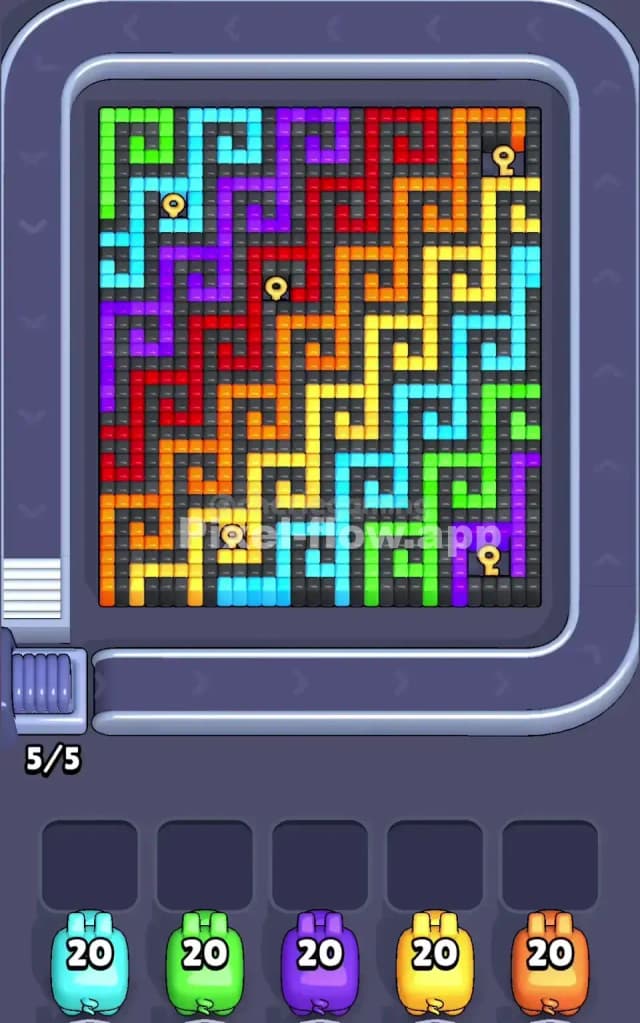
This level is a geometric nightmare if you aren't careful. The board is filled with a dense "Greek Key" or meandering pattern. Instead of a cute animal or object, you have strict diagonal stripes of interlocking S-shapes.
- Top Left: Starts with Green and Cyan.
- Middle: Transitions through Purple, Red, Orange, and Yellow.
- Bottom Right: Ends with Light Blue, Green, and Purple again.
- Key Mechanic: There are Gold Keys embedded in the Cyan (top left), Red (center), Yellow (bottom left), Yellow/Orange (top right), and Purple (bottom right) zones. These keys usually lock away deeper layers or specific color blocks.
Is it hard? Yes. This is a very hard level because the pattern is so uniform. Every stripe looks the same, which makes it incredibly easy to misjudge which layer is "on top." If you attack the wrong diagonal stripe, your pigs will clog the slots instantly.
Pixel Flow Level 163 Overview
Imagine a tightly woven rug with a diagonal zigzag pattern. That's the vibe here. The pattern moves from the top-left corner down to the bottom-right. The critical thing to notice is the layering. This isn't a flat image. The stripes overlap each other like shingles on a roof.
Usually, the stripes on the bottom-left and top-right edges are physically lower than the central stripes, or vice versa depending on the specific Z-axis of this puzzle. However, looking closely at the shadows:
- The Orange/Yellow stripes in the bottom left often act as a base.
- The Purple/Red stripes in the middle often sit on top of others.
The board is perfectly symmetrical in its chaos. You have multiple "hooks" of color interlocking. If you try to clear the Purple stripe in the middle, but it's actually tucked behind the Red stripe, your Purple pig will have nowhere to shoot and will drop into your waiting slots. Do that five times, and you lose.
Step by step solution walkthrough for Pixel Flow Level 163
First Color Zone to Erase in Pixel Flow Level 163
The safest opening move is to target the Orange and Yellow stripes located near the bottom-left and bottom-center.
Why? These blocks are usually the most exposed "outer" layer in this specific zigzag configuration. Look for the Orange stripe specifically. It has a large, continuous surface area that isn't blocked by the Red or Purple stripes above it.
The Trap: Do not start with the dark Purple or dark Red stripes in the exact center. They often have tiny hidden blocks tucked under the lighter colors (Yellow/Cyan). If you summon a Red pig too early, it might only shoot 2-3 blocks and then sit in your slot, wasting space.
Priority Order:
- Orange: Clears a massive chunk of the lower-left diagonal.
- Yellow: Once orange is gone, the yellow "S" shapes are exposed.
- Cyan (Top Left): This is often a separate, high-sitting layer that can be cleared independently of the messy center.
How to pass Pixel Flow Level 163 without power ups or boosters
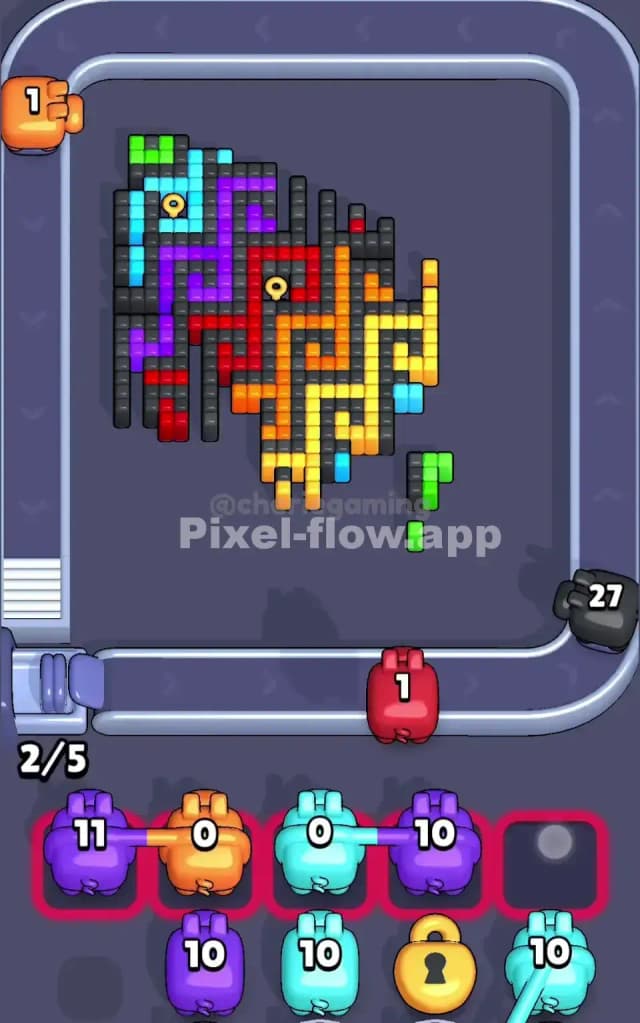
Around the mid-point, the board will look like a jagged mess. You likely have the top-left corner (Green/Cyan) partially intact and a messy center of Red and Purple.
This is the danger zone. You will see Keys floating in mid-air or attached to single blocks. Focus on the keys.
- The Red Key: This is usually central. You need a Red pig to clear the blocks holding it. However, ensure the Red blocks are actually accessible. If a Purple block is physically "above" the Red one in 3D space, the Red pig will ignore it.
- Slot Management: You have 5 slots. In this phase, do not pull a pig unless you can visually confirm at least 10+ clear shots. If you see a single Blue block but the rest are buried, do not pull the Blue pig. Let it cycle on the conveyor belt. It is better to wait 20 seconds for the right color than to clog a slot with a useless pig.
If you get stuck with 3 or 4 clogged pigs, stop looking at the center. Look at the extreme edges. Often, a tiny Green or Purple block on the very edge of the board is the "keystone" holding up the inner layers. Clear the edges to unlock the center.
Last Details You Clean Up in Pixel Flow Level 163
The final few moves will almost always be the "under-layers" that were hidden beneath the zigzag pattern.
- Dark Grey/Black Background: Sometimes the "floor" blocks remain.
- Stragglers: You will likely have 1-2 random Purple blocks in the bottom right corner or a stray Green block in the top left.
Watch out for the Keys. Sometimes unlocking a key reveals a brand new set of blocks (a new layer) right at the end. Make sure you have enough ammo or fresh pigs coming down the belt to handle a surprise spawn of 5-10 blocks after a key unlocks. Don't waste your last "Wild" pig (if you have one saved) until you are sure the final layer is exposed.