Pixel Flow Level 166 Solution Walkthrough | Pixel Flow 166
How to solve Pixel Flow level 166? Get instant solution for Pixel Flow 166 with our step by step solution & video walkthrough.


Pixel Flow Level 166 Overview
The Board: A Colorful Robot Face with Layered Complexity
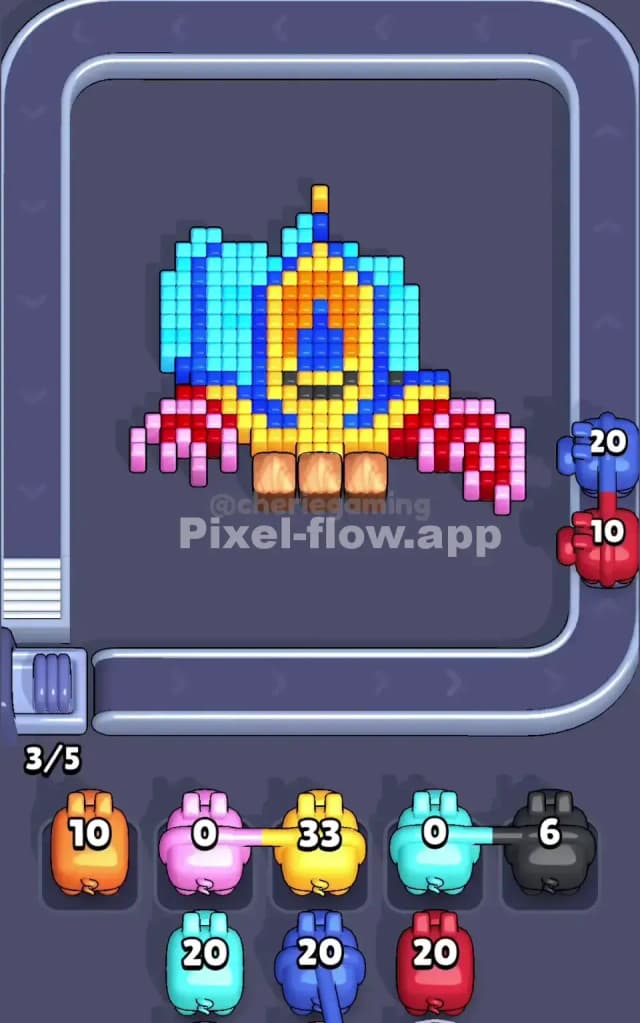
Pixel Flow Level 166 presents you with a charming pixel-art robot face—a fun, retro design that masks a genuinely tricky puzzle underneath. The composition features a large cyan and blue backdrop forming the robot's "head," with yellow details creating the facial features (eyes, mouth), an orange accent in the center, and a bold red section at the bottom representing the robot's "jaw" or lower face. Three tan-colored cubes sit right in the middle of the composition, acting as a visual focal point and a critical strategic element. You're looking at a multi-layered voxel structure where colors sit on top of each other, and you'll need to clear them systematically to expose what's underneath.
Win Condition and Deterministic Pig Behavior
Your goal in Pixel Flow Level 166 is straightforward: eliminate every single cube on the board. You've got three pigs to work with—red (20 ammo), blue (20 ammo), and yellow (20 ammo)—and they'll arrive on the conveyor belt in a fixed order. Each pig automatically shoots voxel cubes that match its color, spending exactly one ammo per cube destroyed. The puzzle is entirely deterministic, meaning the pig sequence never changes; your skill lies in managing when each pig shoots and ensuring you don't jam your five waiting slots with stuck pigs that have nowhere to aim. Clear all cubes, and you've conquered Pixel Flow Level 166.
Why Pixel Flow Level 166 Feels So Tricky
The Central Bottleneck: The Tan Cubes and Hidden Layers
The biggest threat in Pixel Flow Level 166 is how those three tan-colored cubes sit dead center, blocking your view of what lies beneath them. These aren't your color—no pig can shoot them—so they're purely obstacles. What makes this dangerous is that they're likely hiding a substantial chunk of blue or yellow cubes underneath, and you won't know exactly what you're dealing with until you've cleared away the overlying red and outer cyan sections. If you're not careful about your pig sequencing, you'll burn through your red and blue ammo trying to expose the layers, only to find yourself with a yellow pig holding 15+ ammo and nowhere near enough yellow cubes visible to spend it all. That's when the waiting slots fill up, and you're stuck.
Subtle Problem Spots: Color Pockets and Ammo Mismatches
Another headache in Pixel Flow Level 166 is the way cyan and blue cubes are densely packed across the upper and middle regions. At first glance, it looks like blue will have plenty of targets, but the cyan acts as a visual distraction—your blue pig can't touch cyan, only darker blue cubes. This means you might think blue has an easy time, but in reality, the valid targets are scattered and sometimes surrounded by cyan "walls" that force you to wait for other pigs to clear first. Additionally, the yellow accent details (forming the robot's eyes and mouth) are fragmented into separate clusters. Your yellow pig might clear the top crown first, then struggle to reach the middle section, burning ammo inefficiently if you're not deliberate about the order.
Personal Insight: When the Logic Clicks
Honestly, Pixel Flow Level 166 frustrated me for a few attempts because I kept rushing my blue pig into the dense upper-middle section, assuming I'd expose everything I needed. Instead, I'd clear a bunch of blue cubes, only to realize the red and yellow were still locked behind unexposed layers, and my waiting slots started filling with desperate pigs. The real breakthrough came when I stopped thinking about "clearing colors" and started thinking about "exposing layers." Once I accepted that I needed to strategically clear the red section first to expose what the blue needed, and carefully meter out my blue ammo to support yellow's final push, everything clicked. Patience with the order is key.
Step-by-Step Strategy to Clear Pixel Flow Level 166
Opening: Clear Red First to Establish Your Foundation
Start by letting your red pig take the lead and attack the bold red section at the bottom of the board. Red is your workhorse in Pixel Flow Level 166 because it occupies a discrete area and has a clear ammo-to-target ratio. Don't overthink it—your red pig will shoot roughly 20 red cubes (or close to it), and this serves two critical purposes. First, it clears a visible layer, making you feel progress and building momentum. Second, it exposes the underside of the robot's face, revealing hidden blue and yellow cubes that were sitting just above or adjacent to the red section. Crucially, during this opening phase, keep your waiting slots flexible. If your red pig burns through its full ammo and there are still no red cubes visible on the board, it'll drop into a waiting slot—that's fine, because you've got four slots remaining, and you haven't panicked yet. Aim to have at least two waiting slots completely empty once red finishes.
Mid-Game: Sequence Blue and Yellow to Expose Inner Layers
Once red has done its job, your blue pig enters the conveyor belt and faces a more complex puzzle within Pixel Flow Level 166. The cyan-and-blue upper region is now your territory, but don't spray ammo everywhere. Instead, focus blue on the darker blue cubes first—the ones that form the main face and head structure. These are easier to spot and will consistently expose yellow accents or deeper color patches beneath them. As blue clears the upper and central layers, watch for yellow cubes to become visible. This is where patience matters: you want to expose enough yellow cubes to keep your yellow pig fed when it arrives, but not so much that you tempt yourself to use blue ammo wastefully on blue cubes that don't matter. A helpful rule of thumb is to stop blue once you've cleared the main facial features (eyes, nose area) and the central cluster around those tan blocking cubes. At this point, your blue pig might still have 5–10 ammo left; park it in a waiting slot if it has no blue targets remaining. This prevents jamming and keeps your buffer open for yellow.
End-Game: Yellow's Final Push and the Clean Finish
Your yellow pig is the finisher in Pixel Flow Level 166, and its success depends entirely on what blue exposed. Yellow needs to mop up the remaining yellow accents—the crown at the top, the facial details, and the scattered highlights throughout the robot's design. Since yellow starts with 20 ammo and there are roughly 15–18 yellow cubes on the board (in the usual distribution), you'll have a small buffer. The trick is to let yellow work through its targets methodically, moving from the top crown downward and sideways to catch isolated yellow cubes before they become unreachable. If yellow runs out of visible yellow cubes before burning all its ammo, it'll drop into a waiting slot. That's not failure—it just means you've successfully cleared the board. However, if you've sequenced pigs poorly and both red and blue are stuck in waiting slots with ammo remaining while the board still has their color cubes visible, you've created a jam. To avoid this in Pixel Flow Level 166, always verify that the next pig's primary targets are reasonably visible before it arrives. If you see a major color cluster that the current pig can't touch, hold back and let a waiting pig handle it instead.
The Logic Behind This Pixel Flow Level 166 Plan
Exploiting Order, Ammo, and Slot Management
The strategy for Pixel Flow Level 166 isn't about flashy moves or hidden tricks—it's about respecting the constraints. You have three pigs, five waiting slots, and a finite ammo pool. The beauty of this game is that pig order is fixed, so you can't scramble it; instead, you work with it. By clearing red first, you're leveraging that pig's ammo to expose the puzzle for the next two pigs. By sequencing blue to target the dense upper-middle region and then parking it when necessary, you're preventing it from becoming a "stuck" pig that pollutes your slots. Yellow, as the finisher, has the simplest job: clean up what's left. This creates a natural flow where each pig's success builds the foundation for the next pig's success. Pixel Flow Level 166 rewards this kind of forward thinking because it forces you to see the board not just as a current state, but as a series of future states. Every cube you clear with red or blue directly impacts whether yellow will have enough targets or jam the system.
Staying Calm Under Pressure: Anticipation and Ammo Counting
The real skill in mastering Pixel Flow Level 166 is developing the habit of looking two or three pigs ahead. As red is shooting, you're already scanning the board for blue targets. As blue is shooting, you're mentally rehearsing yellow's path. Count your ammo—literally count it. If your blue pig has 12 ammo left and you see roughly 14 blue cubes on the board, you know blue won't finish the job, so blue will end up in a waiting slot. That's fine, as long as your slots aren't full. The moment you see a waiting slot getting filled, start asking yourself: "Is the next pig going to have enough targets to avoid joining the queue?" If the answer is "maybe not," then be extra surgical with the current pig's ammo, prioritizing shots that expose deeper layers. Pixel Flow Level 166 becomes far less frustrating once you stop reacting to each pig individually and start treating the puzzle as a unified system where every action ripples forward. Stay patient, count methodically, and trust the logic—you've got the ammo, the pigs, and the plan to clear it all.