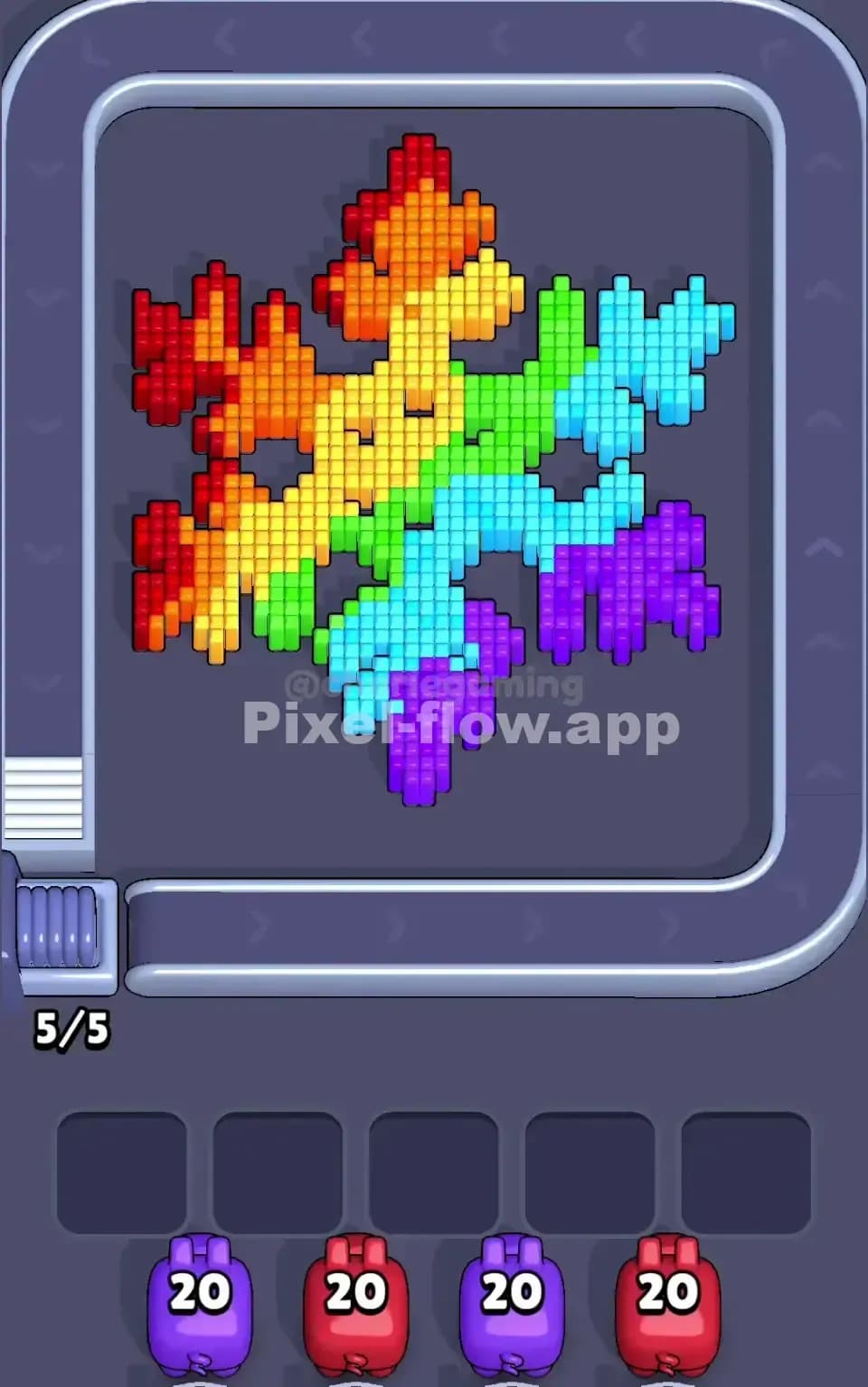
Pixel Flow Level 171 Solution | Pixel Flow 171 Walkthrough
How to beat Pixel Flow Level 171: Video solution & walkthrough. The fastest way to pass Pixel Flow 171.
Is this the wrong level layout?🤔
Pixel Flow randomizes levels for different players. Don't worry, just upload a screenshot of your board, and our AI will find the correct video instantly.



Pixel Flow Level 171 Overview
The Board Layout and Visual Design
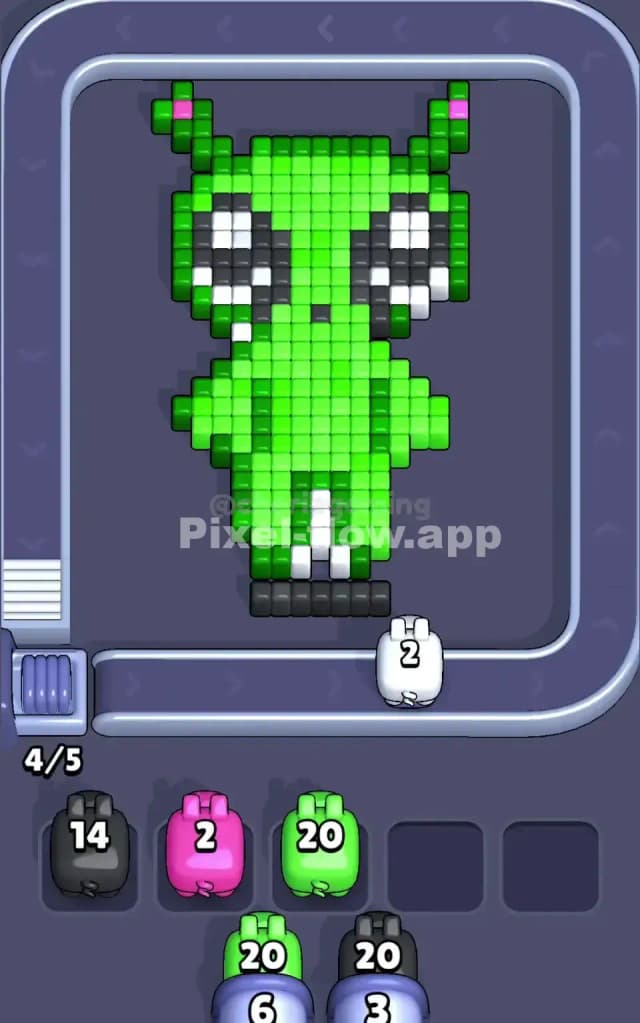
Pixel Flow Level 171 presents a striking pixel art face with a distinctly geometric, almost ornamental design. The board is dominated by bright lime green cubes that form the bulk of the facial features, including the cheeks, forehead, and overall contours. White cubes create sharp angular details around the eyes and mouth, while dark gray and charcoal blocks form the eye pupils and add depth to the expression. At the very top of the board, you'll notice small clusters of magenta (pink) and green cubes that serve as accent details. Most notably, there's a horizontal bar of magenta cubes positioned at the bottom center of the board, sitting above the conveyor belt where pigs emerge. This layered composition means you're not just destroying colors randomly—you're systematically peeling away exterior colors to expose and eventually clear the interior shades beneath.
Understanding the Win Condition
Your goal in Pixel Flow Level 171 is straightforward: clear every single voxel cube from the board by sending color-matched pigs down the conveyor belt to shoot and eliminate them. The counter at the top left shows "5/5," indicating you have five pigs queued and ready to roll. Each pig carries a specific ammo count that determines exactly how many cubes of its color it can destroy. Once a pig fires all its ammo or has no valid targets left, it drops into one of the five waiting slots at the bottom. The level ends in victory only when every cube is gone and you haven't jammed your waiting buffer. Understanding that pig order and ammo values are completely deterministic is key—this isn't a luck-based puzzle, but a logic puzzle where every decision matters.
Why Pixel Flow Level 171 Feels So Tricky
The Magenta Bottleneck
Here's what catches most players off guard in Pixel Flow Level 171: that magenta bar at the bottom is a potential death trap. You can see there's a solid horizontal line of magenta cubes, and if your magenta pig arrives before you've properly exposed and removed enough blocking cubes, it'll burn through its ammo without being able to reach the magenta targets. Worse, if the magenta pig runs out of ammo or gets stuck with visible magenta cubes it can't access, it drops into a waiting slot while still "holding" unused ammo. Fill all five waiting slots with pigs in this predicament, and you're locked into a losing state instantly. The magenta section demands respect and careful sequencing—you can't just fire pigs willy-nilly and expect the magenta problem to solve itself.
The Gray and White Complexity
Another subtle trap in Pixel Flow Level 171 is managing the gray and white cubes that sandwich the eyes and mouth. These colors appear in relatively small pockets scattered across the face, which means the corresponding pigs might have modest ammo counts that seem adequate until you realize one pig's target cubes are buried under another color. If you send a white pig too early, it'll clear the outer white details but then get stuck waiting while the inner white cubes remain hidden. Similarly, the gray cubes forming the pupils are partially obscured by the eye whites, creating a sequencing puzzle where you genuinely must clear white before gray can reach its full potential. This interplay between exposed and hidden targets is what separates a smooth solve from a frustrating jam.
The Green Giant Problem
Don't let the abundance of bright green fool you into complacency in Pixel Flow Level 171. Green dominates the visual board, which means you're likely dealing with a pig or pigs carrying substantial green ammo. The challenge isn't the ammo count itself—it's that green cubes are distributed across multiple regions (cheeks, forehead, background), and some green cubes sit on top of or adjacent to other colors. If your green pig clears one cluster perfectly but can't "see" the next batch of green targets because they're blocked by white or gray, you've wasted valuable ammo and lost positioning flexibility. I found myself frustrated more than once when a fully-loaded green pig would drop into waiting with 5+ ammo remaining simply because the board geometry refused to expose the remaining green cubes at the right moment.
When the Puzzle "Clicks"
Honestly, Pixel Flow Level 171 frustrated me for a solid dozen attempts until I stopped thinking in terms of "which color should I clear first" and started thinking in terms of "which pig will unlock the next pig's targets." Once I mapped out which colors were blocking which, the level suddenly shifted from chaotic to chess-like. That moment of clarity—when you realize you need the white pig to clear certain whites so the gray pig can see the pupils—is when Pixel Flow Level 171 stops feeling impossible and starts feeling satisfying.
Step-by-Step Strategy to Clear Pixel Flow Level 171
Opening: Establishing Board Control
Launch into Pixel Flow Level 171 by sending your first pig with confidence, but with intention. I recommend targeting white first if it's among your opening pigs, since white forms the angular eye and mouth details that sit atop other layers. Clearing the white boundary pieces does two critical things: it removes one color from your waiting queue and it exposes the gray pupils and interior structures beneath. While that first white pig is firing, keep your eye on the waiting slots—you want to maintain at least two empty slots at all times as you progress through Pixel Flow Level 171. This buffer prevents the catastrophic scenario where you're forced to use a pig in a suboptimal order. If your first pig isn't white but green, that's fine too; you can safely clear exposed green from the cheeks and forehead without fear of jamming. The rule of thumb for Pixel Flow Level 171's opening is: never let a pig shoot its entire ammo and drop into waiting unless you're certain its color has no more exposed targets on the board.
Mid-Game: Exposing Layers and Parking Pigs Strategically
As you progress through Pixel Flow Level 171, you'll hit the critical mid-game phase where exposed targets start becoming scarce and hidden layers demand attention. This is where patience and pig parking become your best tools. When you send a gray pig to clear the eye pupils in Pixel Flow Level 171, it might have 8 ammo but only 6 visible targets—don't panic and send the next pig immediately. Wait, watch, and see if clearing gray opens up new green or white cubes that the next pig in the queue can reach. If you're forced to park a pig with leftover ammo, choose a waiting slot and move on, but make mental note that this pig must have a return opportunity later, or you've essentially created a dead pig in your buffer. In Pixel Flow Level 171, the mid-game is where you're essentially "setting up dominoes" for your endgame. Send the magenta pig only when you're absolutely certain the bottom magenta bar is either fully exposed or when you have a strategic reason to park it with full knowledge of when it'll see targets again.
End-Game: Cleaning Up and Avoiding the Final Jam
The endgame of Pixel Flow Level 171 is where precision matters most. As the board thins out, you'll have 1–2 pigs left and hopefully 2–3 waiting slots still empty. At this stage, every move is a commitment; you can't afford a pig to miss its targets. Clear the remaining green, then tackle any stragglers of white, gray, or black. Save the magenta for near the very end in Pixel Flow Level 171 unless you've already cleared enough blocking cubes that magenta is fully accessible. Your final 1–2 pigs should be able to see all their targets clearly and fire their ammo with zero waste. If you've planned well through Pixel Flow Level 171, your last pig will empty its ammo into the final cubes, the board will glow with completion, and all five waiting slots remain unfilled. That's a clean victory.
The Logic Behind This Pixel Flow Level 171 Plan
Why Sequence Matters More Than Ammo Count
On the surface, Pixel Flow Level 171 might seem like it's all about having enough ammo to match the cube count—and technically, that's true. But the real puzzle is that pig order is fixed and ammo spending is deterministic. You can't ask for a different pig; you have to work with the queue in front of you. The strategy I've outlined for Pixel Flow Level 171 isn't about discovering some magical pig combo—it's about recognizing that by delaying certain pigs and parking them wisely, you create the conditions for earlier pigs to clear blocking layers, which then exposes targets for the later pigs to hit. A pig with 8 ammo is worthless in Pixel Flow Level 171 if it has no visible targets, so the entire puzzle hinges on the order and timing of exposure, not the raw ammo pool.
Staying Calm and Counting Ahead
The key mental skill for mastering Pixel Flow Level 171 is proactive thinking, not reactive panic. Before you send a pig, glance at the queue and ask yourself: "If I send this pig now, what color will be exposed next, and does the following pig have targets for it?" Count your ammo carefully in Pixel Flow Level 171; if a pig has 20 ammo and you see only 15 visible targets, you've got a problem brewing. Watch the waiting slots like a hawk—the moment you have three pigs parked, you're entering danger territory in Pixel Flow Level 171. The level rewards you for looking two or three pigs ahead rather than just reacting to the present. Once you internalize that rhythm for Pixel Flow Level 171, the puzzle stops feeling like a lottery and starts feeling like a strategy game where every decision cascades forward in predictable, elegant ways.