
Pixel Flow Level 172 Solution | Pixel Flow 172 Walkthrough
How to beat Pixel Flow Level 172: Video solution & walkthrough. The fastest way to pass Pixel Flow 172.
Is this the wrong level layout?🤔
Pixel Flow randomizes levels for different players. Don't worry, just upload a screenshot of your board, and our AI will find the correct video instantly.


Pixel Flow Level 172 Walkthrough
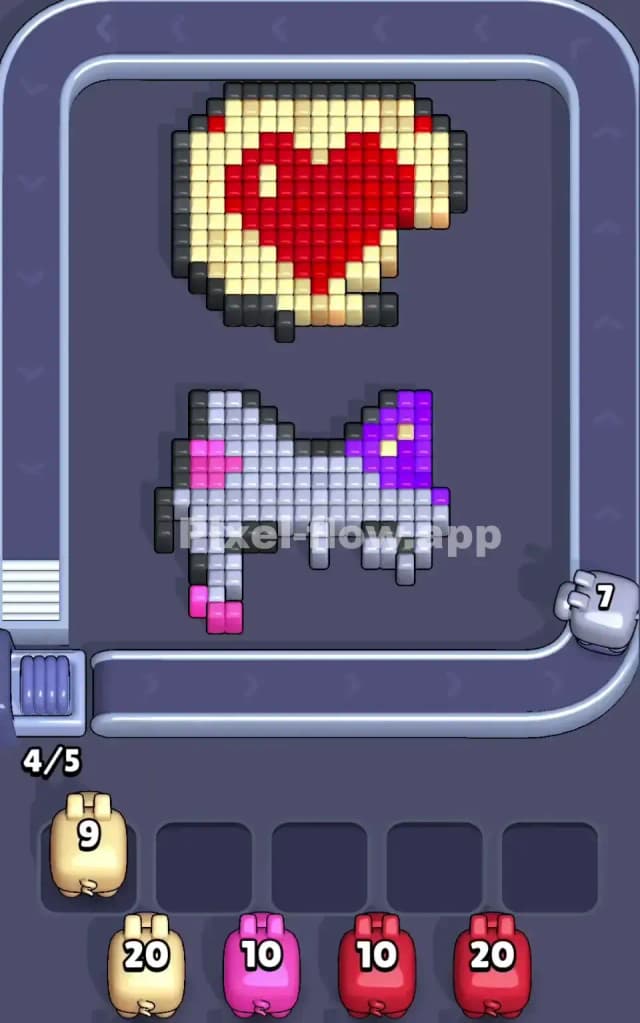
This level is a charming two-part vertical puzzle. You are dealing with a "love-struck cat" scene. The board is split into two distinct voxel clusters: a speech bubble containing a heart at the top, and a cat’s face at the bottom. This separation is your biggest enemy. Pigs that target the top cluster might be useless against the bottom, and vice versa.
The primary rule to beat Pixel Flow Level 172 is layer management. The red heart is buried under cream blocks. The cat’s facial features are buried under grey and black blocks. You must peel the outer colors like an onion. If you fail to expose the inner colors (specifically Red and Pink/Purple) before those colored pigs arrive in your queue, you will clog your slots instantly.
Is this a difficult stage? No. It is not a very hard level. It is a standard layering puzzle that tests your ability to prioritize "shield" colors (Cream and Grey) over "core" colors (Red).
Pixel Flow Level 172 Overview
The artwork here is surprisingly detailed for its size. The bottom figure is a grey kitten. It has a cute bit of asymmetry: the left ear and cheek have Pink markings, while the right ear and cheek have Purple markings. The face is mostly Light Grey, framed by a thick Black border.
Hovering directly above the cat is a pixelated speech bubble. This shape is defined by a heavy Cream fill that acts as a background for a bright Red heart in the center. Like the cat, this bubble is wrapped in a Black outline.
The visual trap here is the vertical gap. Your pigs shoot in straight lines. A pig aligned with the far left edge of the cat might completely miss the speech bubble above it. You have to watch which columns interact with which shapes. The Red blocks are strictly in the top center. The Pink blocks are strictly bottom-left. The Purple blocks are strictly bottom-right. If a Pink pig shows up and the left side of the cat is still covered in Grey armor, you’re in trouble.
Step by step solution walkthrough for Pixel Flow Level 172
First Color Zone to Erase in Pixel Flow Level 172
Focus immediately on the Cream blocks in the top speech bubble.
Narratively, this makes sense because the Cream is just "noise" hiding the Red heart. Logically, it is critical because the Cream layer is thick and covers the entire central target zone. Looking at your starter pigs, you likely have a high-ammo Cream pig or a Black pig early in the queue.
Use the Cream pig to decimate the background of the speech bubble. You need to do this aggressively. Why? Because there is almost certainly a Red pig waiting in your queue (as seen in the level preview). That Red pig has zero targets until you shave off the Cream surface. If the Red pig arrives before the heart is exposed, it drops into a slot and sits there, wasting space.
Simultaneously, use any Black pigs to strip the outline. The Black outline is the common denominator between the top and bottom shapes. Clearing the Black blocks opens up angles on the edges of the cat’s face and the sides of the speech bubble, effectively widening your target area for the inner colors.
How to pass Pixel Flow Level 172 without power ups or boosters
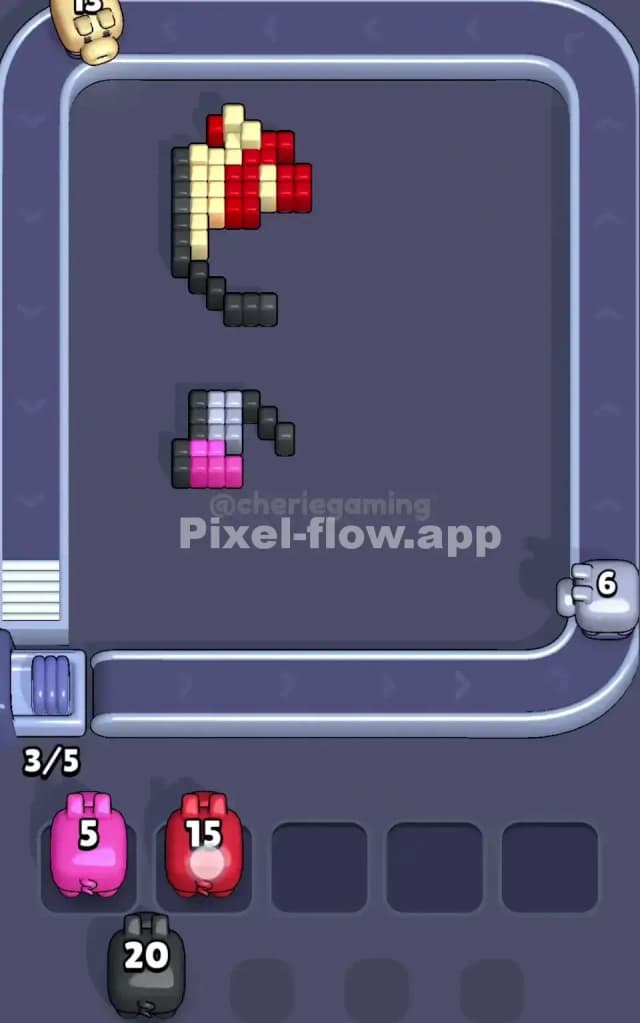
Midway through the level, the board often looks like a mess. The speech bubble will be half-eaten, perhaps leaving a jagged rim of Cream, and the cat face will be missing chunks of Grey.
At this stage, the danger is the Grey pig. The cat face is a massive block of Grey voxels. When a Grey pig arrives, do not waste it on the edges. Aim for the center of the cat’s face. You are trying to expose the Pink and Purple patches underneath or adjacent to the Grey.
If you refuse to use power ups, you must be disciplined about the "Waiting Slots." In Pixel Flow 172, you only have 5 slots.
- Scenario: You get a Purple pig, but the Purple ear is blocked by a Black outline pixel you missed.
- Action: Do not panic. Let the Purple pig drop into a slot.
- Follow-up: Immediately focus on the next pig that can clear that obstruction (likely Black or Grey). Once the path is clear, that waiting Purple pig will automatically jump back into action and empty its ammo.
The most common mistake in Pixel Flow 172 is ignoring the Pink and Purple specific zones. Players often clear the middle of the face and forget the ears. Then, a Pink pig arrives with 20 ammo and nowhere to shoot because the ear tips are still covered in Black. Always check the corners of the cat’s head.
Last Details You Clean Up in Pixel Flow Level 172
The end game is usually just the Red heart and the specific ear accents.
Once the Cream shield is gone, the Red heart is a very easy target. It sits high up and central. It rarely causes issues unless you failed to clear the Cream earlier.
The real cleanup difficulty comes from the Pink and Purple patches on the cat. These are small targets, consisting of only a few voxels each. If you have a pig with 10 ammo and only 4 target blocks remain, that pig will clear the blocks and then vanish (wasting the excess ammo). That's fine. The problem is if you have no targets.
Double-check the bottom row of pixels on the cat. Sometimes a stray Black or Grey pixel hides at the very bottom "chin" of the cat, obscured by the 3D perspective. Ensure the chin is clean so you don't get stuck with a 1-ammo pig clogging your final slot right before victory.