Pixel Flow Level 173 Solution Walkthrough | Pixel Flow 173
How to solve Pixel Flow level 173? Get instant solution for Pixel Flow 173 with our step by step solution & video walkthrough.


Pixel Flow Level 173 Overview
The Board Layout and Color Composition
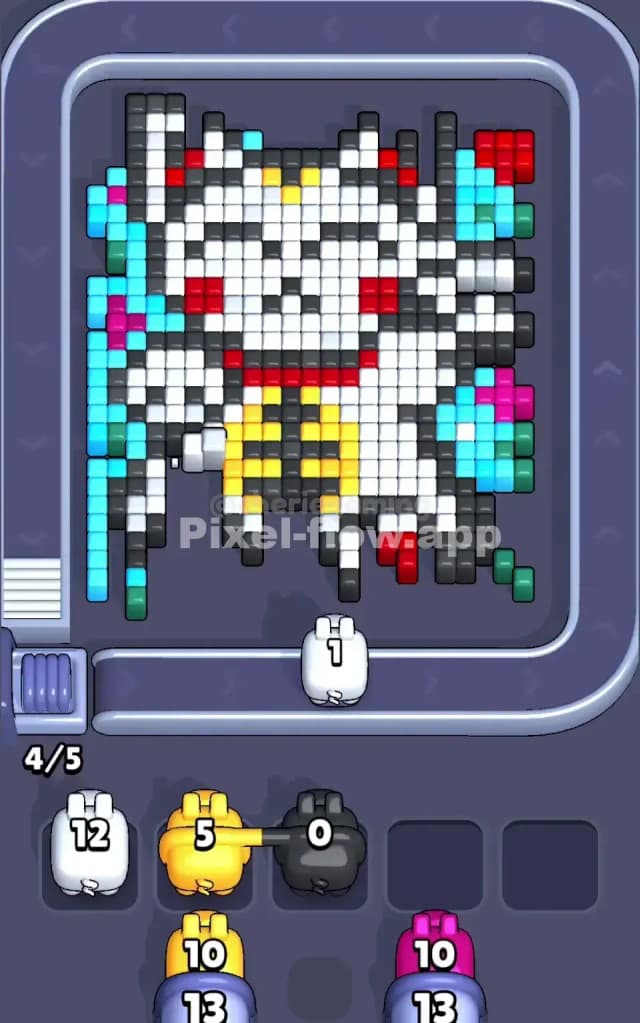
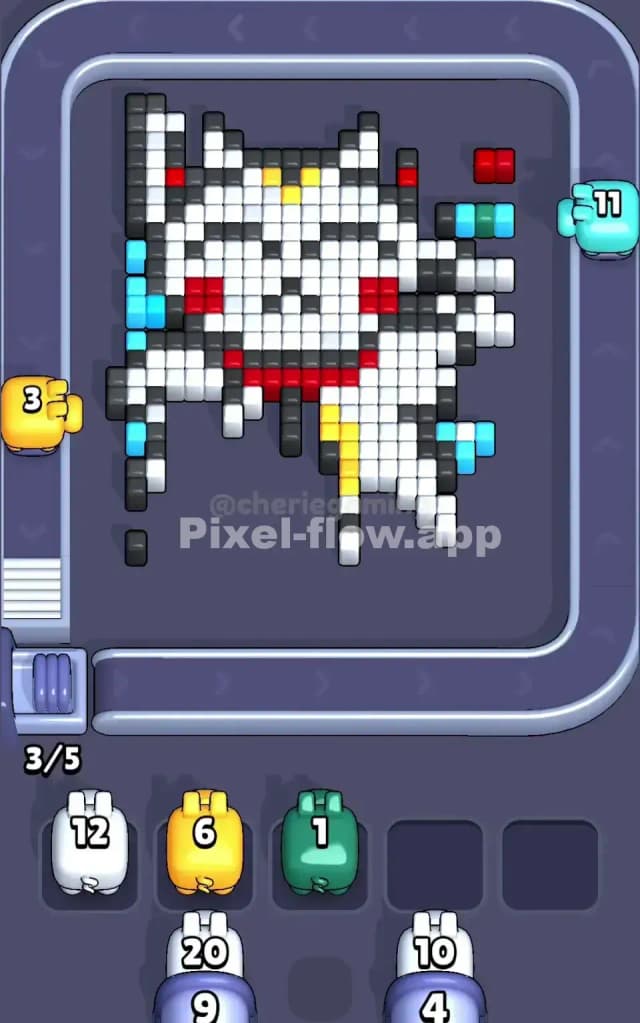
Pixel Flow Level 173 presents a dense, multi-layered pixel art scene with a commanding character or icon at its center. The board is dominated by cyan (light blue) cubes forming a thick border around the entire puzzle, with magenta (pink), white, black, gray, red, yellow, and green cubes creating intricate detail patterns throughout the middle section. You'll notice the cyan blocks are particularly abundant, especially along the left and right edges, creating a visual frame that suggests they'll be a major focus early on. The center features a striking concentration of white and black cubes forming what appears to be facial features or decorative elements, while yellow and red clusters sit slightly lower, adding visual weight to the composition. What makes Pixel Flow 173 challenging is that these colors aren't randomly scattered—they're stacked in layers, meaning you can't access certain hues until you've cleared the overlying cubes. The white blocks act as a dense choke point in the middle, and the sheer volume of cyan means you'll need significant ammo reserves to punch through the perimeter.
Win Condition and Deterministic Mechanics
To beat Pixel Flow Level 173, you must eliminate every single cube on the board. Your five waiting slots at the bottom will be filled by pigs in the order they appear on the conveyor belt, and each pig carries a fixed ammo count that never changes. This determinism is crucial—there's no randomness here, only strategy. You'll see three pigs queued up at the bottom with their ammo displayed (the counter shows 20, 20, and 20 for the first three), and you must orchestrate their release in an order that prevents any pig from becoming "stuck" with unspent ammo while all waiting slots are full. Success on Pixel Flow Level 173 hinges on planning two or three moves ahead and understanding how your pig sequence interacts with the color distribution on the board.
Why Pixel Flow Level 173 Feels So Tricky
The Cyan Bottleneck Problem
The biggest threat in Pixel Flow Level 173 is the sheer volume of cyan cubes scattered across the perimeter. Cyan dominates the left border, right border, and bottom sections, creating a situation where you might have cyan pigs arrive in quick succession, each demanding 20 ammo shots to clear their targets. If you send cyan pigs out without a solid plan, you risk burning through waiting slots faster than you can expose new colors beneath. The danger isn't just about ammo depletion—it's about waiting slots filling up with cyan pigs that still have ammo but no valid targets left to shoot. Once a pig exhausts its ammo or runs out of matching cubes, it drops into a waiting slot and occupies space. If all five slots are full and you have a pig with 15 ammo sitting idle because the last cyan cube is buried under white cubes, you're essentially locked. This is why cyan management is the linchpin of Pixel Flow Level 173.
Color Patches and Ammo Mismatches
A second major headache in Pixel Flow Level 173 involves the white and black cubes clustered densely in the center. These colors create awkward isolation zones where you might have, say, three red cubes visible but your red pig carries 20 ammo. If you deploy that red pig early, it'll clear the three visible red cubes and then drop into a waiting slot with 17 ammo still loaded—ammo that cannot be spent until you expose more red cubes deeper in the board. The yellow cluster presents a similar puzzle; there are yellow blocks both in the upper-middle and lower-middle sections, but they're separated by black and white, meaning a single yellow pig release won't hit all yellow targets in one pass. Additionally, the magenta cubes appear sporadically—corners and scattered positions—which means magenta pigs are easy to jam if you don't plan their release carefully.
The Personal Challenge and When It Clicks
Honestly, Pixel Flow Level 173 was frustrating the first two attempts because I kept sending pigs out reactively, watching the waiting slots fill with half-spent pigs, and then realizing I'd painted myself into a corner with no way to expose deeper layers. The breakthrough came when I sat back and counted—really counted—how many cyan, white, and black cubes were actually on the board, then mapped out which pig should go when to ensure every single pig either emptied completely or arrived when I needed to park it safely in a waiting slot. Once I accepted that Pixel Flow Level 173 required deliberate sequencing rather than instinctive firing, the solution became clear. The level "clicked" when I stopped thinking about individual pigs and started thinking about the five-slot buffer as a strategic resource to manage.
Step-by-Step Strategy to Clear Pixel Flow Level 173
Opening: Establishing Breathing Room
Start by identifying which pig is white or black—these are your safest opening moves for Pixel Flow Level 173 because the center of the board is packed with these colors, meaning a white or black pig will have targets immediately available and won't clog your waiting slots prematurely. Release your white or black pig first, burn through a large chunk of ammo, and keep at least two waiting slots empty at this stage. As those cubes are eliminated, you'll expose the colors layered beneath them, which opens up multiple paths forward. Avoid launching your cyan pig right away, even though cyan is everywhere—you want to expose internal layers first so that when cyan pigs do arrive, their ammo lands on deep board cyan rather than surface cyan. This prevents the wasteful scenario where a cyan pig clears only a handful of visible cubes and then sits idle. Your goal in the opening phase of Pixel Flow Level 173 is to carve out the central white and black core, reducing visual clutter and revealing the secondary layers of color you'll need to sequence later.
Mid-Game: Layering and Ammo Precision
Once you've established breathing room, focus on cyan in earnest—but do it strategically. Release cyan pigs in a sequence that targets both the perimeter blocks and any newly exposed internal cyan. Watch your waiting slots: if you've got two cyan pigs queued and both carry 20 ammo, don't fire them back-to-back unless you've confirmed there are at least 40 distinct cyan cubes still on the board in Pixel Flow Level 173. If there are only 35, the second cyan pig will spend 15 ammo and then drop into a waiting slot partially full, which is wasteful. This is where counting becomes essential. Between cyan pushes, interleave your red, yellow, magenta, and green pigs to expose and eliminate their respective target clusters. Red appears in the middle and lower sections, so deploying red after you've cleared some white obstruction makes sense. Yellow sits in a concentrated band, so a single yellow pig release should vaporize most yellow cubes at once—plan it for after you've cleared the overlying black and white. By mid-game in Pixel Flow Level 173, you should have used at least two waiting slots, parked at least one half-spent pig safely, and exposed most of the internal color layers. Keep refreshing your mental inventory: how many cyan cubes are left? How many red? Are all visible yellow exposed, or are there more underneath? This constant assessment prevents the jamming disaster.
End-Game: Finishing Clean
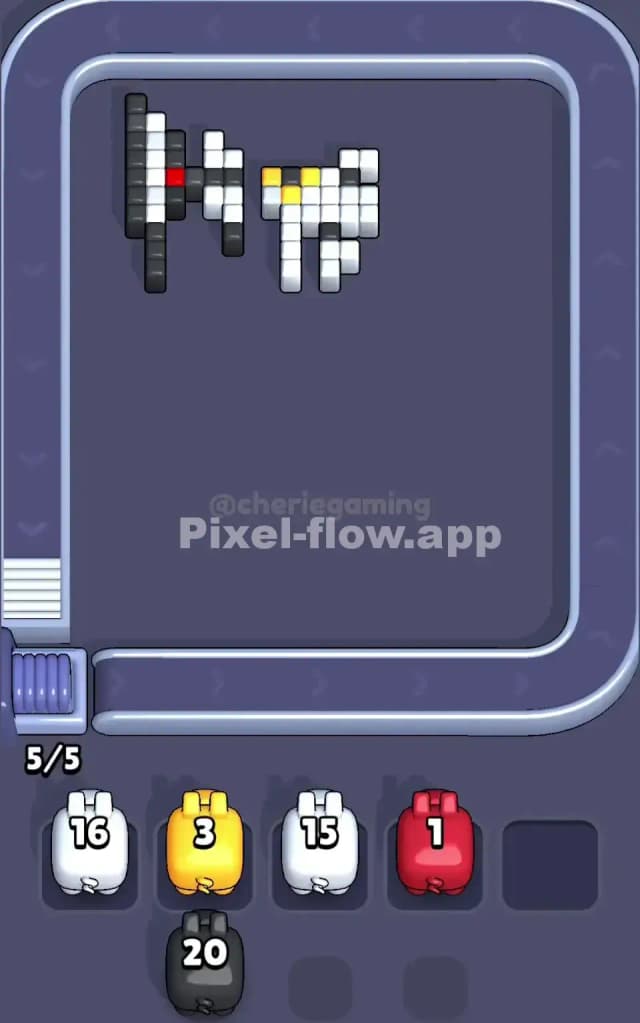
The final phase of Pixel Flow Level 173 is where precision matters most. You'll have fewer and fewer cubes remaining, but they'll be scattered and require careful pig ordering to avoid leaving a single stray cube of some color with no pig left to shoot it. Ideally, your last three or four pigs should be carefully timed so that each one either empties completely or comes out just as the waiting slots clear. If you have a magenta pig with 8 ammo and you can see exactly 8 magenta cubes remaining, that's your signal to release it—it'll finish perfectly and free up a waiting slot. If you have cyan with 5 ammo but only 4 cyan cubes visible, hold off; wait for a different color pig to expose that final cyan cube, then send your cyan pig. The absolute worst mistake in the end-game of Pixel Flow Level 173 is having all five waiting slots full with pigs that still have ammo but no valid targets, forcing a restart. Avoid this by releasing pigs only when you can confirm targets exist, and by deliberately parking half-spent pigs in waiting slots as "spacers" so you retain flexibility. Your last pig should be the one that clears the final cube—there's a satisfying symmetry to that, and it means you've solved Pixel Flow Level 173 perfectly.
The Logic Behind This Pixel Flow Level 173 Plan
Systematic Ammo Accounting
This strategy works because it treats Pixel Flow Level 173 not as a seat-of-your-pants puzzle but as a deterministic puzzle with fixed inputs and outputs. Every pig has an ammo count, every color has a cube count, and the waiting slots are a finite resource. By counting cubes before releasing pigs, you remove guesswork. If you know there are 47 cyan cubes and your first two cyan pigs carry 20 and 20 ammo respectively, you know the second cyan pig will have 7 ammo leftover. That leftover ammo must be spent on a third cyan pig release or absorbed by parking the second pig in a waiting slot. This methodical accounting is what separates success from failure on Pixel Flow Level 173. You're not hoping the pigs work out—you're engineering them to work out by respecting the math.
Queue Management and Lookahead
The power of planning two or three pigs ahead is that you avoid reactive panic. When you stare at the Pixel Flow Level 173 board and see your waiting slots filling, if you've already mentally mapped out the next three pigs and their targets, you stay calm. You know that pig four is magenta with 20 ammo and there are 25 magenta cubes scattered throughout, so pig four will definitely find targets and park successfully. You know pig five is red and will clean up the remaining red cubes. This confidence comes from counting, from writing out (mentally or on paper) your pig sequence and ammo plan before you execute it. Pixel Flow Level 173 rewards this deliberate, forward-thinking approach—it punishes hasty button-mashing. Stay patient, count your cubes, plan your pigs, and watch how smoothly Pixel Flow Level 173 unfolds. The level isn't actually that difficult; it just demands respect and strategy.