
Pixel Flow Level 177 Solution | Pixel Flow 177 Walkthrough
How to beat Pixel Flow Level 177: Video solution & walkthrough. The fastest way to pass Pixel Flow 177.
Is this the wrong level layout?🤔
Pixel Flow randomizes levels for different players. Don't worry, just upload a screenshot of your board, and our AI will find the correct video instantly.

Pixel Flow Level 177 Walkthrough
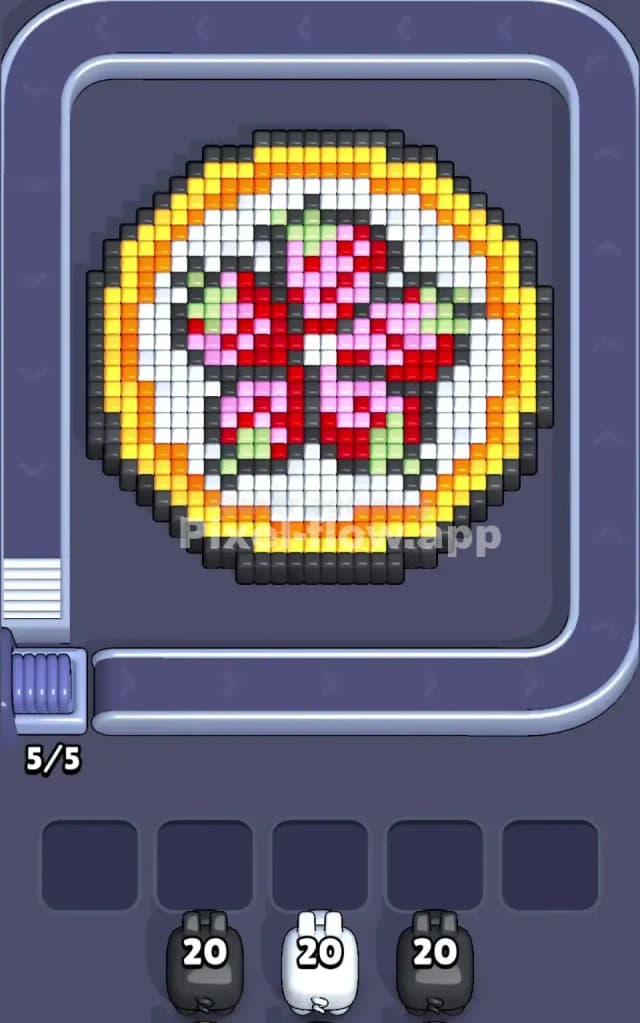
Pixel Flow Level 177 is what I call an "Onion Level." You are looking at a top-down view of a pixelated sushi roll—specifically a maki roll. The outer layer is a hard shell of dark grey (nori seaweed), followed by a ring of yellow/orange, then a mass of white rice, and finally a complex center of red, pink, and green fillings.
The rules here are brutal but simple. You cannot hit the inner colors until you peel away the outer layers. Because the dark grey ring completely encircles the board, you have zero shot at the red or green pixels initially. You must prioritize the outer shell. If you fill your five waiting slots with colors that are buried deep inside the sushi (like green or pink), you will choke your board and lose. Is this a hard level? Yes. I would classify it as very hard simply because one or two bad picks in the first ten seconds can ruin the run.
Pixel Flow Level 177 Overview
Imagine a giant piece of sushi floating on a conveyor belt. That is exactly what Pixel Flow Level 177 is. The artwork is dense and circular.
On the very outside, you have a thick, protective ring of dark grey cubes. This represents the seaweed wrapper. It is the gatekeeper. Immediately inside that is a decorative ring of yellow and orange pixels. These are bright and annoying because they sit between the wrapper and the main body.
The bulk of the level is the white "rice" layer. It takes up nearly 40% of the visible pixels. Buried deep in that white field is a floral-looking pattern of pink and red (the fish) and small accents of green (vegetables/wasabi).
The visual layout is roughly symmetrical, but that doesn't help you much. The challenge isn't finding the pixels; it's accessing them. The board is a fortress. You are trying to lay siege to the castle, but you can’t storm the throne room (the red center) until you knock down the outer walls (the grey and yellow rings).
Step by step solution walkthrough for Pixel Flow Level 177
First Color Zone to Erase in Pixel Flow Level 177
You have no choice here. You must attack the Dark Grey Outer Ring.
Narratively, you have to eat the wrapper before you get to the rice. Logically, the game physics demand it. If you look at the board state at the start, every single inner color is shielded.
Here is the trap: The conveyor belt will tease you with Pink, White, or Green pigs early on. Do not take them. If a White pig comes down the belt and you have an empty slot, let it loop around. Do not put it in your holding tray unless you have absolutely no other moves. You need Black/Dark Grey pigs exclusively for the first minute.
Look at the bottom of the screen. If you have three Black pigs with 20 ammo each, you are in a great spot. Place them anywhere on the perimeter. Since it’s a ring, a Black pig placed on the left edge will just shoot straight into the left wall of the sushi. That’s fine. You just need to create a breach. Once one section of the wall is gone, you can start firing at the yellow layer beneath it, but focus on clearing that dark grey perimeter completely first. It simplifies your mental load.
How to pass Pixel Flow Level 177 without power ups or boosters
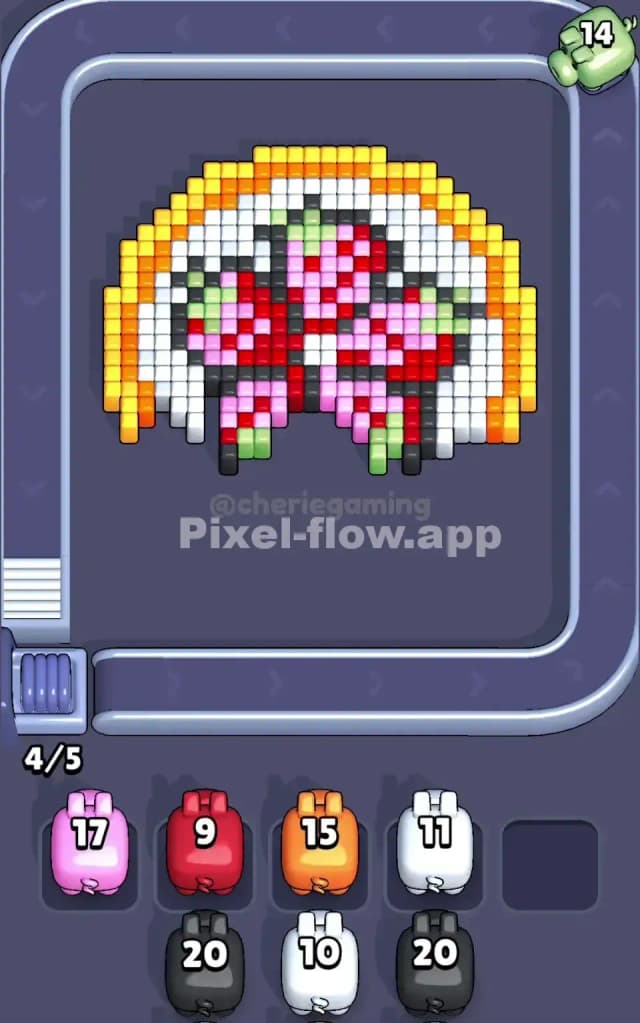
Mid-game is where Pixel Flow Level 177 gets messy. You’ve likely broken the dark grey seal, and now the sushi looks half-eaten. You will see a jagged crescent of yellow and orange, and a lot of exposed white rice.
The temptation now is to grab any color that matches anything you see. Don’t do that. Stick to the "Peel the Onion" strategy.
- Prioritize the Yellow/Orange Ring: Even if you can see the white rice, try to clear the yellow border first. Why? Because the yellow ring is thin. A single high-ammo pig (like an Orange 20) can often wipe out half the ring in one go. If you ignore the yellow ring to chase the white rice, you leave "stray pixels" on the edges that block your shots later.
- The White Whale: Once the yellow is mostly gone, you need White pigs. The white section is massive. You will need multiple high-ammo White pigs (20s or 30s) to clear this. If you see a White pig on the belt, grab it. Prioritize White over the inner colors (Red/Pink) because the White blocks the center.
- Slot Discipline: If your slots are filling up with Green and Pink pigs but the white rice is still covering the center, you are in trouble. You have to discard or play sub-optimally to free up space. Ideally, keep 2 slots open at all times for the color you are currently focusing on (White).
Last Details You Clean Up in Pixel Flow Level 177
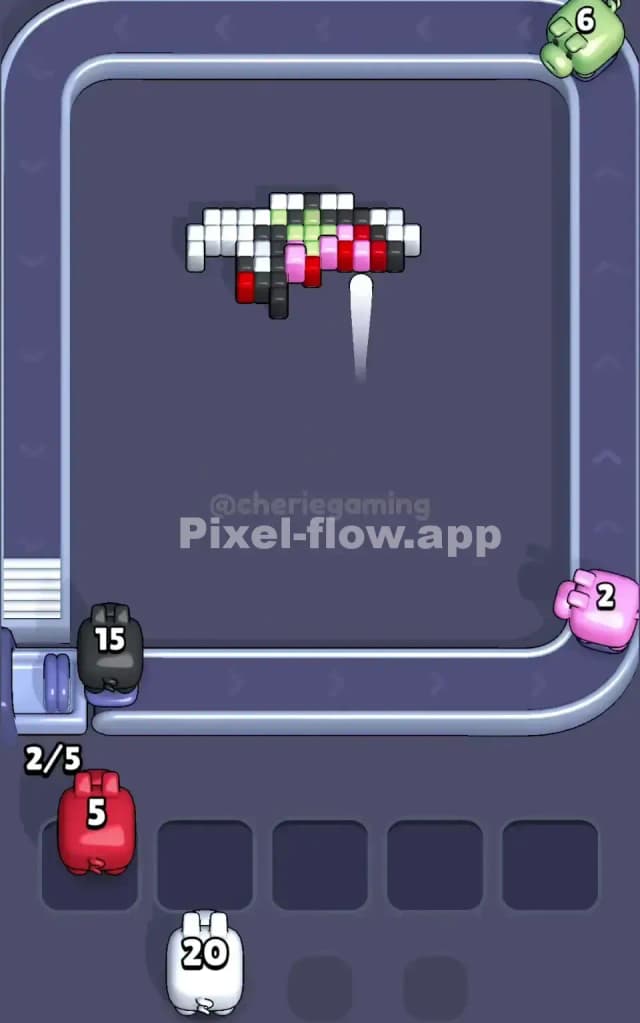
The end game of Pixel Flow Level 177 is a colorful mess in the center. The rice is gone. The seaweed is a distant memory. All that remains is the "filling": chunks of Red, Pink, and Green.
This part is tricky because the shapes are irregular. The green pixels are small "leaves" or cucumber slices, often only 3 or 4 blocks big. A Green pig with 20 ammo is overkill here; it will shoot 4 blocks and waste 16 ammo. That’s acceptable now. Don't try to be efficient with ammo at this stage; just try to clear the board.
Watch out for the Pink vs. Red confusion. In the heat of the moment, the dark pink and light red look very similar. Double-check which pig you are grabbing. Usually, the Red forms the darker core of the flower shape, while the Pink is the petals. Clear the Pink first if you can, as it usually surrounds the Red. The Green bits are usually isolated on the edges of the flower pattern—save them for last or snipe them whenever a small Green pig appears. Once those last veggie bits vanish, the level is yours.

