Pixel Flow Level 193 Solution | Pixel Flow 193 Walkthrough
How to beat Pixel Flow Level 193: Video solution & walkthrough. The fastest way to pass Pixel Flow 193.
Is this the wrong level layout?🤔
Pixel Flow randomizes levels for different players. Don't worry, just upload a screenshot of your board, and our AI will find the correct video instantly.


Pixel Flow Level 193 Walkthrough
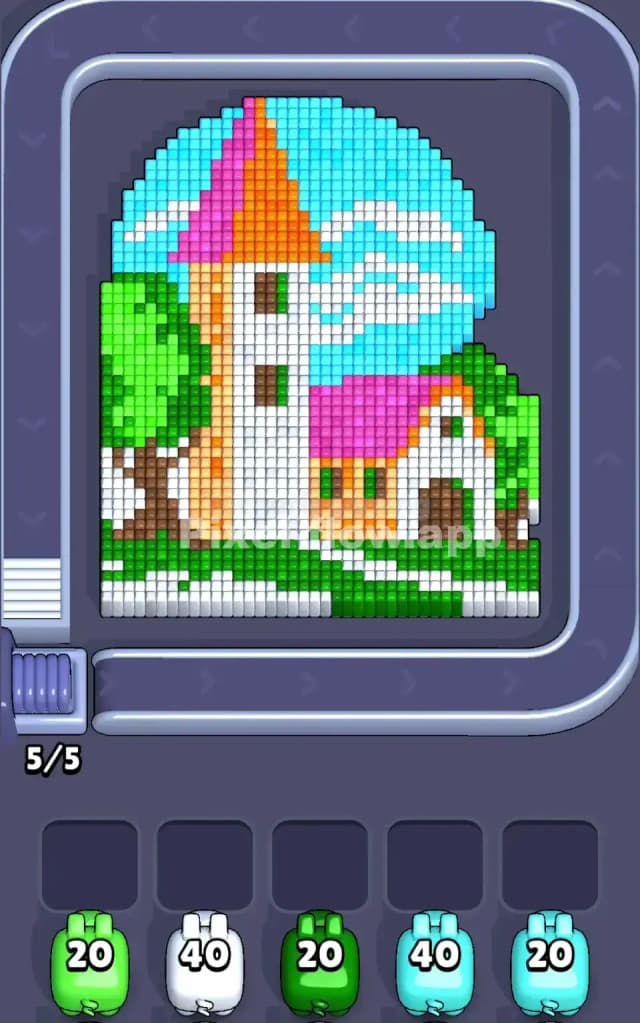
This level features a scenic medieval landscape. You are looking at a tall white watchtower on the left and a smaller cottage on the right, both set against a massive backdrop of light blue sky. The scene is framed by heavy green foliage on the sides and a strip of grass and white path along the bottom.
To beat Pixel Flow Level 193, you simply need to peel back the layers of the sky and trees to reveal the full structures of the buildings. You must prioritize the massive background colors (blue and green) to stop your waiting slots from filling up with useless ammo for the detailed house parts.
Is this a tough one? Honestly, it is not a very hard level. It looks intimidating because the white blocks are scattered everywhere—in the clouds, the walls, and the ground—but the layers are distinct enough that you won't get stuck often.
Pixel Flow Level 193 Overview
The artwork here is a classic fairytale setup. On the left side, you have a tall, skinny tower topped with a cone-shaped roof that splits into pink and bright orange. It feels vertical and imposing. To its right, there's a squat, cozy cottage with a similar pink roof and a dark brown door.
The environment is what eats up your ammo. The background is a solid wall of Light Blue sky, interrupted by fluffy White cloud patches. The ground is a checkerboard of Light Green grass and Dark Green shadows, with a stark White path running across the bottom edge.
Asymmetry is huge here. The left side is heavy with the tower's height, while the right side is lower but denser with the cottage details. The trees act as "bookends" on the far left and far right, pushing the buildings into the center. This means you have to work from the outside in. The edges are green; the center is white and orange.
Step by step solution walkthrough for Pixel Flow Level 193
First Color Zone to Erase in Pixel Flow Level 193
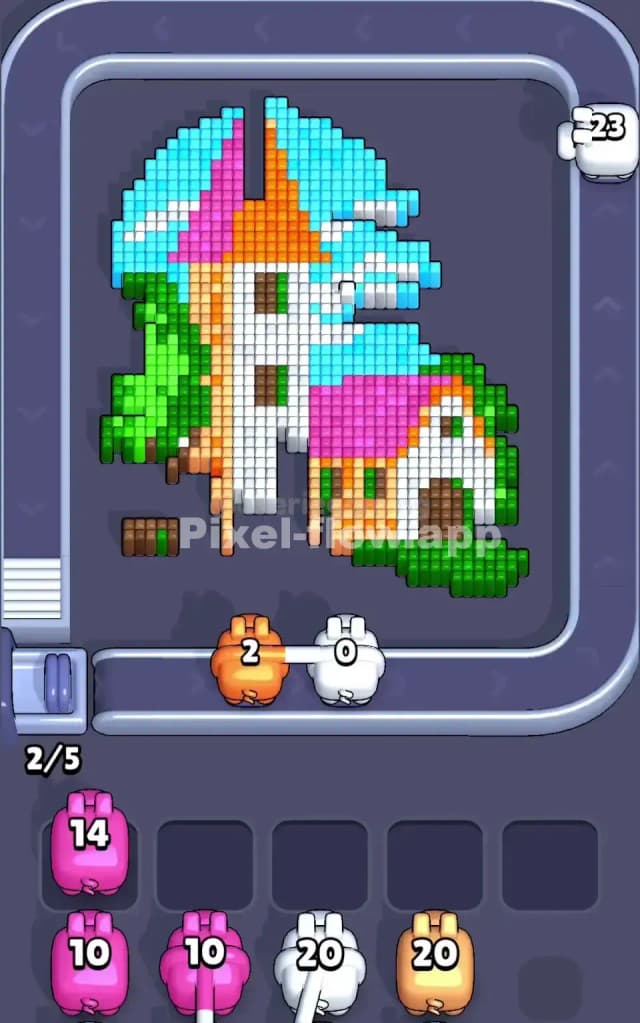
I start by attacking the Light Green foliage and the Light Blue sky.
Narratively, this makes sense because you are clearing the "atmosphere" to see the buildings. Logically, it is critical because these two colors represent the largest surface area on the board. The Light Blue sky blocks are massive, continuous chunks. If you get a Blue pig, you can likely empty its entire magazine in one go.
The Light Green is slightly trickier because it's broken up. You have a clump on the far left (the tree covering the tower base), a clump on the far right (the tree over the cottage), and the grass strip at the bottom. Focus on the bottom grass strip first. It clears the "floor" of the level and ensures that any subsequent Green pigs have a clear line of sight to the side trees. If you ignore the grass, stray Green pixels at the bottom will block your shots at the upper trees later.
How to pass Pixel Flow Level 193 without power ups or boosters
Once the sky and the outer trees are gone, you hit the "half-destroyed" phase. This is the danger zone. The picture now looks like two floating white skeletons of buildings with colorful hats. The background is gone, so missed shots will just fly into the void.
At this stage, your biggest enemy is the White ammo.
In Pixel Flow 193, White is dangerous because it belongs to three different objects:
- The clouds (which you should have cleared with the sky).
- The path at the bottom.
- The actual walls of the tower and cottage.
When you see White pigs coming down the belt, check your line of sight. If the Pink or Orange roof tiles are overhanging and blocking the White walls, do not click the White pig. Let it pass or wait. If you click it, it will drop into a slot and sit there, unable to hit the walls because the roof is in the way.
Focus on clearing the Pink and Orange roofs next. These are the "lids" of the buildings. By shaving them off, you expose the top edges of the White walls. This turns those dangerous White pigs into useful ones. Clear the roof, then hammer the white walls.
Last Details You Clean Up in Pixel Flow Level 193
The final cleanup is almost always the Dark Brown and Dark Green bits that were hiding deep inside the structure.
Specifically, look for the windows on the tower and the door on the cottage. These are Brown voxels surrounded by White walls. Often, you can't hit them until the front face of the white wall is gone. You will likely end up with a Brown pig sitting in a slot for a long time. That’s okay. Just make sure you don't have three Brown pigs clogging your slots.
The last thing to vanish will be the tiny Dark Green shadows that were part of the trees. They often hide behind the lighter green leaves you cleared at the start. Once those darker accents are gone, the level is yours.