Pixel Flow Level 197 Solution | Pixel Flow 197 Walkthrough
How to beat Pixel Flow Level 197: Video solution & walkthrough. The fastest way to pass Pixel Flow 197.
Is this the wrong level layout?🤔
Pixel Flow randomizes levels for different players. Don't worry, just upload a screenshot of your board, and our AI will find the correct video instantly.
Pixel Flow Level 197 Walkthrough
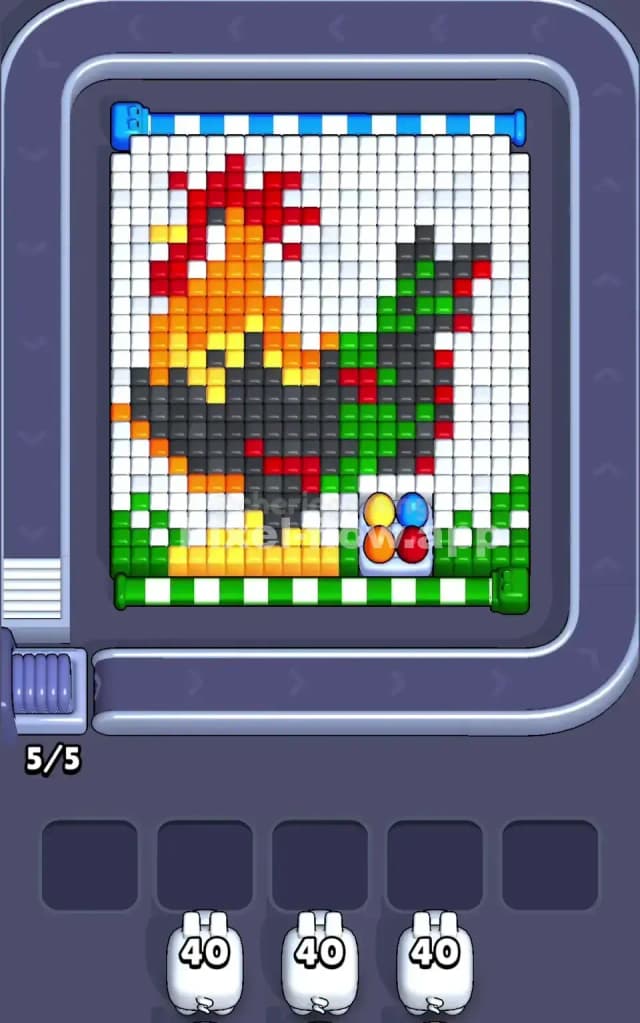
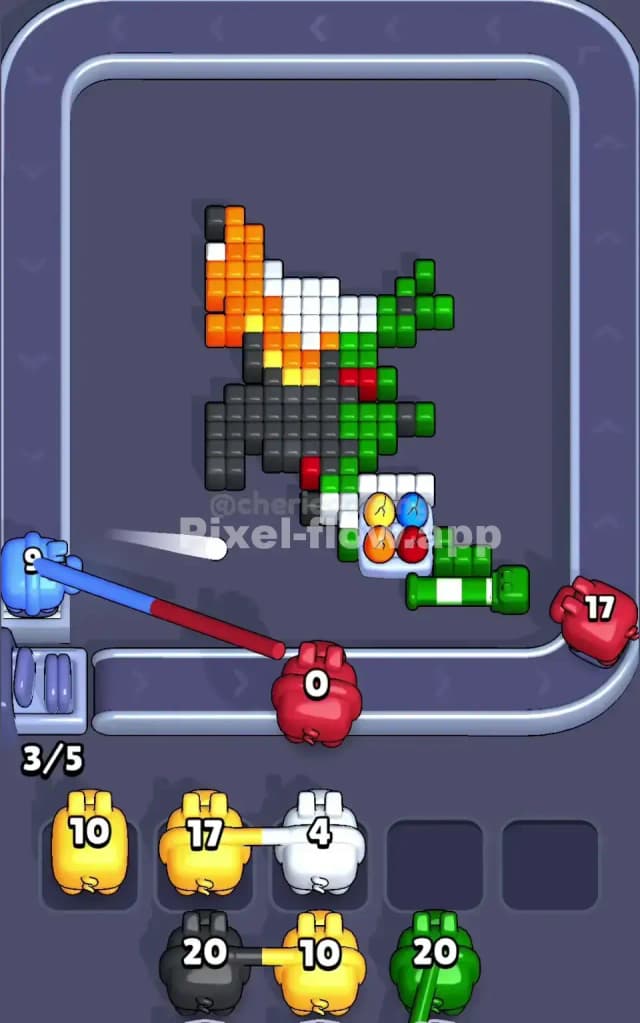
This level features a large, pixel-art Rooster standing on a patch of grass, complete with a small basket of eggs in the corner. The colors are vibrant—lots of White, Orange, Red, Black, and Green. The main challenge here isn't the total number of blocks, but how the colors are interleaved in the tail feathers and the egg basket.
The rule to beat Pixel Flow Level 197 is patience with your slot management. You have five holding slots. If you fill them with pigs that have 40 ammo but only 2 valid targets on the board, you are dead in the water. You need to verify that a color is actually accessible on the top layer before you tap that pig.
My verdict: This is not a very hard level. It looks intimidating because of the complex tail pattern, but the layers are generous. If you strip the outer layers logically, the inner core takes care of itself.
Pixel Flow Level 197 Overview
The artwork depicts a classic farm scene. You have a rooster facing left, puffing out its chest. The background is a massive field of White pixels representing the empty canvas or sky.
The rooster itself is segmented distinctly:
- The Head & Neck: A mix of bright Red for the comb and wattle, blending into a large block of Orange for the neck feathers.
- The Body: A solid chunk of Black pixels forms the wing and underbelly.
- The Tail: This is the messy part. It’s a checkerboard of Green and Black, with tiny specks of Red thrown in for detail. This area is dangerous because the colors don't form solid blocks.
- The Base: A strip of Green grass runs along the bottom.
- The Trap: In the bottom right corner, sitting on the grass, is a 2x2 basket of eggs. These are Yellow, Blue, Orange, and Red. This tiny area is an asymmetry trap because it demands four different colors for a very small pixel count.
The board feels top-heavy with that White background, but right-heavy with the complex Green/Black tail patterns. Your eyes naturally go to the bright Orange neck, but that’s not where the danger lies. The danger is in the tail and the eggs.
Step by step solution walkthrough for Pixel Flow Level 197
First Color Zone to Erase in Pixel Flow Level 197
You absolutely must start with White.
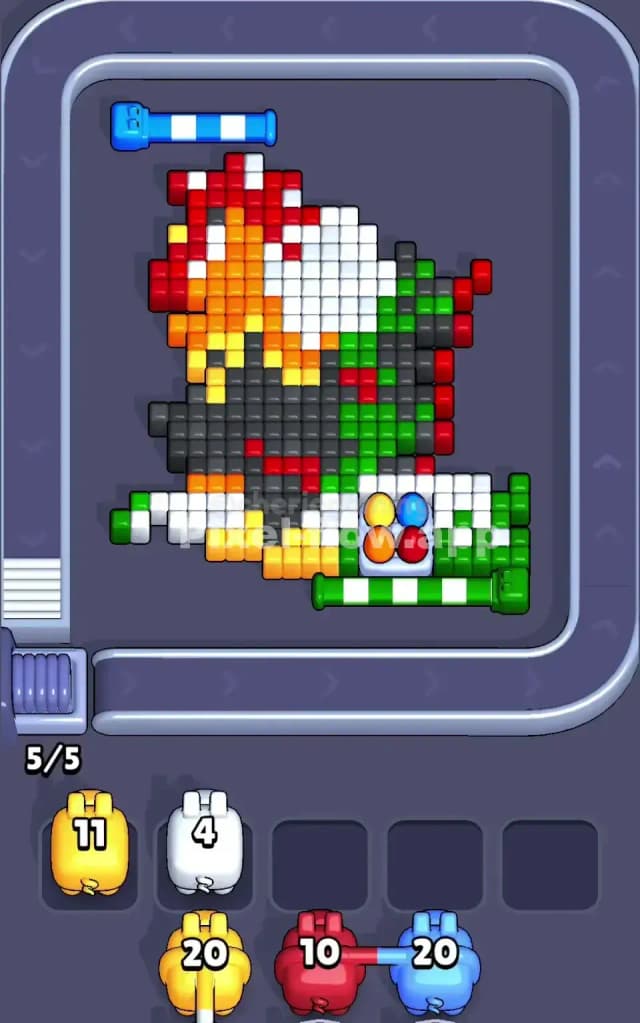
Look at the board. The White pixels form a thick wrapper around the entire rooster. They cover the edges of the comb, the back of the tail, and the grass. Until you remove this White layer, almost no other color is fully accessible.
If you try to grab a Red pig early to hit the comb, you might hit three pixels and then realize the rest are buried under White blocks. Now that pig is stuck in your slot with 30 ammo, clogging up your workflow.
Grabbing the White pigs first is the only logical play. It clears the board periphery. It exposes the jagged edges of the Green tail and the Red comb. It essentially "unwraps" the puzzle. Plus, the White areas are huge continuous blocks. You can drain a White pig’s ammo bar in seconds, keeping your slots empty and your cycle fast.
How to pass Pixel Flow Level 197 without power ups or boosters
Once the White background is gone, the level enters its mid-game phase. This is where people lose Pixel Flow Level 197. The rooster will look half-destroyed. You’ll see the skeleton of the image: the Black body and the Orange neck.
Here is how you survive without boosters:
- Target the Solids First: Ignore the tail for a moment. Look at the Orange neck and the Black body. These are large, solid clusters. If you see an Orange or Black pig, take it. You are guaranteed to dump huge amounts of ammo here because the pixels are clustered together. Clearing these big chunks opens up the layers beneath them.
- The Green Grass Buffer: Before you get fancy with the tail, clear the Green grass at the bottom. Why? Because the grass connects to the bottom of the tail feathers. Clearing the grass usually finishes off a Green pig's ammo, allowing you to cycle it out before you have to deal with the tricky single-pixel Green spots in the tail.
- Watch the Red: The Red pixels are tricky. They exist in the comb (top head) and as tiny dots in the tail. Before you grab a Red pig, check if the tail dots are exposed. If they are still covered by Green or Black feathers, wait. You don't want a Red pig idling while you desperately try to clear the blocking feathers.
Last Details You Clean Up in Pixel Flow Level 197
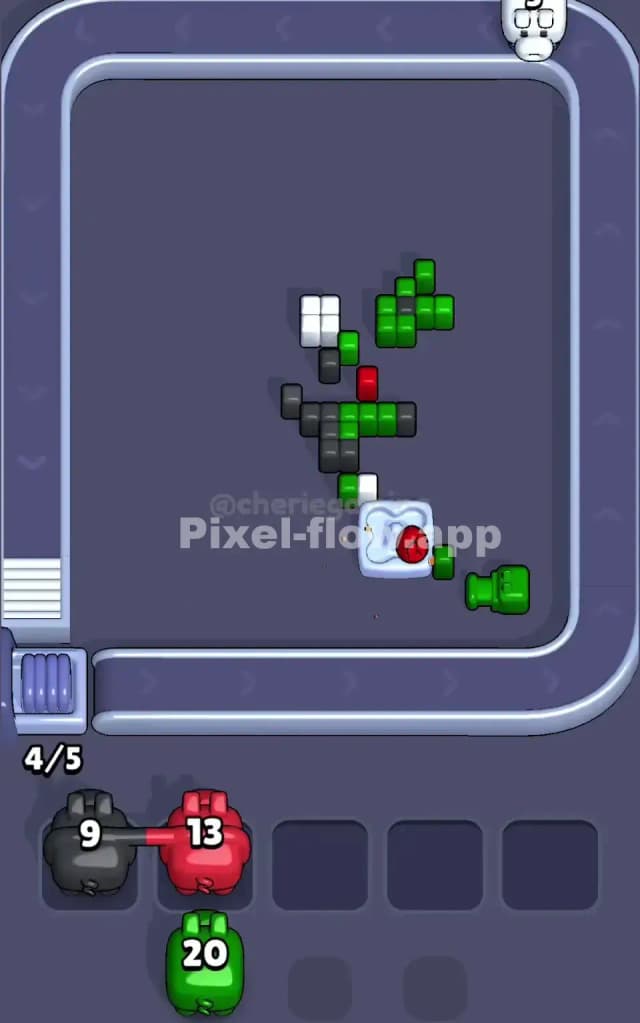
The end game of Pixel Flow 197 is almost always the Egg Basket and the Tail Tips.
The Egg Basket in the bottom right is annoying. It usually has one Blue pixel, one Yellow, one Red, etc. You will likely end up with a Blue pig in your slot just to hit that one single Blue egg. That is fine, as long as it's the last thing you do.
Don't panic if you have pigs sitting in slots with only 2 or 3 ammo left. At this stage, that's normal. Just make sure you prioritize the Green and Black mix in the tail. This checkerboard pattern often hides one or two pixels of a different color underneath.
Your final moves will likely be:
- Clearing the last ragged Green feathers.
- Populating your slots with the specific colors needed for the egg basket.
- Watching the last pig snipe that single Blue or Yellow egg to finish the level.