
Pixel Flow Level 200 Solution | Pixel Flow 200 Walkthrough
How to beat Pixel Flow Level 200: Video solution & walkthrough. The fastest way to pass Pixel Flow 200.
Is this the wrong level layout?🤔
Pixel Flow randomizes levels for different players. Don't worry, just upload a screenshot of your board, and our AI will find the correct video instantly.

Pixel Flow Level 200 Walkthrough
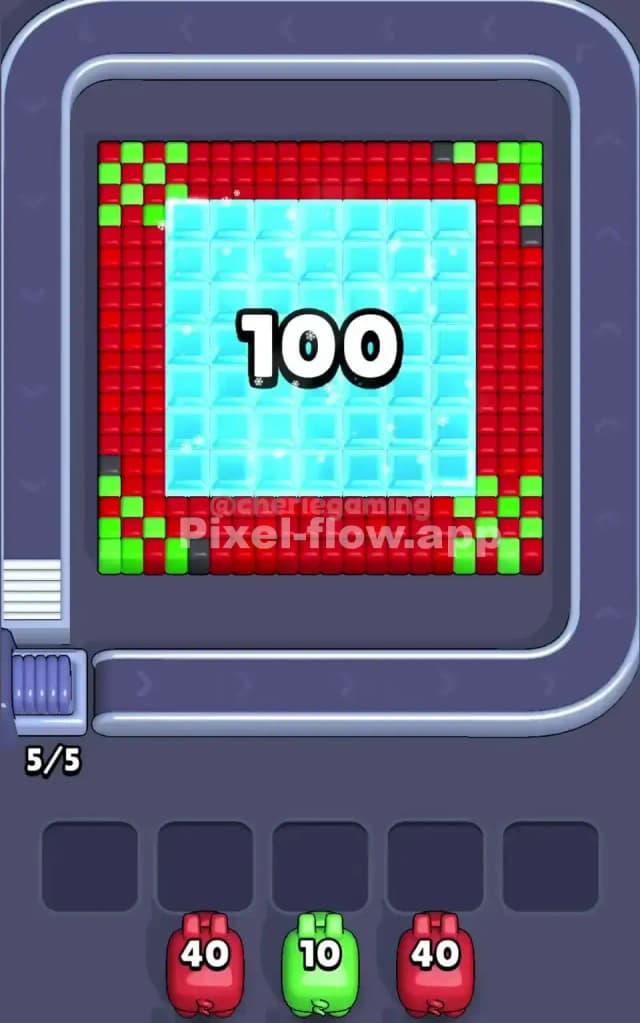
This is a milestone level, and the game throws a massive obstacle right in your face to celebrate. You are looking at a giant, frozen vault. The center of the board is dominated by a massive, light blue Ice block with the number 100 stamped on it. You cannot shoot through this. Surrounding this ice block is a thick frame of Red pixels, with the corners decorated in a Green checkerboard pattern mixed with tiny Black dots.
To beat Pixel Flow Level 200, you have to peel the outer frame to reach the "meat" of the level hidden underneath that ice. The ice acts as a shield; you generally have to clear the colored pixels around it to make progress. Is it hard? Yes. The high ammo counts on the Red pigs (40 shots!) mean that if you make a mistake, that pig sits in your tray forever. I judge this as a very hard level because of the patience required to dismantle the frame without clogging your slots.
Pixel Flow Level 200 Overview
Think of this level as an archaeological dig. You aren't just painting a picture; you are breaking into a safe. The outer layer is completely abstract—just a holiday-colored box of Red and Green wrapping paper protecting that 100-count Ice block. It feels static and heavy.
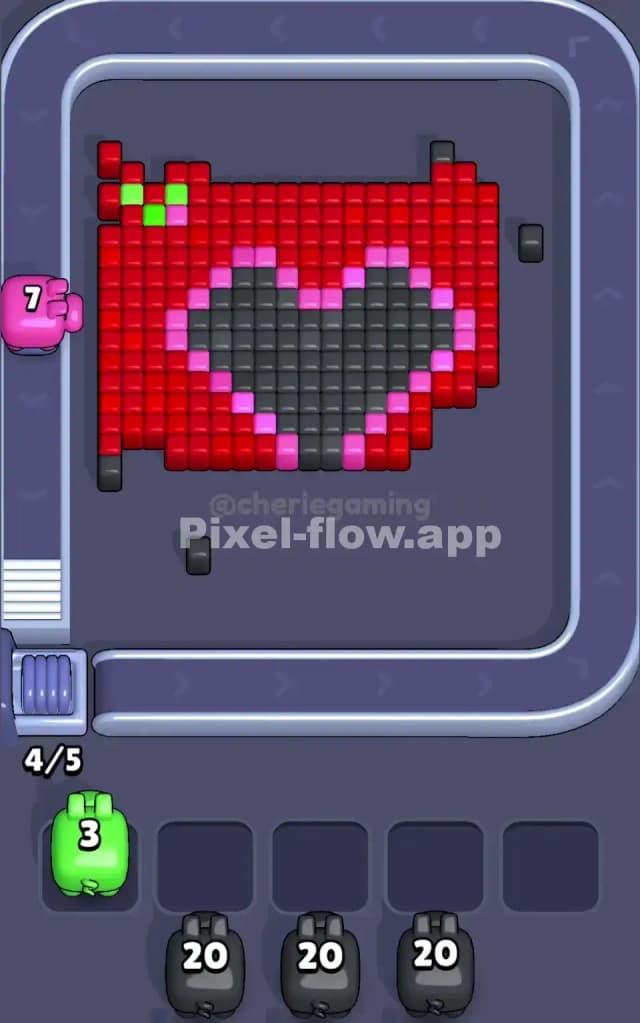
However, once you strip away that geometric border and the ice clears, the vibe shifts completely. Underneath that frozen exterior is a creature profile—specifically, a Red Dragon head facing the right side of the screen. This inner layer is jagged and organic, unlike the square border. You’ll see a massive block of Red for the head, bright Green pixels for the eyes, a jagged Black area representing the mouth or teeth, and a streak of Pink running along the lower jawline.
The asymmetry here is dangerous. The outer frame is perfectly symmetrical, lulling you into a rhythm. The inner dragon is not. The mouth (Black) and neck details (Pink) are lower down and specific to certain columns. If you play symmetrically on the second half, you will lose.
Step by step solution walkthrough for Pixel Flow Level 200
First Color Zone to Erase in Pixel Flow Level 200
You have no choice but to attack the Red border first. Look at your starting lineup: you likely have Red pigs with massive ammo clips (40). This is a blessing and a curse.
I start by focusing entirely on the vertical Red columns on the far left and far right. Do not worry about the Green corners yet. The logic is simple: the Red border is the thickest part of the outer shell. You need to dump that 40 ammo immediately. If you try to get cute and snipe the Green corner pixels, you might end up with a Red pig in your slot that has no valid targets because the belt moved past the Red zones. Clear the Red sides to open up the board.
How to pass Pixel Flow Level 200 without power ups or boosters
The mid-game is where the panic sets in. You’ve cleared the frame, the "100" ice block has shattered or vanished, and now you are staring at the Red Dragon. This is where the game tries to kill you.
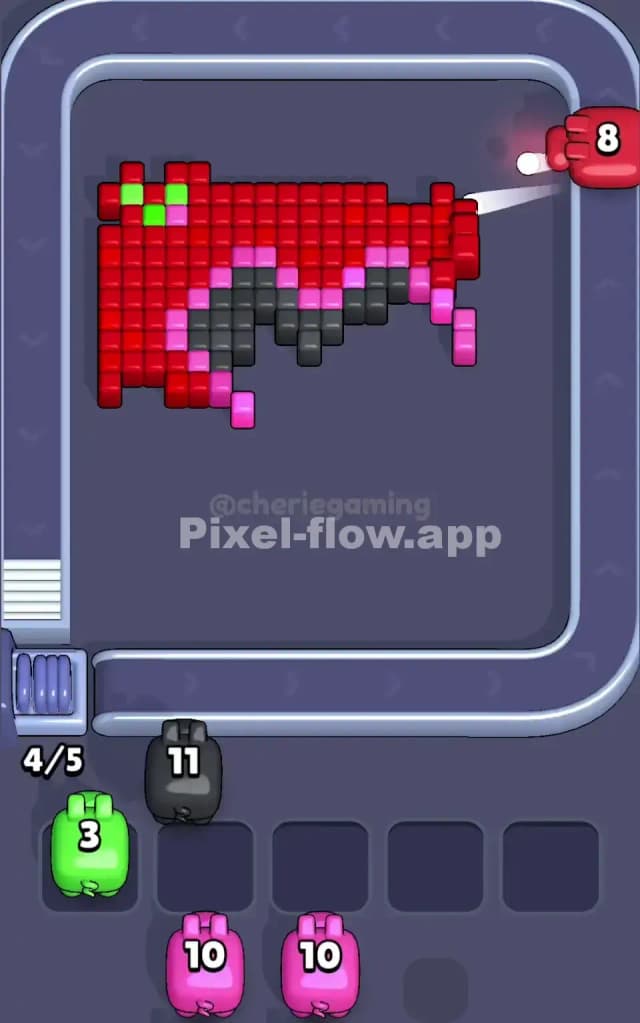
You will see pigs for the inner colors: Pink (10 ammo), Black (11 ammo), and Green (3 ammo). The trap is the Red body of the dragon. It covers the Black mouth and Pink jaw.
To survive without items, you must prioritize vertical drilling. You need to clear the Red pixels that are directly above the Black and Pink zones. If a Black pig comes down the chute and the Black mouth is still covered by a layer of Red scales, that Black pig will drop into your slot. He is useless until the Red is gone.
So, the strategy shifts. Ignore the easy Red blocks on the back of the dragon's head. Focus all your fire on the front of the face and the neck area. You need to expose the Black and Pink pixels before those specific pigs clog your waiting area. If you see a Pink pig coming, stop shooting Red elsewhere and clear the path to the pink jaw immediately.
Last Details You Clean Up in Pixel Flow Level 200
By the end, the dragon looks like a skeleton. The massive Red bulk is gone. You are likely left with two distinct problem areas: the Green eyes and the Pink neck scales.
The Green eyes are tricky because they are small—often just 2 or 3 pixels. You might get a Green pig with 10 ammo. If you shoot the eyes, you have 7 ammo left and zero targets. This is the final fail state. Ensure you have at least one empty slot reserved for this "waste" pig. Do not fill your last slot trying to clear the Pink jaw if you know a Green pig is about to strand itself. Eat the penalty, let the Green pig sit in the slot, and use your remaining slots to finish off the Pink and Black pixels to close out Pixel Flow Level 200.