Pixel Flow Level 204 Solution Walkthrough | Pixel Flow 204
How to solve Pixel Flow level 204? Get instant solution for Pixel Flow 204 with our step by step solution & video walkthrough.


Pixel Flow Level 204 Overview
The Board Layout and Visual Design
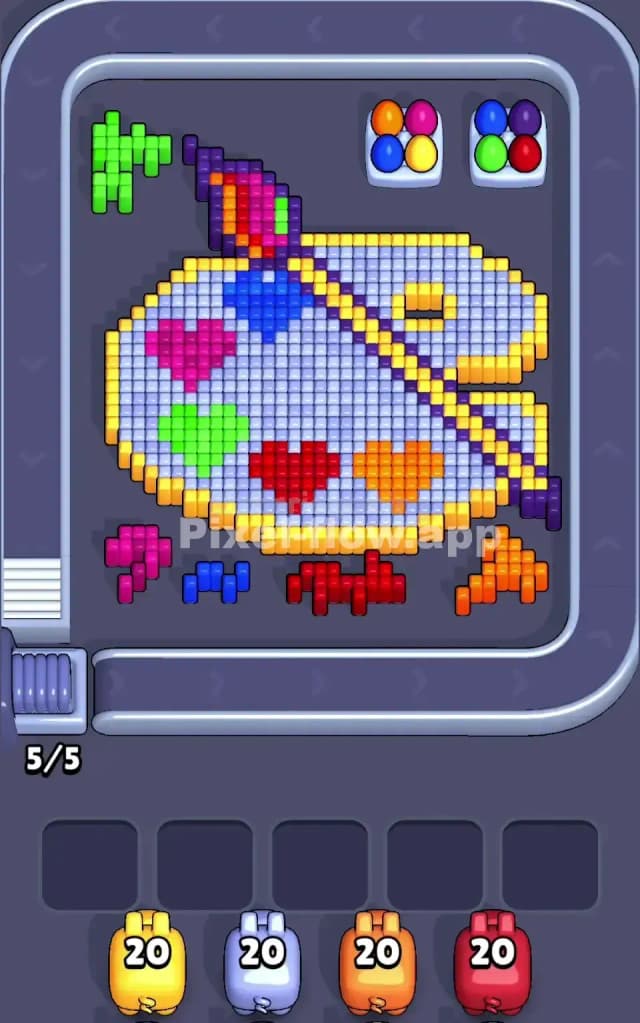
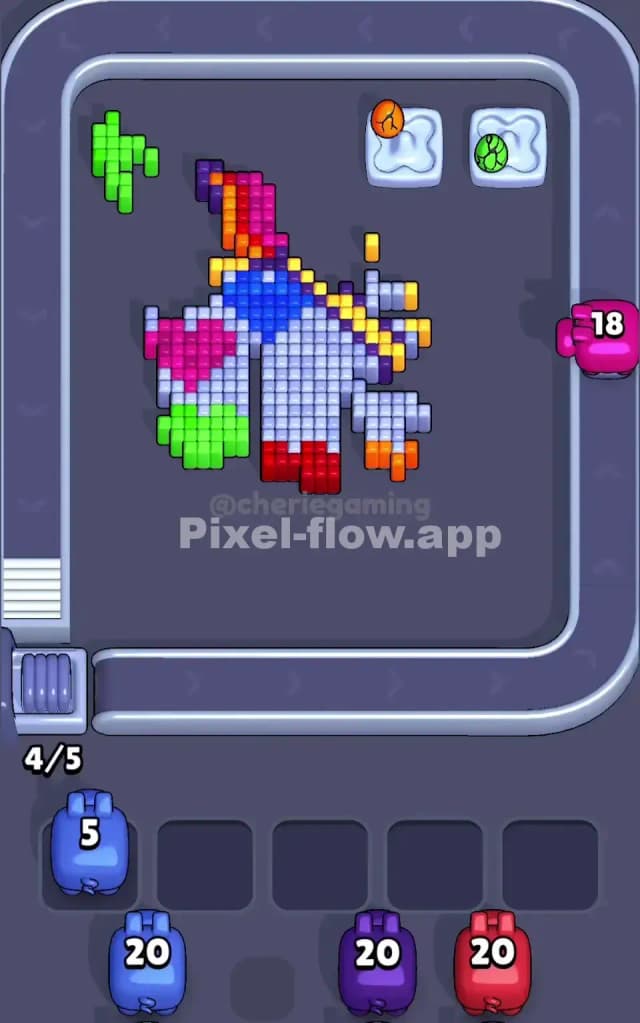
Pixel Flow Level 204 presents you with a colorful voxel fish as the main subject, swimming across a light-blue background that fills most of the play area. The fish itself is constructed from multiple color layers: the body is predominantly light blue, with bright yellow fins and border pieces that form the outline and distinctive swimming silhouette. Inside the fish, you'll notice vibrant accent colors—magenta, green, red, and orange—arranged as decorative patches that add visual richness and, more importantly, create distinct puzzle targets. At the top of the board, a smaller color gradient (orange, magenta, blue, and purple) appears to be a background or header element that you'll need to clear as part of your overall strategy.
The board also shows several pigs at the bottom in the waiting area, each carrying 20 ammo cubes of their respective colors. You're dealing with exactly four pigs: yellow (20 ammo), light blue (20 ammo), orange (20 ammo), and red (20 ammo). The conveyor system will deliver these pigs in a fixed sequence, and your job is to time their arrival and placement so that every single voxel cube on the board gets eliminated without jamming all five waiting slots simultaneously.
Win Condition and Deterministic Nature
To clear Pixel Flow Level 204, you must destroy every colored cube visible on the board—no cubes left behind. Since the pig order and ammo counts are entirely deterministic, success depends purely on your ability to sequence which pig shoots when. You're not fighting randomness; you're solving a puzzle where every move is calculated. The light-blue background cubes form the bulk of your work, and the colored accents hidden within and around the fish are your real strategic test.
Why Pixel Flow Level 204 Feels So Tricky
The Light-Blue Bottleneck
The biggest threat in Pixel Flow Level 204 is the sheer volume of light-blue cubes that make up the fish's body. You have only one light-blue pig with 20 ammo, yet the background appears to contain far more than 20 light-blue targets. This mismatch creates a critical problem: if you fire the light-blue pig too early and expose inner layers too quickly, you'll be left with uncovered light-blue cubes that no remaining pig can target. The light-blue pig will then become "stuck" in the waiting area, unable to spend its remaining ammo because no valid targets exist. If you allow multiple pigs to become stuck this way, your buffer fills up, and you lose instantly.
The solution isn't obvious at first glance, which is why Pixel Flow Level 204 punishes hasty players. You need to carefully control when the light-blue pig shoots, sometimes letting other colors go first to expose or cover light-blue targets strategically.
Awkward Color Patches and Layering Issues
The magenta, green, red, and orange patches scattered throughout the fish add another layer of complexity to Pixel Flow Level 204. These colors aren't just decorative—they're actual cubes that block access to deeper layers. For example, if a magenta cube is sitting on top of a light-blue cube, you can't hit the light-blue target until the magenta cube is gone. However, looking at the current pig queue, you don't have a magenta pig available, which means those magenta cubes are either on a later wave or they're already deeply nested, and you need to expose them through adjacent color clears.
Additionally, the yellow border cubes that frame the fish create a visual trap. There's a lot of yellow on screen, but your yellow pig only has 20 ammo. Some of those yellow cubes might be background filler or structural elements that don't need to be cleared to win, so you need to distinguish between essential yellow targets and red herrings. Pixel Flow Level 204 tests your ability to read the board critically rather than just blasting every color you see.
The Waiting Slot Pressure
With five waiting slots and only four pigs total, you'd think you're safe—but you're not. The real danger is that pigs stay in the waiting area until they empty their ammo completely. If a pig runs out of valid targets while holding ammo (because deeper layers aren't exposed yet), it gets stuck. Imagine firing the yellow pig, clearing some of its targets, but leaving 8 ammo unspent because the remaining yellow cubes are hidden behind other colors. That pig now occupies a waiting slot permanently, eating up your buffer room. Do this twice, and you're down to three free slots for incoming pigs, setting you up for a cascade failure later.
I won't lie—Pixel Flow Level 204 frustrated me the first few attempts because I kept firing pigs greedily without planning two or three moves ahead. The level "clicked" for me only when I realized that the waiting area isn't a garbage dump; it's a resource. Every occupied slot is a commitment, and managing that commitment is the real game.
Step-by-Step Strategy to Clear Pixel Flow Level 204
Opening Moves: Yellow First, Keep Buffer Space
Start by sending the yellow pig down to shoot. Yellow cubes form the border and are highly visible, making them a safe first target. The yellow pig should burn through most or all of its 20 ammo on the outer frame, clearing the fish's perimeter. This accomplishes two critical things: it immediately frees up waiting slots (so the next pig has room to enter), and it exposes the inner layers without committing to the risky light-blue pig yet. As you watch the yellow pig shoot, count every hit mentally. If it uses all 20 ammo and clears all visible yellow, perfect—it doesn't clog the waiting area. If a few yellow cubes remain hidden, note that and prepare to send yellow back later.
Keep at least two waiting slots empty throughout Pixel Flow Level 204's early phase. This breathing room is essential because you're about to make decisions that could either expose new targets or trap your pigs.
Mid-Game: Sequencing Colors and Exposing Layers
After yellow, it's time to carefully consider your next move. Look at the red patch on the fish and the orange patch—both are visible and isolate key regions. I'd recommend sending the red pig next to clear the red heart-shaped cluster in the lower-left area of the fish. Red should have a clear line of sight to these cubes, and clearing them opens up the surrounding light-blue background. Again, watch your ammo count. If red empties all 20 and still has targets, something went wrong; if it fills the waiting area, that's also a warning.
Once red is committed, the orange pig is your next logical choice. Orange cubes are concentrated in the lower-right quadrant, and firing orange will expose more of the blue body underneath. By this point, you've used three pigs, and the board should look significantly simpler. The key insight for Pixel Flow Level 204 is that you're using the colored accents as a "key" to unlock the blue underneath—you're not trying to clear blue first; you're clearing the obstacles in front of it.
Now comes the critical moment: the light-blue pig. Before you send it, examine the board carefully. Which light-blue cubes are now exposed after yellow, red, and orange did their work? Count them. If there are 20 or fewer visible light-blue targets, fire the light-blue pig and let it spend all ammo. If there appear to be more than 20 uncovered light-blue cubes, do NOT send light-blue yet. Instead, check if any other color pig is waiting and ready—sometimes a secondary wave of pigs arrives after the first four. If no new pigs are coming, you've made a strategic error earlier, and you'll need to restart.
Assuming you've timed it correctly, the light-blue pig should clear most or all remaining blue cubes, pushing Pixel Flow Level 204 toward its end state.
End-Game: Closing Cleanly Without Jamming
As the board empties, you'll be left with any remaining colored cubes and the pigs in the waiting area. If you executed the mid-game correctly, you should have minimal cubes left and at least one or two free waiting slots. Examine the board one last time: are there stray magenta, green, or other color pieces? If yes, you might have a hidden pig wave incoming—wait for it before declaring victory. If no, and the board is clean, you've cleared Pixel Flow Level 204 successfully.
The key to avoiding a last-second jam is simple: never allow more than three pigs in the waiting area at once. If you see the waiting area filling up, pause and reassess. Did a pig get stuck? Did you miscalculate the layer structure? Pixel Flow Level 204 rewards patience and planning, not speed.
The Logic Behind This Pixel Flow Level 204 Plan
Exploiting Determinism and Ammo Pools
Pixel Flow Level 204 is solvable only if you treat it as a math puzzle disguised as a shooting game. Each pig has a fixed ammo pool, and each voxel cube requires exactly one shot to destroy. Your job is to match ammo to targets perfectly. The strategy of clearing yellow, then red, then orange, then blue follows a logical progression: it clears outer layers first, exposing inner targets so that the final pig (light-blue, which has the most cubes to hit) arrives when all its targets are visible. This isn't arbitrary sequencing; it's layer-aware problem-solving.
By counting visible targets and comparing them to each pig's ammo, you transform Pixel Flow Level 204 from a chaotic shooter into a deterministic puzzle. There is one correct sequence (or possibly a few correct sequences), and every other order will lead to stuck pigs and failure. Accepting this unlocks the level.
Staying Calm and Planning Ahead
The pressure of watching your waiting slots fill up is real, but the antidote is discipline. Before firing each pig, ask yourself three questions: Where will its shots land? Will all targets be exposed? How many ammo cubes will it use? By answering these questions consistently, you develop a rhythm for Pixel Flow Level 204 that's methodical rather than frantic. Watch the queue of incoming pigs, count the ammo on the board, and think two or three pigs ahead. This mindset transforms a frustrating level into a satisfying puzzle where you feel in control.
Pixel Flow Level 204 isn't your enemy—misplanning is. Control what you can control: the order of your pigs, your observation of the board, and your patience with the puzzle's logic. Do that, and you'll clear it with confidence.