
Pixel Flow Level 211 Solution | Pixel Flow 211 Walkthrough
How to beat Pixel Flow Level 211: Video solution & walkthrough. The fastest way to pass Pixel Flow 211.
Is this the wrong level layout?🤔
Pixel Flow randomizes levels for different players. Don't worry, just upload a screenshot of your board, and our AI will find the correct video instantly.


Pixel Flow Level 211 Overview
The Board Layout and Visual Design
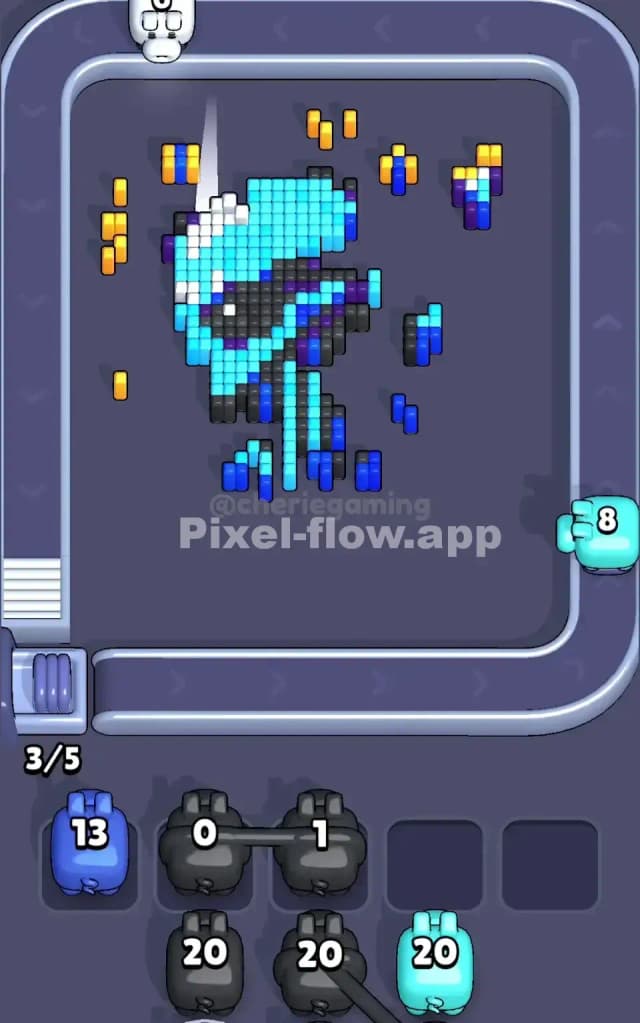
Pixel Flow Level 211 presents you with a stunning, multi-layered voxel art depicting an elephant's head as the centerpiece. The main figure dominates the board with cyan, blue, and dark gray cubes forming the elephant's face, ears, and trunk in a beautiful pixel mosaic. Behind and around this focal point, you'll notice deeper layers of color—purple, white, and additional shades of blue and cyan—that create depth and complexity. The five waiting slots at the bottom are currently empty, giving you a full buffer to work with at the start. Above the main board, you can see smaller color columns in the queue showing which pigs are coming: you'll have access to a black pig (20 ammo), a cyan pig (20 ammo), and a blue pig (20 ammo). The "5/5" indicator in the corner tells you all five waiting slots are free—and that's your greatest asset right now.
The Win Condition and Deterministic Challenge
Your mission in Pixel Flow Level 211 is straightforward: clear every single voxel cube from the board until it's completely empty. Each pig shoots cubes matching its color, spending one ammo per cube destroyed. The trick is that pig order, ammo counts, and the board layout are fully deterministic—meaning there's an optimal sequence waiting to be discovered. You can't brute-force your way through Pixel Flow Level 211; instead, you'll need to think ahead, count ammo carefully, and manage your waiting slots so you never trap a pig with leftover ammo and nowhere valid to shoot.
Why Pixel Flow Level 211 Feels So Tricky
The Cyan Bottleneck
The biggest threat in Pixel Flow Level 211 is the sheer volume of cyan cubes scattered across the elephant's face and body. Cyan dominates the visual palette, and while you have a 20-ammo cyan pig in your queue, those cubes aren't all clustered in one easy-to-clear region. Some cyan blocks nestle deep within the darker gray interior, hidden behind layers of black and blue. This means you can't fire the cyan pig early and expect instant gratification—you'll likely need to clear black and blue first to expose all the cyan targets. If you miscalculate and fire cyan too soon, you'll leave it with remaining ammo but no valid targets visible, and boom—it's stuck in a waiting slot, silently draining your buffer space while you scramble to expose more cyan cubes.
Awkward Color Patches and Hidden Layers
Pixel Flow Level 211 hides several tricky color pockets that'll catch you off-guard if you're not paying attention. White cubes appear scattered in the elephant's face, creating highlights, but there aren't many of them—and you don't see a white pig in the initial queue. Similarly, purple cubes sit on the right side of the board in what looks like ear detailing, but again, there's no obvious purple pig showing. This disconnect between visible colors and available pigs means some layers are definitely deeper than they appear. You might spend black ammo clearing what looks like a simple dark area, only to realize that white or purple cubes were hiding underneath, and now you're stuck waiting for a pig that hasn't appeared yet.
The Personal Frustration Point
I'll be honest—Pixel Flow Level 211 annoyed me for a solid ten attempts before it clicked. The elephant's complexity made me want to just start blasting with whatever pig was coming next, but that impatience caused immediate jams. The moment things shifted for me was when I stopped looking at the board as a picture and started seeing it as a puzzle of layered colors. Once I accepted that I'd need to systematically peel away black, then cyan, then blue in a careful dance, the level suddenly felt manageable. That mental shift—from "clear everything" to "clear in the right order"—is what separates a frustrating slog from a satisfying solve.
Step-by-Step Strategy to Clear Pixel Flow Level 211
Opening: Start with Black to Expose Hidden Targets
Your first move in Pixel Flow Level 211 should be to fire the black pig immediately. Black forms the structural "shadow" layer of the elephant, running through the middle and lower portions of the board as a dark grid holding everything together. Firing black early accomplishes two critical things: it removes the obscuring layer so cyan and blue cubes behind it become visible, and it keeps your waiting slots mostly free since black will spend a solid chunk of its 20 ammo without getting stuck. Don't overthink this—black is your excavation tool. Keep at least three waiting slots open after black is done; you'll need that buffer for cyan and blue, which have more complex visibility issues.
Mid-Game: Sequence Cyan Carefully and Manage Your Buffer
Once black has done its job, cyan becomes your primary target in Pixel Flow Level 211. However, don't fire cyan all at once. Watch the board after each black volley, and only fire cyan when you can see a meaningful number of cyan targets exposed. Cyan will have plenty of ammo left after clearing the elephant's main face features, so you may need to park it in a waiting slot mid-way through and rotate in blue to expose additional layers. This is where patience pays off: if you see cyan sitting in a waiting slot with ammo remaining, it means the board layout is forcing you to clear other colors first. That's not a failure—that's the puzzle working as intended. Use this "downtime" to clear blue cubes in areas where cyan can't reach, and inch your way toward exposing any white or purple cubes hiding in the depths.
End-Game: Finish with Precision and Avoid Last-Second Jams
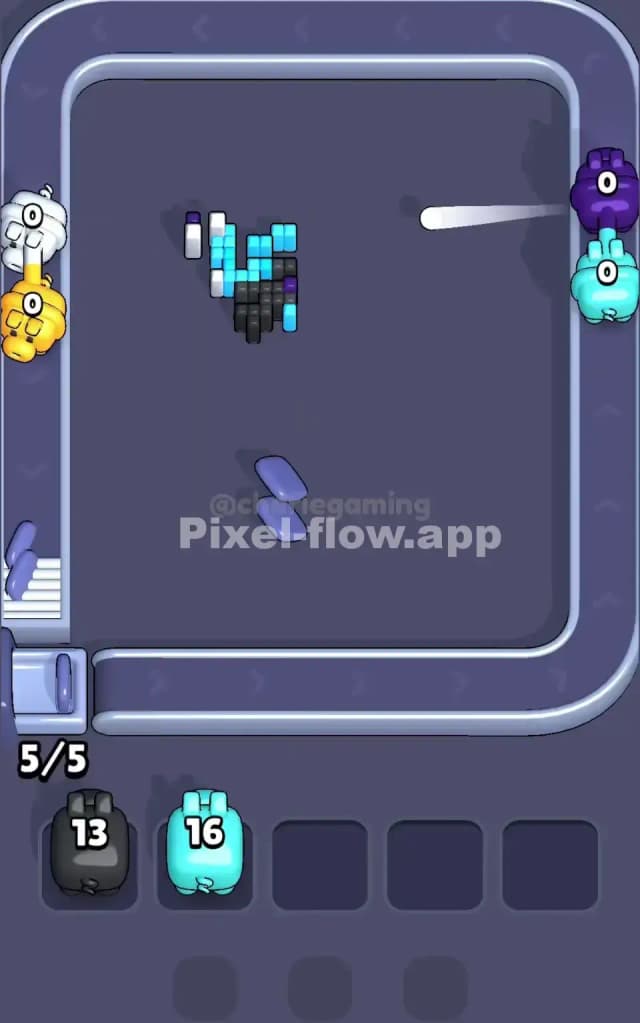
As you approach the final handful of cubes in Pixel Flow Level 211, resist the urge to fire pigs frantically. Instead, count the remaining ammo for each pig currently in the queue or waiting. If you have three cyan cubes left and cyan still has 8 ammo available, you need a plan to spend that other 5 ammo, or cyan will get stuck with no targets. Look for any stray cubes of other colors that might be buried in what looks like empty space. Sometimes a single white or blue cube sits isolated, waiting to be the "unlocking" shot that lets cyan find more targets. Fire methodically, check the board after each pig, and don't be afraid to park a pig in a waiting slot for one or two turns while you re-assess. The last few cubes in Pixel Flow Level 211 often reveal themselves in unexpected places, and you need breathing room to adapt.
The Logic Behind This Pixel Flow Level 211 Plan
Exploiting Determinism Instead of Reacting
Pixel Flow Level 211 succeeds because every element—pig order, ammo counts, and cube positions—never changes. This means the level has a "correct" solution, and your job is to find it through logical deduction rather than luck. By prioritizing black first, you're not guessing; you're removing the visual noise so you can actually see what you're working with. By parking pigs strategically in waiting slots, you're buying yourself time to think and plan ahead. The strategy of "black first, cyan second (with breaks), blue as a filler" isn't arbitrary—it's the order that naturally exposes the fewest dead-end situations where a pig runs out of visible targets.
Staying Calm and Thinking Two Pigs Ahead
The hardest part of Pixel Flow Level 211 isn't the shooting—it's the mental discipline to look ahead. Before you fire a pig, ask yourself: "After this pig empties, will the next pig in queue have visible targets?" If the answer is no, don't fire yet. Park the current pig in a waiting slot, rotate in a different color, and come back later. This forward-thinking approach transforms Pixel Flow Level 211 from a chaotic scramble into a choreographed sequence. You'll start to recognize patterns: cyan will get stuck twice, blue will be your cleanup crew, and the final few moves will feel inevitable because you've already mapped them out three turns earlier. Stay relaxed, count ammo, and trust the plan. Pixel Flow Level 211 rewards patience far more than speed.