Pixel Flow Level 222 Solution | Pixel Flow 222 Walkthrough
How to beat Pixel Flow Level 222: Video solution & walkthrough. The fastest way to pass Pixel Flow 222.
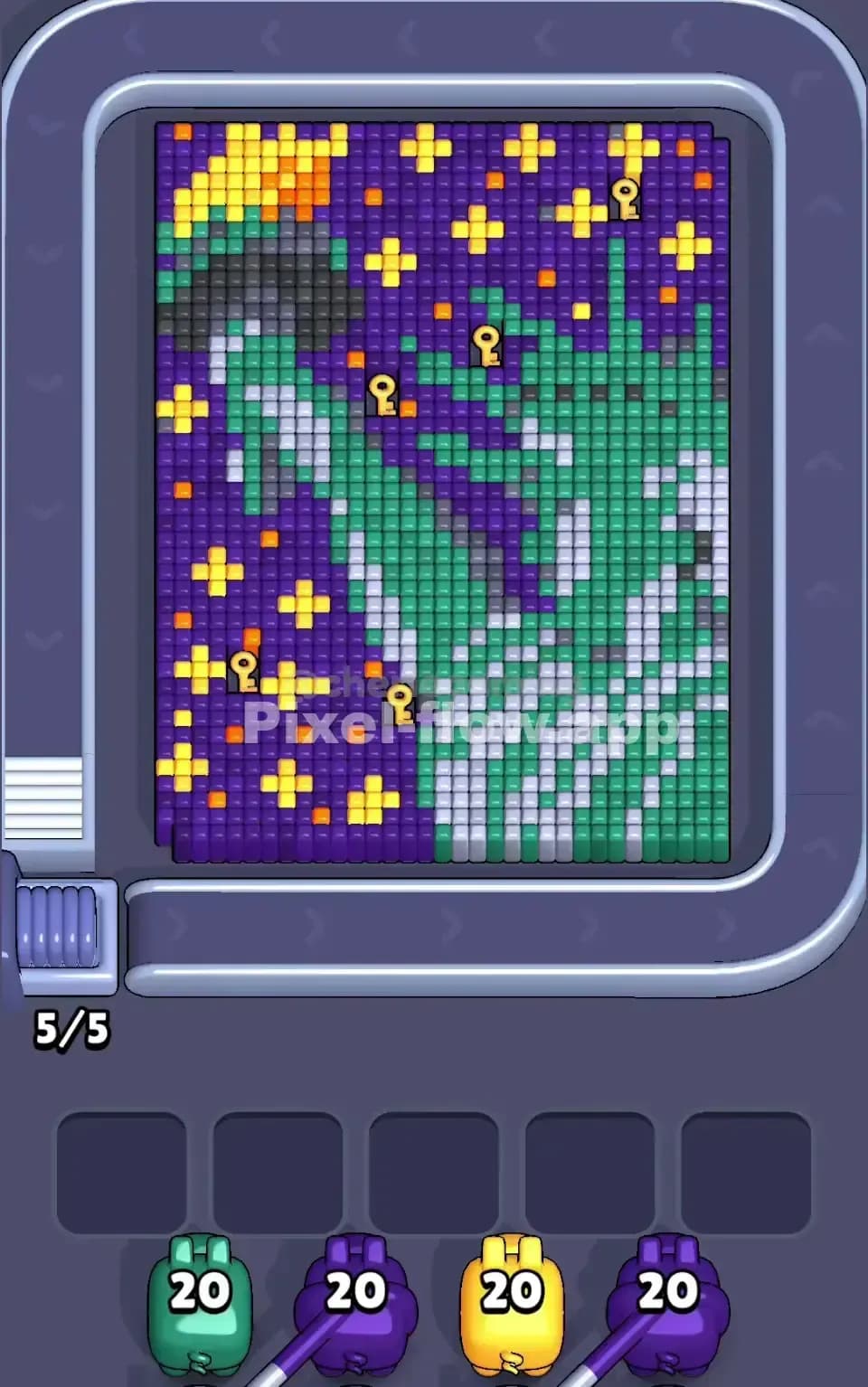
Is this the wrong level layout?🤔
Pixel Flow randomizes levels for different players. Don't worry, just upload a screenshot of your board, and our AI will find the correct video instantly.

Pixel Flow Level 222 Walkthrough
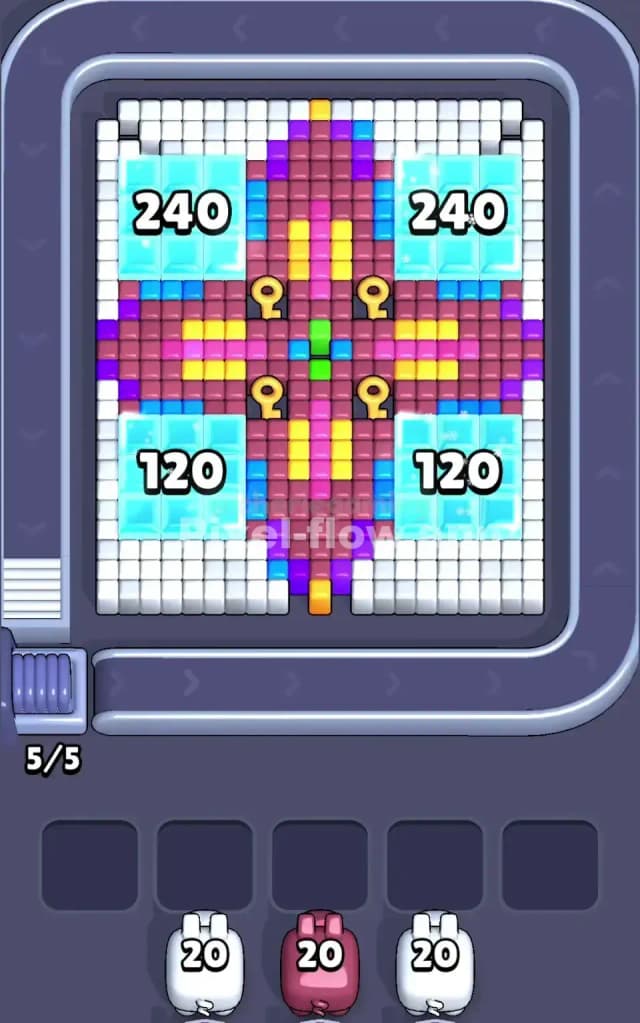
Level 222 is a defensive fortress disguised as a flower. You are looking at a symmetrical, cross-shaped pattern—dominated by deep maroon and white—that is heavily guarded by four massive blocks of ice. The top two ice blocks have 240 HP. The bottom two have 120 HP. These aren't just decorations; they are shields blocking the quadrants of the board.
The color layout is strict. A thick White border surrounds the entire grid. Inside, a Maroon cross structure holds smaller pockets of Yellow, Pink, and Purple. At the dead center, four golden Key Locks protect a tiny core of Green and Blue. Because the ice blocks block so much of the playable area and the HP counts are massive, this is a very hard level. One bad discard, one clogged slot, and you are done.
Pixel Flow Level 222 Overview
Think of this level as a frozen vault. The artwork itself resembles a decorative ceramic tile or a medieval shield, but you won't see much of it at the start. The White pixels form a rectangular perimeter, acting like a fence. Everything important is trapped inside this fence, under the ice.
The visual trap here is the symmetry. It looks balanced, which makes you think the gameplay will be smooth. It won't be. The four ice blocks (labeled 240 and 120) effectively blind you to what is underneath the corners. You can see the central Maroon cross peeking out between the ice, but you cannot easily reach it because the White border takes priority.
The most dangerous aspect is the Key Locks in the center. These four locks prevent you from clearing the middle of the cross until you have dismantled the outer arms. This creates a bottleneck. You will have pigs loaded with ammo for the center colors (Green, Blue) appearing in your queue long before you can actually shoot those blocks. If you don't manage your five waiting slots perfectly, those premature pigs will kill your run.
Step by step solution walkthrough for Pixel Flow Level 222
First Color Zone to Erase in Pixel Flow Level 222
You have no choice but to attack the White border first. This is mandatory.
Look at your starting queue. You get White pigs immediately. Use them to strip away the outer rectangle. Do not try to get clever and save them. The White layer is the only thing your pigs can reliably hit without being blocked by the ice or the keys.
Narratively, you are "breaking the seal." By removing the white border, you do two things:
- Create Space: You open up angles to hit the Maroon blocks that form the skeleton of the cross.
- Isolate the Ice: The ice blocks often rely on the structure around them. Even if they don't disappear immediately, clearing the white pixels adjacent to them is usually the trigger to lower their HP or expose the blocks underneath that you actually need to shoot.
Be aggressive with White. If you see a White pig, send it. Do not let it sit in a slot. You need that border gone to widen your firing angles.
How to pass Pixel Flow Level 222 without power ups or boosters
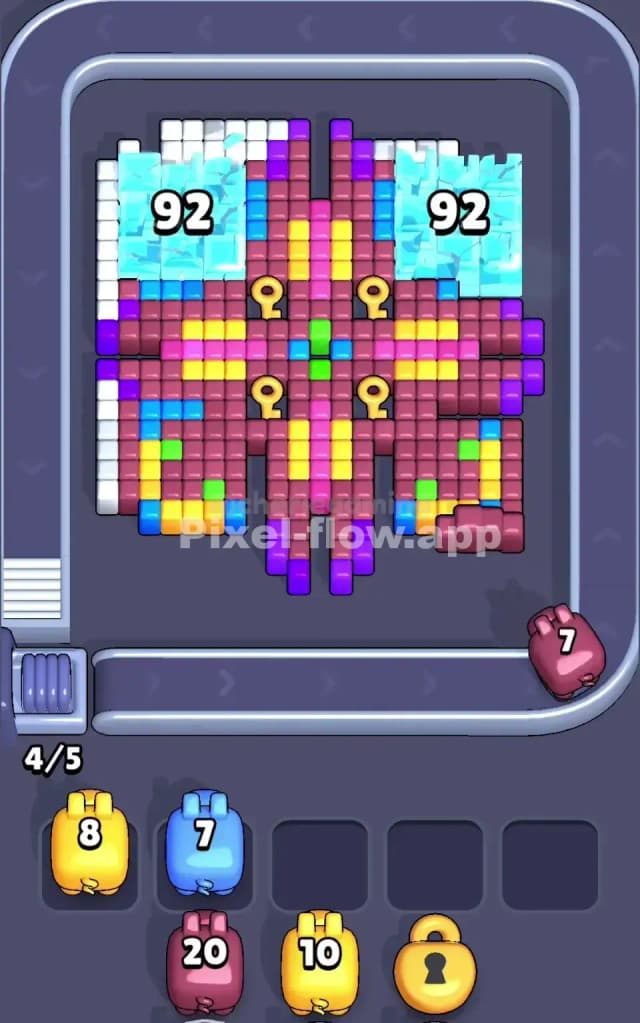
Once the white border is thinning out, the level gets messy. This is the mid-game grind. You will see the Maroon cross structure fully exposed, but the inner colors (Yellow, Pink) are still buried inside the Maroon walls.
Here is the crucial friction point: The game will start sending you Yellow and Pink pigs while you are still trying to clear the Maroon layer.
- The Maroon Priority: You must clear the Maroon blocks to expose the Yellow and Pink cores. If you put a Maroon pig in a waiting slot because you want to use a Yellow one first, you are making a mistake. The Yellow blocks are likely "under" or "behind" the Maroon ones in the 3D stack. You cannot shoot the filling until you eat the crust.
- Slot Discipline: You only have 5 slots. During this phase, you might get a Green or Blue pig meant for the absolute center. Do not let these clog your slots. If you have 3 slots filled with "end-game" colors (Blue/Green) and you still haven't cleared the Maroon layer, you will lose. You might have to sacrifice a pig (send it to the belt even if it wastes ammo) just to keep the conveyor moving to find a Maroon pig.
- Ignore the Keys: Don't obsess over the keys yet. They unlock automatically as you clear the adjacent Maroon/Purple blocks. Focus on dismantling the four arms of the cross.
Last Details You Clean Up in Pixel Flow Level 222
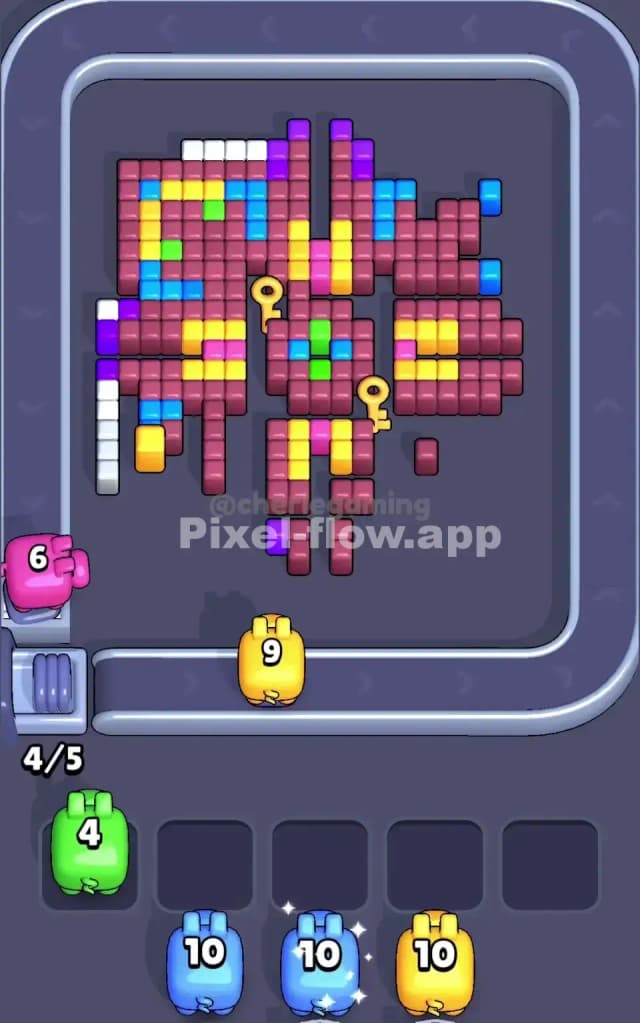
The end game is tight. The ice is shattered, the white border is a memory, and the thick maroon arms are gone.
Now you are left with the "guts" of the level:
- The Center Core: The four Key Locks will pop, revealing the Green and Blue pixels in the dead center.
- The Highlights: Scattered remains of Purple (tips of the cross) and Pink (horizontal arms) might still be lingering.
The danger here is aiming. With most of the board empty, your pigs have a long travel time to the target. Watch the rotation of the board (if it moves) or the speed of the belt. Make sure your Blue pig actually has a line of sight to the blue center and isn't blocked by a stray pixel of Purple you forgot to clear.
Usually, the final move is a single Blue or Green pig cleaning up that tiny 2x2 cluster in the middle. It’s satisfying, but getting there requires you to be ruthless with your waiting slots in the mid-game.