Pixel Flow Level 27 Solution Walkthrough | Pixel Flow 27

How to solve Pixel Flow level 27? Get instant solution for Pixel Flow 27 with our step by step solution & video walkthrough.

Share Pixel Flow Level 27 Guide:
Pixel Flow Level 27 Gameplay
Pixel Flow Level 27 Solution 1
Pixel Flow Level 27 Solution 2
Pixel Flow Level 27 Solution 3

Pixel Flow Level 27 Overview

The Board Layout and Visual Challenge

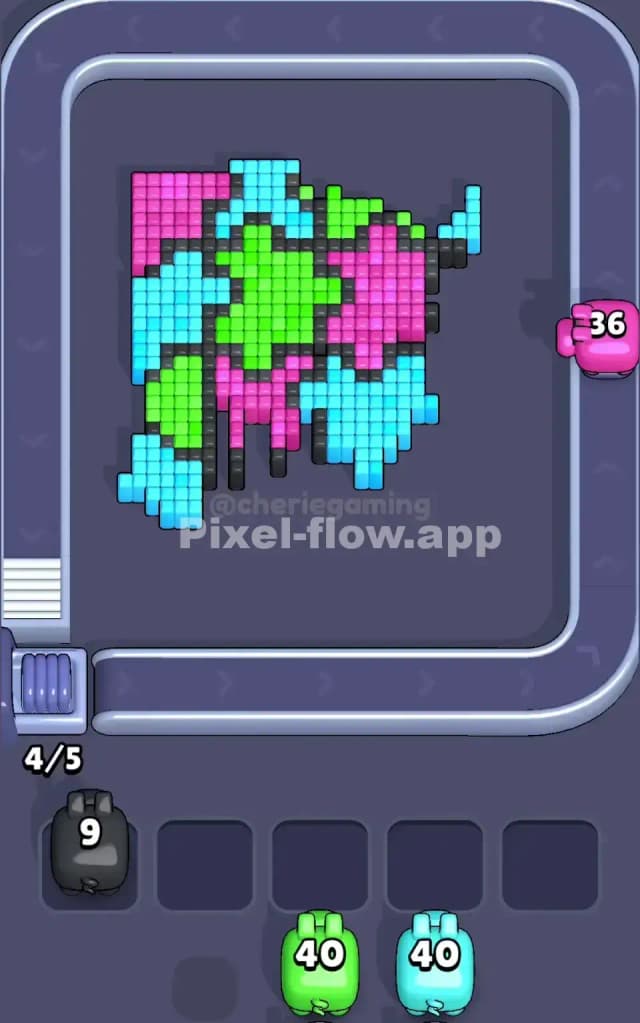
Pixel Flow Level 27 presents a densely packed, intricate voxel mosaic dominated by three primary colors: magenta (pink), cyan (light blue), and lime green. The board is essentially a chaotic abstract pattern where all three colors are scattered across multiple layers, creating a visually complex puzzle that demands careful sequencing. You're looking at roughly equal distribution of each color across the visible surface, with black voxel gaps interspersed throughout that hint at deeper structural layers beneath. The arrangement isn't immediately obvious—it's not a simple portrait or single recognizable shape, but rather an overlapping color study that forces you to think in three dimensions.

The conveyor belt at the bottom shows you're working with exactly three pigs: one cyan pig with 40 ammo, one magenta pig with 40 ammo, and one lime green pig with 40 ammo. That's 120 total ammo for what appears to be well over 120 voxels on the board. This tight ammo budget means every single shot must count, and you can't afford wasteful targeting or dead zones.

Win Condition and Determinism

To clear Pixel Flow Level 27, you must eliminate every single voxel cube on the board by matching colors. The win condition is absolute: zero cubes remaining. The good news? The pig order and their ammo counts are completely deterministic—they never change between attempts. This means success isn't about luck; it's about understanding exactly which pigs will arrive when and planning your moves to expose the right colors at the right moments. Once you crack the sequence, you can replicate it perfectly.


Why Pixel Flow Level 27 Feels So Tricky

The Bottleneck of Balanced Color Distribution

The biggest threat in Pixel Flow Level 27 is that all three colors are so evenly spread across the board that no single pig can carve through a massive contiguous region early on. When you release the first pig, you'll immediately face the reality that its 40 ammo, while generous, won't finish half the board. This means you'll frequently run out of matching targets before exhausting a pig's ammunition. When that happens, the pig drops into one of the five waiting slots. If you're not careful about timing, you could jam all five slots with partially spent pigs who still have 15–20 ammo left but can't find valid targets because their color is hidden beneath other layers. That's a game-over scenario waiting to happen.

The Awkward Mid-Board Color Pockets

Scattered throughout Pixel Flow Level 27 are isolated pockets of each color surrounded by the other two colors. These pockets are deceptively dangerous. Imagine a small cluster of magenta cubes trapped inside a region dominated by cyan and green. If you expose that magenta pocket too early with a stray green shot, your magenta pig might waste half its ammo on those 4–5 cubes and then have nowhere to shoot for the remaining 20+ rounds. You'll be forced to park it in the waiting area, and suddenly your buffer is shrinking. Strategic reveals are crucial; you must expose layers in an order that maximizes each pig's target-rich environment when it's actually firing.

The Frustration Point and When It Clicks

I'll be honest—Pixel Flow Level 27 beat me several times before the pattern became clear. The moment of frustration came around my fourth or fifth attempt, when I had two pigs jammed in the waiting slots with 15 ammo each and no visible targets for either. That's when I realized I'd been too reactive, firing the first pig wherever I saw its color instead of thinking three moves ahead. Once I started mentally mapping out which colors were hiding beneath which layers and planned my pig sequence to deliberately expose them in the right order, the level went from impossible to elegant. It "clicked" when I stopped trying to finish regions and started thinking about sculpting the board to serve future pigs.


Step-by-Step Strategy to Clear Pixel Flow Level 27

Opening: Establish Board Flow and Protect Your Buffer

Start with the cyan pig. Your first priority in Pixel Flow Level 27 is not to maximize cyan kills but to establish a clean board state that doesn't overfill your waiting slots. Look for the largest contiguous cyan region on the surface—typically in the upper-left or center area—and methodically clear it. Target about 20–25 of the cyan pig's 40 ammo at this region, deliberately leaving some cyan pockets unexposed. The goal is to drop the cyan pig into a waiting slot (it will run out of targets naturally) while keeping at least three slots empty. By parking the cyan pig after spending roughly half its ammo, you've kept your options open and signaled that you're thinking in phases.

Pay close attention to what gets revealed as you clear cyan. Often, magenta or green will emerge in predictable patches. Make mental notes of these exposed colors—they'll inform your next pig's strategy. Never feel obligated to chase down every single cyan cube. Restraint here is strength.

Mid-Game: Sequencing and Layer Exposure

Now release the magenta pig. In Pixel Flow Level 27, the magenta pig's job is twofold: clear obvious magenta regions and deliberately expose the green layer beneath. Target the large magenta clusters, especially those on the left and center of the board, spending roughly 25–30 ammo. As you clear magenta, you'll expose green underneath, which is exactly what you want. When the magenta pig runs out of targets, park it in a waiting slot (you should still have 2–3 slots free).

Here's the key insight for Pixel Flow Level 27: the green pig has the most ammo "breathing room" because green is scattered everywhere. You can afford to be more aggressive with it. Release the green pig and let it run wild on the exposed green clusters. Spend 30–35 of its 40 ammo clearing visible green, and let it naturally expose hidden cyan and magenta beneath. If the green pig still has ammo when it runs out of targets, it'll drop into a waiting slot, and now you have all three pigs staged.

This mid-game phase is where Pixel Flow Level 27 rewards planning ahead. You're not trying to finish the board; you're sculpting it into a state where remaining ammo aligns perfectly with remaining targets.

End-Game: The Precision Finish

By this point in Pixel Flow Level 27, you've cleared maybe 60–70% of the board, and all three pigs are waiting. Now bring them back in a carefully chosen order. If cyan still has 15–20 ammo, and you can see 18 cyan cubes, release cyan. If magenta has 12 ammo left and 10 magenta cubes are exposed, release magenta next. The final pig should hit an empty board—or nearly empty—with just a handful of cubes remaining.

The absolute final move in Pixel Flow Level 27 is critical: ensure your last pig clears the very last voxel. Count your remaining ammo and remaining targets obsessively. If you have any doubt, pause and recount. A single miscalculation here—one pig that runs out of targets with a cube remaining—can force a restart.


The Logic Behind This Pixel Flow Level 27 Plan

Exploiting Determinism and Ammo Alignment

The strategy for Pixel Flow Level 27 hinges on one principle: treat the puzzle as a three-phase ammo-allocation problem, not a three-pig allocation problem. Each pig arrives with a fixed ammo budget. Your job is to deliberately spend just enough ammo in each phase to expose the optimal board state for the next phase. This isn't about efficiency; it's about synchronization. You're choreographing the pigs so that when pig two arrives, the board looks like it was designed for pig two. By the time the third pig shows up, the board should be nearly finalized.

Waiting slots are your buffer, not your enemy. Pixel Flow Level 27 allows up to five pigs to wait simultaneously, and you have only three pigs total. This means you have room to "fail gracefully"—to let pigs drop into waiting when they run out of targets, knowing you can retrieve them later when the board state improves. Respecting this buffer turns Pixel Flow Level 27 from a real-time puzzle into a turn-based strategic one.

The Art of Staying Calm and Thinking Ahead

Pixel Flow Level 27 demands that you resist the urge to spray ammo wildly just because targets are visible. Instead, before you release each pig, spend 10 seconds mentally scanning the board and asking yourself: "If this pig shoots 30 targets, what colors will get exposed? Will the next pig have things to shoot?" This forward-thinking approach transforms frustration into confidence. You're no longer hoping for the best; you're architecting the solution.

Count ammo ruthlessly. At any point in Pixel Flow Level 27, you should know exactly how many remaining ammo shots each waiting pig has and roughly how many matching cubes are still on the board. If you see a discrepancy—more cubes than ammo, or vice versa—you know you've made a mistake somewhere and need to restart earlier to recalibrate. Pixel Flow Level 27 rewards precision and planning; it punishes improvisation.