Pixel Flow Level 291 Solution Walkthrough | Pixel Flow 291

How to solve Pixel Flow level 291? Get instant solution for Pixel Flow 291 with our step by step solution & video walkthrough.

Share Pixel Flow Level 291 Guide:
Pixel Flow Level 291 Gameplay
Pixel Flow Level 291 Solution 1
Pixel Flow Level 291 Solution 2
Pixel Flow Level 291 Solution 3

Pixel Flow Level 291 Overview

The Starting Board and Its Layers

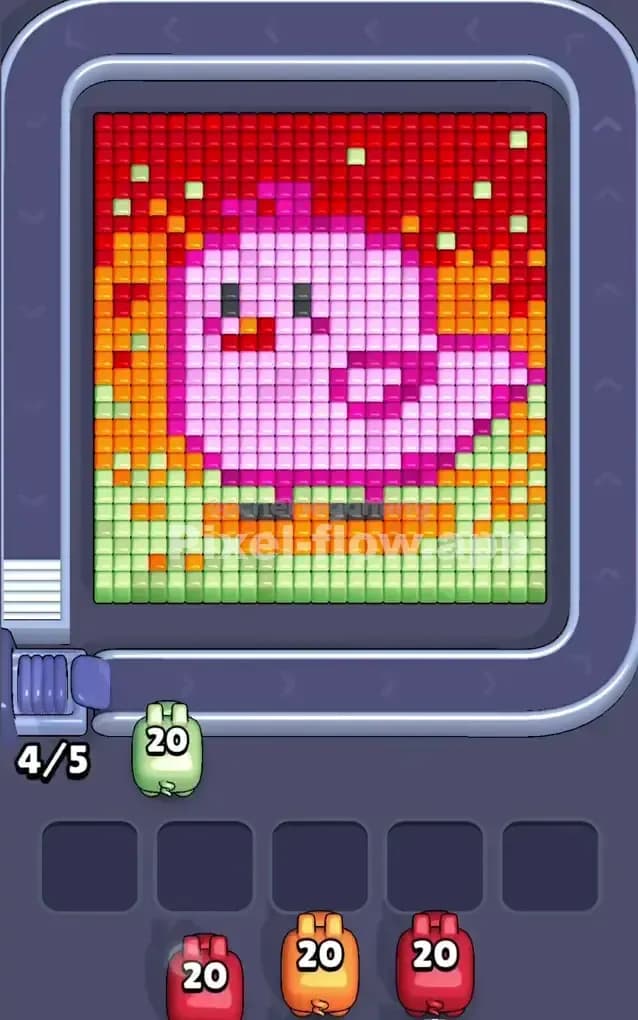
Pixel Flow Level 291 presents a charming pixel-art sunflower face against a vibrant, multi-colored voxel landscape. The dominant colors you'll encounter are red (forming the petals and background), pink and magenta (creating the flower's inner details and shading), orange (transitioning zones and petal highlights), yellow-green (the lower grass or stem area), and lime green (the base layer). The sunflower's face—rendered in pink, white, and black pixels—sits dead center, and it's surrounded by a thick border of warm reds and oranges that form the main visual weight of the puzzle. What makes Pixel Flow 291 particularly sneaky is that these colors aren't evenly distributed; the red and pink layers are dense and front-heavy, while the yellow-green and lime segments are tucked beneath, waiting to be exposed only after you've cleared enough upper cubes.

The win condition for Pixel Flow Level 291 is straightforward: eliminate every single voxel cube on the board by matching pig colors to cube colors. You start with four pigs in the queue (shown at the bottom) and have five waiting slots to manage. Each pig carries a fixed ammo count—in this case, you're looking at three pigs with 20 ammo each—and the order in which they appear is completely deterministic. That means there's no luck involved; success in Pixel Flow 291 depends entirely on how cleverly you sequence your pigs and manage your waiting slots.

Understanding the Win Condition and Deterministic Nature

What I love about Pixel Flow 291 is that it rewards planning over reflexes. Because every pig's ammo count is locked in from the start, you can theoretically map out the entire solution before you fire a single shot. The board won't change unless you act, and your pigs won't deviate from their color or ammo total. This deterministic quality means that if you fail Pixel Flow Level 291, you can learn exactly where you went wrong and adjust your strategy for the next attempt. There's no randomness to blame—only your sequencing.


Why Pixel Flow Level 291 Feels So Tricky

The Red and Pink Bottleneck

Here's where Pixel Flow Level 291 throws a curveball: red and pink dominate the board, and if you're not careful about how you deploy your red and pink pigs, you'll find yourself with one or two pigs still holding ammo but no valid targets left to shoot. When that happens, they drop into the waiting slots and sit there uselessly. If all five waiting slots fill up with stuck pigs and you still have ammo pigs in the queue, you're locked out—game over. The red and pink sections are so visually dense that it's tempting to just blast away at them first, but that's exactly the trap Pixel Flow Level 291 sets.

The problem is layered: red and pink cubes overlap in the flower's petals and face area, and some pink is tucked underneath where orange or red appears on top. If you clear all visible red before exposing the hidden pink beneath, your pink pig will drop into a waiting slot with unused ammo, and you've wasted a crucial buffer slot. That's the bottleneck—not managing it cleanly means you won't have room for later pigs, and the level becomes unsolvable.

The Color Sequence and Hidden Layers Problem

Another sneaky aspect of Pixel Flow Level 291 is that orange, yellow-green, and lime green cubes are partially or entirely hidden behind the red and pink facade. You might think you see all the orange, but in reality, once you clear away the front layer of reds, more orange pops into view. The same goes for the lime green base. If your orange pig arrives before you've exposed enough of its hidden cubes, it'll fire off ammo into nothing and drop prematurely. Similarly, the yellow-green and lime pigs need careful timing because they're the final colors; if they arrive too early, they'll be stranded in the waiting slots while you're still cracking through the upper layers.

The Frustration Point and the "Click" Moment

I'll be honest: my first three attempts at Pixel Flow Level 291 felt chaotic. I'd clear some red, watch my red pig disappear into a waiting slot with 5 ammo still left, and then panic as the next pig arrived. But then it clicked—I realized I needed to think backwards from the end. What if I asked, "What's the last color I need to clear?" and worked from there? That mental shift transformed Pixel Flow Level 291 from frustrating to manageable. Once I accepted that I should expose inner layers deliberately (rather than just blasting the obvious colors), the level became solvable.


Step-by-Step Strategy to Clear Pixel Flow Level 291

Opening: Establishing Control and Preserving Buffer Space

Don't fire your first pig immediately. Take five seconds to count the visible cubes by color. In Pixel Flow Level 291, you'll see roughly 60–80 red cubes, 40–50 pink, 30–40 orange, and scattered yellow-green and lime below. Your first move should be your green pig (the one with 20 ammo currently at the front of the queue). Yes, green seems out of place at the start, but here's why it works: your green pig will target the lime green cubes visible at the very bottom and edges. Firing it immediately accomplishes two things: it clears a foundational layer without wasting ammo (because all 20 lime cubes are likely visible), and it removes one pig from the queue, freeing up mental space.

After your green pig fires and hopefully clears all visible lime green, it should exit the board cleanly. Now you have 4/5 waiting slots free. Your next pig is likely red. Before you fire the red pig, glance at the board and ask: "Are there any orange cubes peeking through the red layer?" If yes, leave them alone for now—you'll circle back with your orange pig. Fire your red pig at the obvious red cubes in the petals and upper regions, but aim to leave it with 3–5 ammo so it parks in a waiting slot. This isn't wasteful; it's strategic. A red pig sitting in a slot with 2 ammo left is better than one that runs dry, because you'll have a known asset when later cubes appear.

Mid-Game: Layering, Exposure, and Parking Strategy

By move three in Pixel Flow Level 291, your board will look dramatically different. Some red petals will be gone, and you'll see pink inner layers. Your next pig might be orange or pink—check your queue. If it's orange, fire it carefully at the orange you can now see (both the originally visible orange and the orange that just got exposed by removing red). Orange in Pixel Flow Level 291 often has a deceptive count; I've miscounted more than once because orange hides in the transition zones between red and yellow-green. Aim to spend 12–16 of your orange pig's 20 ammo, leaving 4–8 unused so it parks in a slot.

Now the pink pig arrives. Pink is where Pixel Flow Level 291 gets tense. The sunflower's face is mostly pink, and pink also appears in the shading around the petals. You'll have more pink visible now than at the start, thanks to your red pig's work. Fire your pink pig at the concentrated pink areas—the face, the flower center, and any pink shading you can reach. Depending on what you've cleared, you might burn through 12–18 ammo. Again, aim to leave 2–6 ammo unspent; let it park in a waiting slot.

At this point in Pixel Flow Level 291, your waiting slots should have 2–3 pigs, each with a small buffer of ammo. The board should be roughly 50–60% cleared, with pink and yellow-green being the main remaining colors. If you've followed this sequence and you're still seeing cubes of colors that don't match any pig in the queue, pause and reassess. You might have miscounted a color, or a hidden layer might be more substantial than expected.

End-Game: Finishing Clean and Avoiding Last-Minute Jams

The final stretch of Pixel Flow Level 291 is all about discipline. Your remaining pigs are likely a second red or a yellow-green. Before you fire either, count every remaining cube by color. If you see 8 red cubes left and your waiting-slot red pig has 5 ammo, you've got a problem—you'll need those extra 3 ammo to come from the incoming queue. If the queue shows another pig after the current one, you might be fine (it'll be a different color, not blocking red). If the queue is almost empty, you're at risk of jamming in Pixel Flow Level 291.

Deploy your last pigs deliberately. Aim for one pig per remaining color, or consolidate if possible. Yellow-green is typically the second-to-last color to clear in Pixel Flow Level 291, and lime green is last. If you've managed your waiting slots well, you'll have 1–2 free slots when your final pigs arrive, giving you a safety margin.

The absolute final move is the most satisfying: you should have one pig left with just enough ammo to clear the last few cubes of one color. Watch it fire, see those final cubes vanish, and feel that surge of victory. That's Pixel Flow Level 291 complete.


The Logic Behind This Pixel Flow Level 291 Plan

Why This Sequence Works

This strategy for Pixel Flow Level 291 exploits the fixed order and ammo counts to your advantage. By starting with the base-layer color (green/lime) and working upward through orange, then tackling pink and red in a controlled sequence, you ensure that every pig has targets when it fires. You're never creating a situation where a pig arrives to an empty board and gets stuck. Additionally, by intentionally parking pigs with leftover ammo, you're building a "buffer inventory" of ammo scattered across waiting slots. This buffer absorbs surprises—if you've miscounted a color or hidden cubes by three, your waiting pigs have the ammo to handle it.

The Two-Pig Lookahead Mindset

The psychological trick to mastering Pixel Flow Level 291 is staying calm and thinking two pigs ahead. Before you fire the current pig, glance at the next two pigs in the queue. Ask yourself: "If pig #2 fires next, will it find targets? Will it over-clear and jam?" This habit prevents panic and keeps you in control. You're not reacting; you're orchestrating.

Every time you feel tempted to rapid-fire in Pixel Flow Level 291, take a breath. Count the board. Check the queue. Move deliberately. That's how you conquer this level and feel like a true puzzle master.