Pixel Flow Level 334 Solution Walkthrough | Pixel Flow 334
How to solve Pixel Flow level 334? Get instant solution for Pixel Flow 334 with our step by step solution & video walkthrough.


Pixel Flow Level 334 Overview
The Board Layout and Visual Challenge
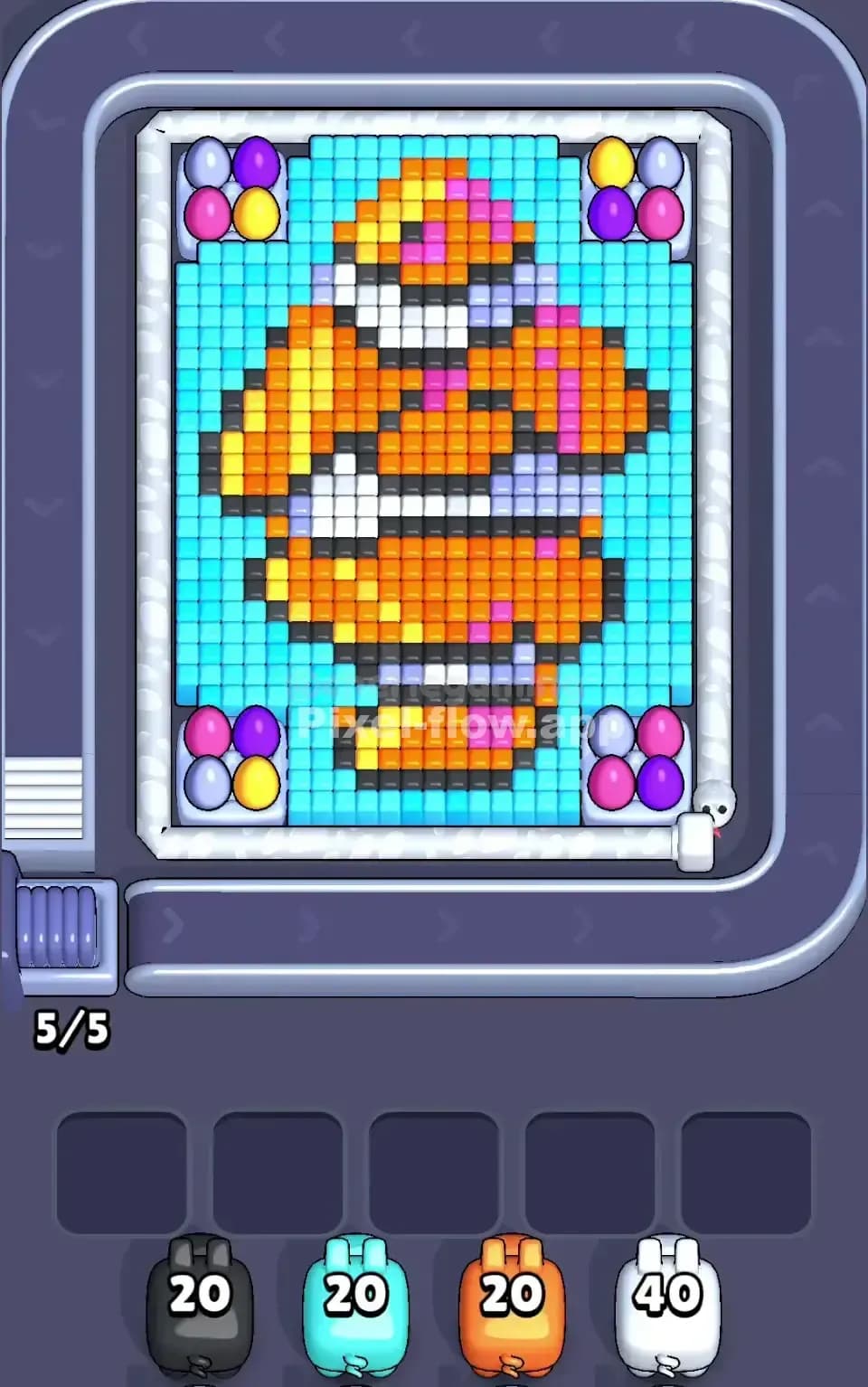
Pixel Flow Level 334 presents a cheerful, multi-layered voxel character—think a cute creature or mascot with a distinctive face and body structure. The pixel art is built in horizontal bands of color, with a vibrant cyan background framing the main subject. You'll see dominant warm tones (orange, yellow) mixed with cooler accents (magenta, white, and light blue), creating a puzzle that looks straightforward but hides real complexity beneath its friendly exterior. The character's proportions mean that certain colors cluster heavily in the middle layers, while others are sparse or locked behind deeper voxels. This layered sandwich structure is what makes Pixel Flow Level 334 genuinely demanding—you can't just blast away at the obvious colors and expect victory.
Win Condition and Deterministic Nature
Your goal is refreshingly clear: clear every single cube from the board. What keeps Pixel Flow Level 334 challenging, though, is that every pig arrives with a fixed ammo count, and every move is deterministic. There's no luck involved once you understand the queue. You've got four pigs waiting below the board (in this case: a black pig with 20 ammo, a cyan pig with 20 ammo, an orange pig with 20 ammo, and a white pig with 40 ammo), and you control their order. The order you pull them from the queue directly controls which cubes get destroyed and how quickly you expose the next layer. Get the sequence wrong, and you'll cram your waiting slots full of half-spent pigs with nowhere to aim—game over.
Why Pixel Flow Level 334 Feels So Tricky
The Core Bottleneck
The biggest threat to your success in Pixel Flow Level 334 is a severe mismatch between ammo availability and the actual cube distribution. You start with 100 total ammo (20 + 20 + 20 + 40) and exactly 100 cubes to destroy. Sounds perfect, right? Not quite. The problem is that certain colors occupy tiny, scattered regions on the board. If you pull out a pig whose color isn't immediately visible—or if you burn through that color too quickly—that pig will drop into the waiting slots with ammo still loaded, and it'll be sitting idle. In Pixel Flow Level 334, this happens fast. The white pig, for instance, has a whopping 40 ammo but might not have 40 white cubes sitting on the surface once you've exposed a few layers. That's your jam point right there.
Subtle Problem Spots
One sneaky issue is the magenta clusters scattered in the corners. They look small and harmless, but they're scattered enough that the magenta pig (if there were one in the queue—though in this case, those cubes are handled by other colors) could activate and then get stuck. Similarly, the face details create pockets of white voxels that don't align neatly with your ammo flow. You might destroy the "obvious" white cubes in the top section, only to find the remaining white is hidden three layers down, with no way to expose it because you've already parked your white pig.
Another subtle trap is the orange-yellow boundary. These warm tones blend visually, which can trick you into thinking one color's job is finished when, in fact, deeper orange or yellow blocks are still waiting beneath. In Pixel Flow Level 334, this color confusion cost me a couple of failed runs before I learned to count pixel-by-pixel rather than estimate by eye.
When the Level "Clicks"
Honestly, Pixel Flow Level 334 frustrated me at first. I kept jamming the buffer around move 8 or 9, staring at two idle pigs and three full waiting slots. But then I reframed my thinking: instead of asking "which color looks easiest to clear," I started asking "which color must be exposed right now to unlock the next layer?" That mindset shift made everything clearer. Once I accepted that the puzzle required a strict sequence rather than flexible strategy, I knocked it out on the next attempt.
Step-by-Step Strategy to Clear Pixel Flow Level 334
Opening: Establish Flow and Preserve Buffer Space
Start Pixel Flow Level 334 by pulling the cyan pig first (20 ammo). Cyan appears in scattered patches—especially in the background—but there should be exactly enough cyan cubes to spend its ammo without overflow. The cyan pig will carve away background detail and expose mid-layer colors. Don't worry if it seems slow; you're essentially "clearing the clutter" that hides what's actually blocking your progress. After the cyan pig drops into a waiting slot, you'll have four free slots remaining. That's healthy breathing room.
Next, pull the black pig (20 ammo). Black appears in the character's outline and facial details. It's a workhorse color that needs steady removal to expose the interior colors. The black pig should spend most or all of its ammo without jamming, because black cubes are distributed across multiple depth layers. As it fires, you'll start to see the true structure of Pixel Flow Level 334 emerge: the character's face and body become clearer, and you'll notice which inner colors are ready to be targeted. After the black pig settles, you should still have three free slots—crucial insurance against future jams.
Mid-Game: Sequence Pigs to Match Exposure
Now pull the orange pig (20 ammo). Orange is the dominant color in the body and limbs of the character in Pixel Flow Level 334. Here's where patience pays off: the orange pig has exactly 20 ammo, and you likely have between 18 and 22 orange cubes depending on how much cyan and black exposed. If you're close, great—let the orange pig fire and settle. If you're way over on orange, that's a red flag; it means you didn't expose enough of the underlying structure yet, and forcing the orange pig now will leave it parked with ammo unused. In that case, send the white pig (40 ammo) instead to clear white accents and details, which creates more depth exposure and eventually reveals additional orange blocks buried beneath.
The key principle in Pixel Flow Level 334's mid-game is this: always check what's newly visible on the board before committing to the next pig. Watch the queue, count how many cubes of each color are showing, and plan two pigs ahead. If you see that white and orange will dominate the remaining surface, but your cyan and black pigs are already parked, adjust your next move to empty the waiting slots strategically. Park a pig only when you're absolutely sure the next pig's color exists and will spend most of its ammo.
End-Game: Close the Puzzle Without Jamming
As you approach the final few cubes in Pixel Flow Level 334, your waiting slots are under pressure. You might have three pigs parked already, leaving only two slots for emergencies. Now is not the time to panic-fire random pigs. Instead, target the smallest remaining color clusters, knowing that each pig you pull must have a clear path to ammo spending. If you see 8 white cubes, 6 orange cubes, and 2 cyan cubes left, pull a pig whose color is one of those three—never pull a pig whose color isn't visible. If all visible colors are accounted for but a pig still has ammo, that pig will drop into the waiting slots anyway, so your buffer shrinks fast.
The final move should be a deliberate, solvable state. For Pixel Flow Level 334, this often means the white pig (with its hefty 40 ammo) becomes your cleanup crew, mopping up leftover white and any mixed-color end-game mess. Keep one waiting slot free until the absolute last pig fires its last cube. As soon as you see zero cubes remaining, you've won.
The Logic Behind This Pixel Flow Level 334 Plan
Exploiting Determinism and Pig Order
Pixel Flow Level 334 is solvable, not random. Every pig has the same ammo count, every cube is in the same place, and the waiting slots enforce a hard limit on mistakes. The strategy above works because it respects those constraints. By pulling cyan and black early, you're investing in exposure—clearing bulk cubes that don't matter so the cubes that do matter become visible. By reserving the white pig for end-game cleanup, you're using its massive 40 ammo as a safety buffer. The orange pig sits in the middle, handling the character's primary visual mass. This sequence isn't arbitrary; it's derived from the actual geometry and color distribution of Pixel Flow Level 334.
Staying Calm and Counting Ammo
The toughest mental challenge in Pixel Flow Level 334 is resisting the urge to "just try something." Instead, take two seconds before every pull to count cubes of the next pig's color. How many are visible? How much ammo does the pig have? Will there be leftovers? If the answer to the last question is "yes," don't pull that pig yet—work on exposure instead. Panic play is what fills your waiting slots and ends runs. Slow, deliberate play is what clears Pixel Flow Level 334. You've got the ammo and the pigs; the puzzle asks only for patience and a little arithmetic.