Pixel Flow Level 335 Solution Walkthrough | Pixel Flow 335
How to solve Pixel Flow level 335? Get instant solution for Pixel Flow 335 with our step by step solution & video walkthrough.


Pixel Flow Level 335 Overview
The Board and Its Pixel Art Subject
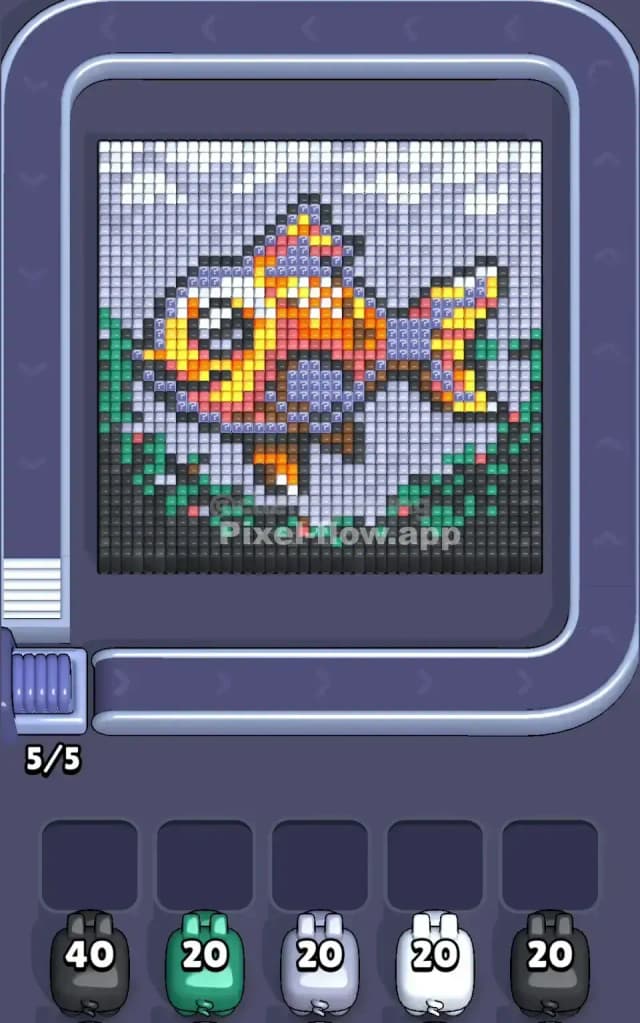
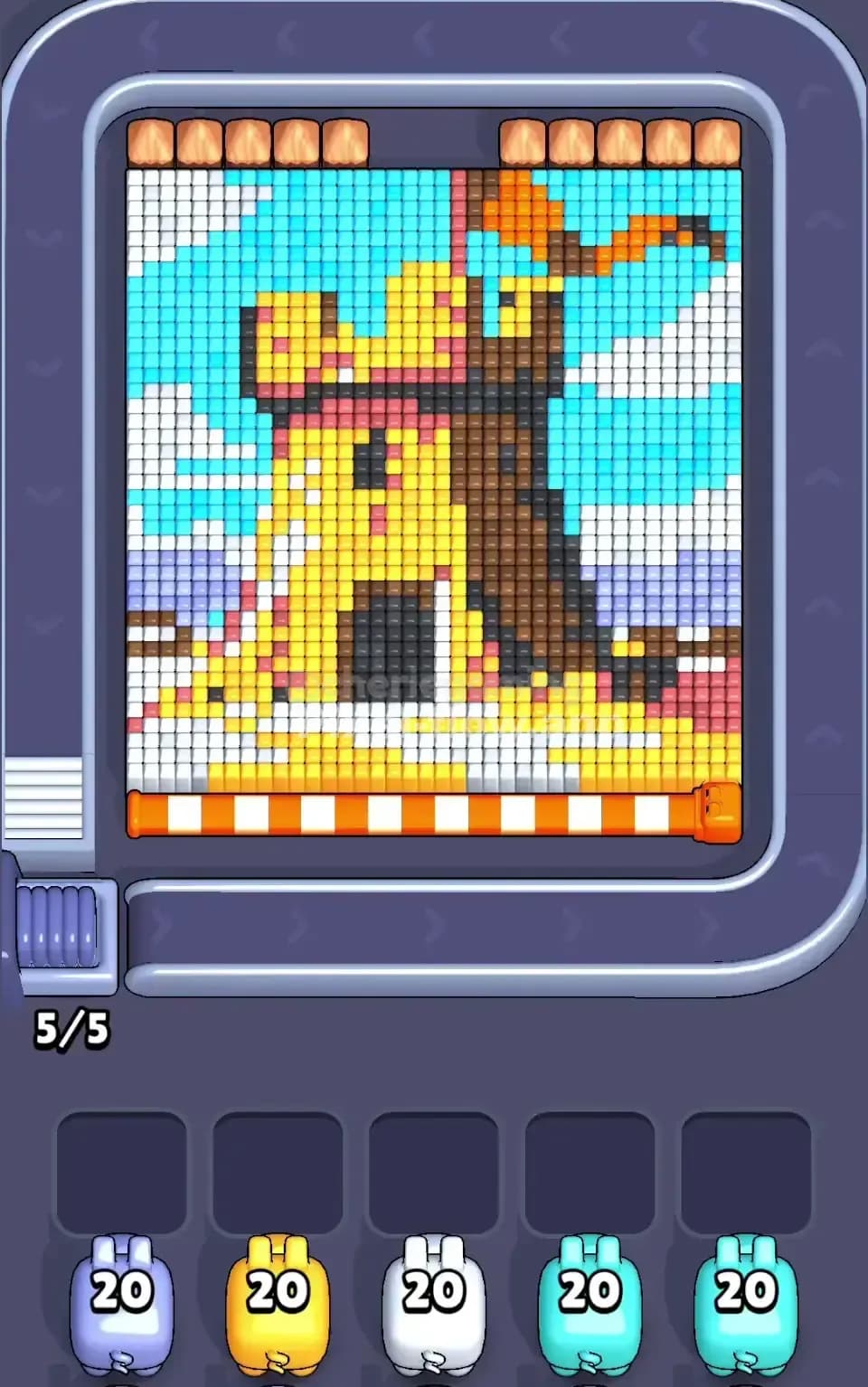
Pixel Flow Level 335 presents a charming desert scene dominated by a golden-brown camel standing against a bright cyan sky. The main subject occupies the center and right portions of the board, featuring warm yellows, oranges, and browns for the camel's body and distinctive humped silhouette. Behind and around the camel, you'll see a layered sky with cyan and white clouds, and at the bottom sits a sandy beach rendered in pale yellows and whites. The board is packed with color variety—you've got significant patches of cyan (sky), yellow and brown (camel), white (clouds and sand), and smaller accents of orange, red, and pink. What makes Pixel Flow Level 335 immediately challenging is that these colors aren't evenly distributed; the camel's body creates thick, interconnected regions that demand careful sequencing to expose.
Win Condition and Deterministic Pig Order
Your goal in Pixel Flow Level 335 is straightforward: clear every single voxel cube from the board. You're given five color-coded pigs, each arriving in a fixed order with exactly 20 ammo rounds. That's 100 total cubes to eliminate, and every action is deterministic—the same sequence of moves will always produce identical results. This means Pixel Flow Level 335 isn't about luck; it's about planning. You must decide which pigs to deploy first, which colors to expose, and how to manage your waiting slots so that no pig gets permanently stuck with leftover ammo and nowhere to go.
Why Pixel Flow Level 335 Feels So Tricky
The Central Bottleneck: Camel Body Density
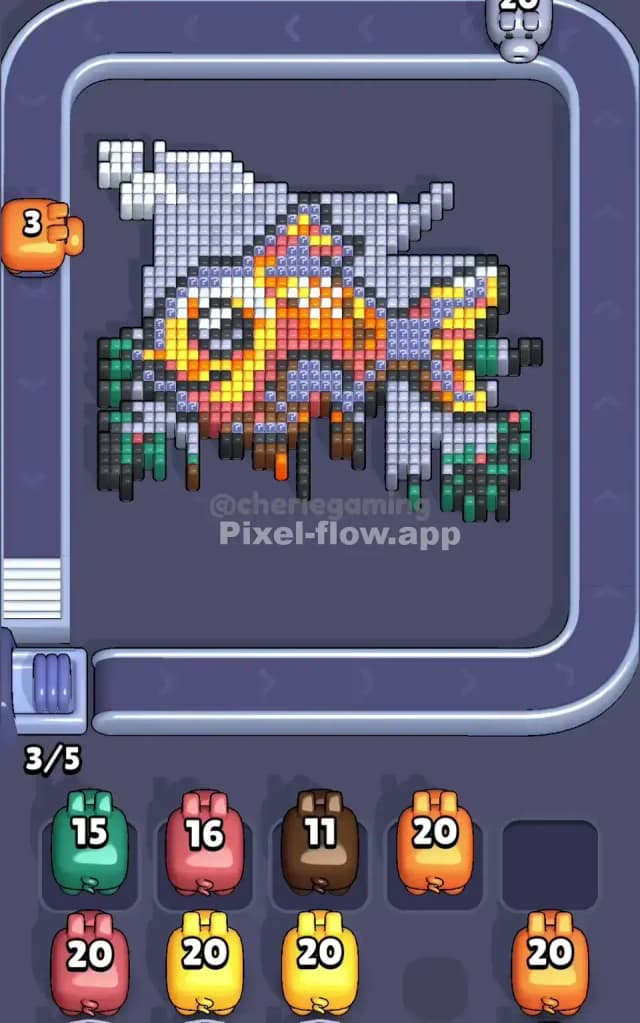
The biggest trap in Pixel Flow Level 335 is the camel's thick, interconnected body dominating the center of the screen. This creates a density bottleneck where multiple colors (yellow, brown, orange) are layered and interlocked, making it tempting to spend pigs randomly on whichever color appears first. If you're not careful, you'll burn through your yellow pig's ammo on exposed yellow pixels in the camel's mane, only to discover that deeper yellow cubes are hidden beneath brown or orange layers. This forces you to sit waiting pigs in the buffer while you excavate, and before you know it, you've filled four of your five slots with half-spent pigs that have no valid targets.
Subtle Color Patches and Misaligned Ammo
Pixel Flow Level 335 has several secondary color patches that don't immediately match your pig count. The sky is dominated by cyan (which has a dedicated pig), but there are scattered white clouds and faint blue shadows that can trick you into thinking white or purple pigs have more work than they actually do. Similarly, the sandy beach is mostly white and pale yellow, but red and pink accents in the lower corners create isolated clusters. If you don't count your targets carefully, you might deploy a pig with 20 ammo expecting to clear 25 cubes, leaving that pig stranded with leftover ammunition and no matches. The white pig is particularly vulnerable in Pixel Flow Level 335 because white appears everywhere—sky clouds, sand, and the camel's highlights—but not in the quantities you'd expect from an even distribution.
Personal Reaction and the "Click" Moment
I'll be honest: Pixel Flow Level 335 frustrated me on my first five attempts because I kept assuming the camel's brown and yellow sections were interchangeable targets. Every time I'd clear some yellow pixels, I'd expect the brown underneath to be next, but instead, more cyan or orange would emerge, forcing me to pivot. The level clicked for me only when I stopped reacting to visible cubes and started mapping out entire color regions before I moved a single pig. Once I realized the camel was essentially a three-layer puzzle—outer yellows and browns, mid-layer oranges, and inner browns—suddenly the waiting slots made sense as temporary holding zones, not failure states.
Step-by-Step Strategy to Clear Pixel Flow Level 335
Opening: Establish Breathing Room and Expose Layers
Your first two moves in Pixel Flow Level 335 should prioritize establishing control rather than burning ammo frantically. I recommend deploying the cyan pig first, since the sky dominates the upper half of the board and offers clean, unobstructed targets. Cyan has 20 ammo and roughly 20 cyan cubes scattered across the sky and background, so this should feel satisfying and slightly net-positive. As the cyan pig shoots, the upper board clears significantly, revealing what's underneath: more white clouds and hints of the camel's head and orange mane.
Next, send the white pig into battle. White appears in the clouds, sand, and scattered highlights, giving you roughly 18–20 targets if you count carefully. The white pig will chew through the cloud layer and the sandy beach simultaneously, opening up sight lines to mid-board colors. After these two pigs, you should have only two waiting slots occupied (with whatever ammo they had left), leaving you three slots of freedom. Don't be tempted to empty the buffer yet; those two pigs might find new targets as layers shift.
Mid-Game: Sequence Yellow, Brown, and Orange with Precision
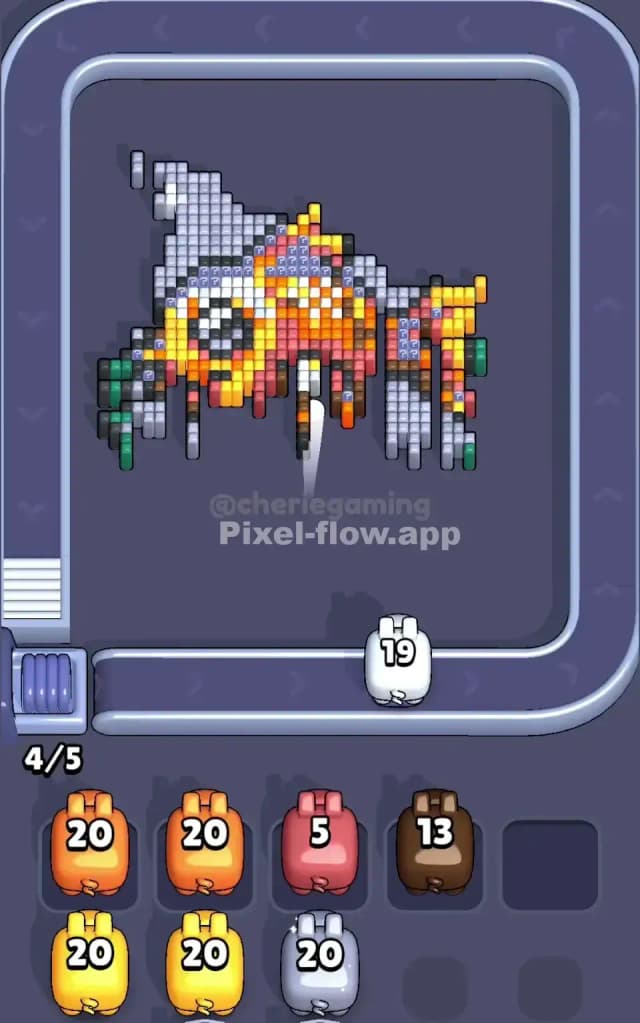
Now comes the critical phase of Pixel Flow Level 335. The camel's body is now more visible, and you're facing overlapping yellow, brown, and orange clusters. Here's where patience matters: deploy the yellow pig third, but watch carefully as it shoots. Your yellow pig has 20 ammo and will target all exposed yellow cubes—both the bright highlights on the camel's flanks and the deeper yellows in the body. As yellow clears, brown cubes underneath will become exposed, but don't panic and immediately send the brown pig. Instead, count the visible brown targets. If you see only 12–15 brown cubes and the brown pig has 20 ammo, you know the brown pig will need a second "pass" or will get stuck with leftover ammo.
To avoid trapping the brown pig, consider deploying the orange pig next (fourth overall). Orange is concentrated in the camel's mane and upper back, with roughly 16–18 visible cubes. This intermediate step breaks up the yellow-brown-orange tangle, allowing new layers to shift and expose fresh brown targets. Once orange has taken its turn, the brown pig's remaining work becomes clearer: the primary brown body should be largely visible, and any hidden layers will be edges you can account for. Deploy the brown pig (your fourth pig) with confidence that its 20 ammo can be spent almost entirely.
End-Game: Clean the Buffer and Finish Strong
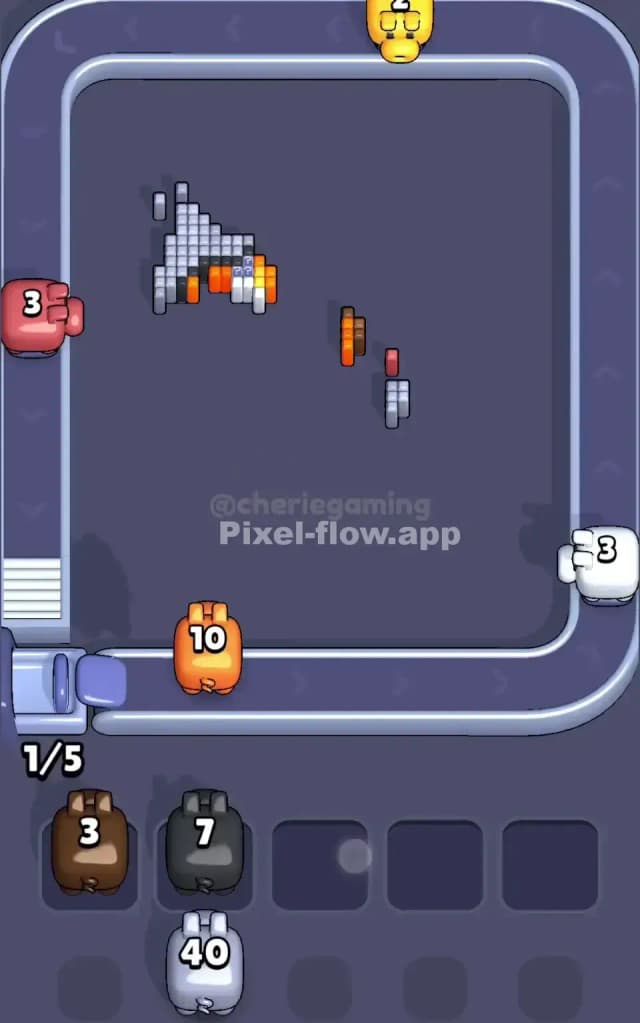
By this point in Pixel Flow Level 335, you've deployed four pigs and should have no more than two waiting slots occupied. Your cyan, white, yellow, and orange pigs have collectively cleared roughly 75 cubes, leaving 25 or so. The brown pig likely still has 3–6 ammo remaining, sitting in a waiting slot. This is the moment to deploy your final cyan pig (yes, there are two cyan pigs in the queue). This second cyan pig will handle any lingering cyan cubes you might've missed in the shadows or overlapped regions, and it should push your total cleared cubes to around 90.
Finally, manage any remaining waiting slots. If your first cyan pig (now in a slot) still has 1–2 ammo and there's one cyan cube hiding in a corner, that'll auto-resolve when the second cyan pig shoots and potentially shifts the board. If the white pig or brown pig are sitting with 2–3 ammo and no valid targets, they're genuinely stuck—but if you've followed this sequence, Pixel Flow Level 335 shouldn't leave you in that state. The key to a clean finish is ensuring that by the time you reach your final pig, the waiting slots are either empty or contain pigs with truly zero remaining ammo.
The Logic Behind This Pixel Flow Level 335 Plan
Exploiting Order, Ammo Counts, and Slot Management
The strategy above works for Pixel Flow Level 335 because it respects the fundamental game mechanic: pigs fire in a fixed order, and the board shifts only when cubes are destroyed. By sending low-risk, high-visibility pigs first (cyan and white), you reduce the board's visual chaos and create space for the mid-game density (yellow, brown, orange) to spread out. You're not reacting to the board; you're reshaping it so that later pigs inherit a clearer puzzle. The waiting slots aren't punishments—they're holding zones that let you defer a pig's deployment until the board state has shifted enough to expose all its targets.
Pixel Flow Level 335 is solvable because the total ammo (100) matches the total cubes, and the five colors are distributed logically. Once you accept that the camel's interior is layered, you stop fighting the puzzle and start orchestrating it. The plan I've outlined treats waiting slots as intentional pauses rather than signs of failure, letting pigs sit temporarily while you reshape the board beneath them.
Staying Calm: Reading the Queue and Counting Ammo
The final skill that makes Pixel Flow Level 335 manageable is staying calm under pressure. Before you deploy each pig, pause and count the visible cubes of that color. If a pig has 20 ammo and you see only 12 targets, that pig will get stuck unless you're confident that more targets will appear as other pigs shoot. In Pixel Flow Level 335, the worst outcome isn't a hard puzzle—it's panic-deploying all five pigs simultaneously and watching three of them jam into waiting slots with nowhere to spend their ammo. Instead, deploy one or two at a time, observe the results, and plan two or three pigs ahead. Watch the queue at the top of the screen; it tells you exactly which colors are coming. If your next two pigs are both cyan, you know you'd better clear a lot of cyan targets with your current pig, or you'll have a backup that can mop up. Pixel Flow Level 335 rewards forward-thinking and punishes reactive scrambling, so breathe, count, and commit.