
Pixel Flow Level 337 Solution | Pixel Flow 337 Walkthrough
How to beat Pixel Flow Level 337: Video solution & walkthrough. The fastest way to pass Pixel Flow 337.
Is this the wrong level layout?🤔
Pixel Flow randomizes levels for different players. Don't worry, just upload a screenshot of your board, and our AI will find the correct video instantly.


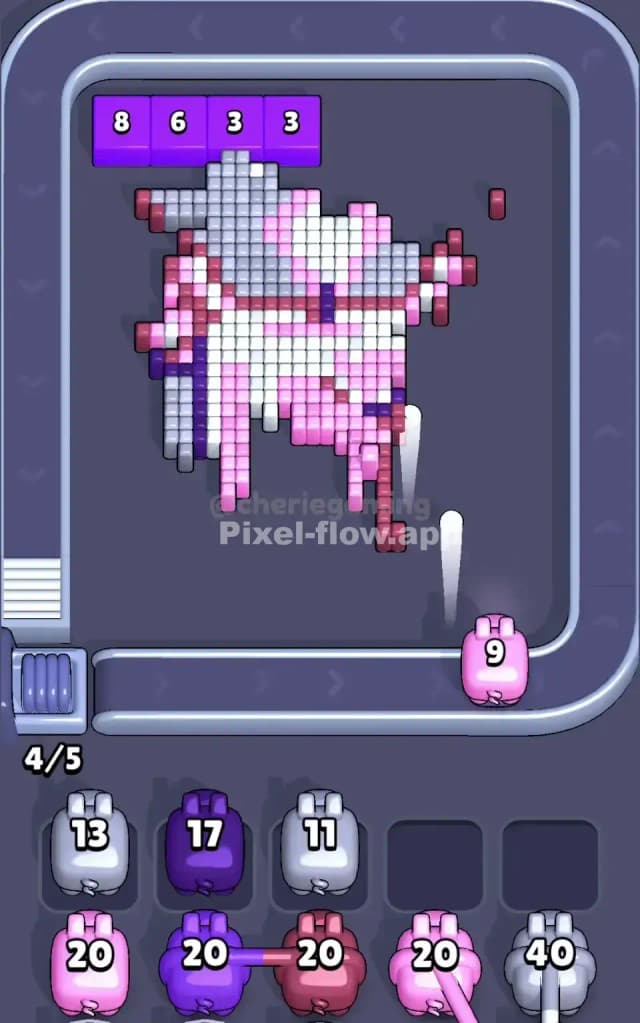

Pixel Flow Level 337 Walkthrough
This level features a stylized, magical candle. It sits on a dark purple base, with a central body of pink and white wax, flanked by two winged structures on the sides. A diamond-shaped flame floats above the wick. The entire scene is set against a pale grey background that acts as a "blocker" layer for almost everything interesting underneath.
Is it very hard? No. It's a moderate challenge. The main difficulty isn't complexity, but volume. The grey background is thick, and the central pink mass requires a lot of ammo. If you aren't efficient with your white/grey pigs early on, you will run out of slots.
Pixel Flow Level 337 Overview
Think of this picture as a layered cake. The "icing" is that massive field of light grey pixels covering the background and parts of the wings. You can't reach the delicious filling—the pink wax or the dark purple base—until you eat through that icing.
The candle itself is symmetrical. It has a heavy base of dark purple that spans the bottom width. The middle is a mix of solid pink and white highlights. The top flame is tricky because it’s isolated; it floats above the main body, surrounded by background grey. This isolation makes it easy to miss stray grey pixels up there, which blocks your access to the flame's core later.
There is a significant asymmetry in color density:
- Grey/White: Dominates the outer edges and the top half.
- Pink: Concentrated heavily in the center "wax" area.
- Dark Purple: A thick bar at the very bottom and accents on the wings.
Your strategy must respect this layout. You have to peel the onion from the outside in.
Step by step solution walkthrough for Pixel Flow Level 337
First Color Zone to Erase in Pixel Flow Level 337
Focus immediately on the Light Grey / White background.
Narratively, you are clearing the fog to see the candle. Logically, this is the only move that makes sense. Look at the board state: the grey pixels form a protective shell around the pink center and the purple base. If you try to deploy pink pigs now, they will have almost zero targets and will just clog your waiting slots.
- Prioritize White/Grey Pigs: Whenever a white pig comes down the conveyor belt, grab it. Let it shred the background.
- Target the Top Flame Area: The background around the diamond flame is tricky. Clear this early so you don't have stray grey blocks hanging out alone later.
- Ignore the Bottom Purple: Even though the dark purple base looks accessible, it usually sits behind a layer of grey or is blocked by the logic that you clear top-down or outside-in. Save purple pigs for later unless you see a clear, uninterrupted line of sight to the bottom row.
How to pass Pixel Flow Level 337 without power ups or boosters
Once the grey background is about 60-70% gone, the board looks messy. You'll have the central candle exposed, but jagged edges of grey will still cling to the wings. This is the danger zone where players lose.
- The Pink Trap: You will see a lot of pink now. It’s tempting to spam every pink pig you see. Don't. Check the shade of pink. The candle has a lighter pink and a slightly darker magenta/red tone on the right side (shadow). Ensure your pig matches the specific block of pixels available.
- Slot Management: You only have 5 slots. If you have 3 pink pigs waiting and the conveyor belt brings a White pig you desperately need to clear the last grey blocks, you are in trouble. Keep at least 2 slots open at all times.
- The "Wing" Tips: The wing-like structures on the left and right are mixed colors (white, pink, purple tips). These often have depth layers. Clear the white parts of the wings fully before trying to hit the purple accents behind them. If a white pig has ammo left but no targets, it sits in your slot. Make sure you have enough white targets (check the wings!) before grabbing that pig.
Last Details You Clean Up in Pixel Flow Level 337
In the final phase, the majestic candle stands mostly revealed. The grey fog is gone. Now you are just melting the wax.
- The Dark Purple Base: This is usually the last big chunk. It's a solid horizontal bar at the bottom. Save your high-ammo purple pigs for this moment. They will rip through that bottom row in seconds.
- The Flame Core: The center of the flame is often white or very light yellow. Don't forget it. Sometimes you clear the pink outline of the flame and forget the center block, leaving one tiny cube floating at the top.
- Hidden Shadows: Check the right side of the candle body. There is often a vertical strip of darker red/magenta representing shadow. This is a separate color from the main pink. Don't confuse them, or your pink pigs will stall out. Clear the main pink face first, then the shadow, then the purple base to finish.