Pixel Flow Level 338 Solution | Pixel Flow 338 Walkthrough
How to beat Pixel Flow Level 338: Video solution & walkthrough. The fastest way to pass Pixel Flow 338.
Is this the wrong level layout?🤔
Pixel Flow randomizes levels for different players. Don't worry, just upload a screenshot of your board, and our AI will find the correct video instantly.

Pixel Flow Level 338 Walkthrough
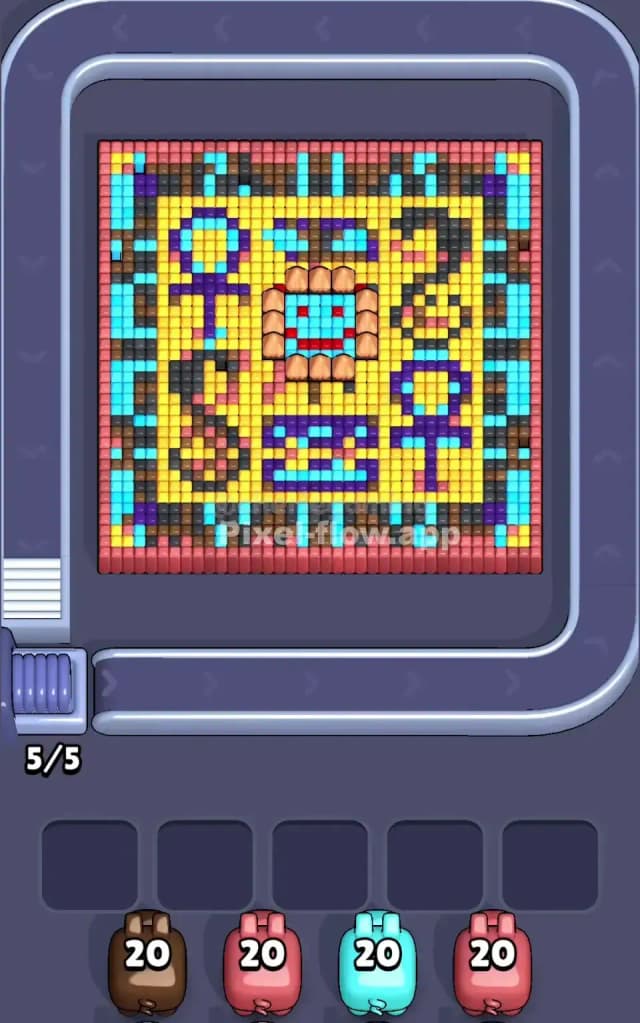
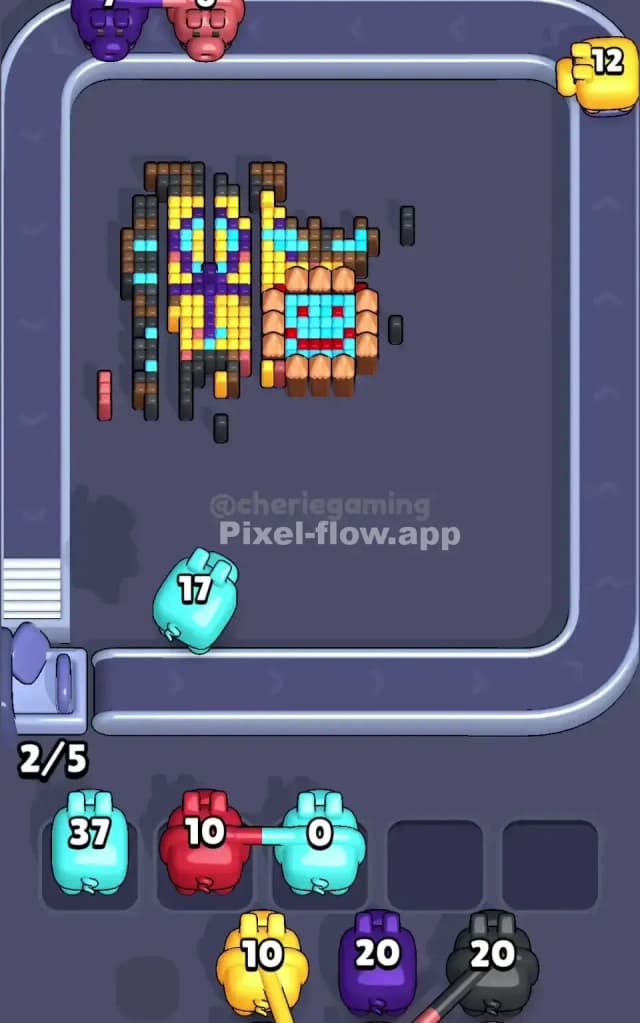
Level 338 is an intricate puzzle that looks like an ancient Egyptian tablet. You are dealing with a dense, flat square of pixels featuring golden yellow sand, hieroglyphic symbols in purple and black, and a turquoise border pattern. The rules here are standard but unforgiving: you must clear the outer layers to reach the core. Because the board is a solid square with no gaps, reaching the middle requires chipping away at the edges first. This is a very hard level because the colors are tightly interwoven—if you grab a yellow pig too early, it will have nowhere to shoot because the yellow is trapped behind red and cyan borders.
Pixel Flow Level 338 Overview
Think of this level as excavating a tomb. The artwork depicts a golden square tablet. In the dead center sits a blue face or mask surrounded by brown "teeth" or spikes. Flanking this central mask are two large purple Ankh symbols (the looped cross of life) on the left and right sides. Above and below the face are more abstract symbols in black and purple.
The entire scene is framed by a complex border. The outermost rim is a solid strip of reddish-pink cubes. Just inside that is a decorative pattern of alternating cyan (light blue) and dark brown blocks. The "sand" (yellow background) fills all the negative space between the symbols, but it is deeply buried.
The critical asymmetry here is vertical. The columns of cyan and brown on the far left and far right act as "walls." You cannot easily hit the yellow or purple pixels until you break down these vertical barriers or the top/bottom red rows.
Step by step solution walkthrough for Pixel Flow Level 338
First Color Zone to Erase in Pixel Flow Level 338
Your absolute priority is the Reddish-Pink Border.
I start by shaving off this outer rim because it completely encases the puzzle. Look at the top and bottom edges of the square—they are solid lines of red. Until these are gone, your vertical shots are useless against anything else. Grabbing a red pig first guarantees it will empty its ammo quickly, clearing the top and bottom rows and exposing the cyan/brown pattern underneath. Do not touch the yellow or purple pigs yet; they will just clog your slots because their targets are buried deep in the center.
How to pass Pixel Flow Level 338 without power ups or boosters
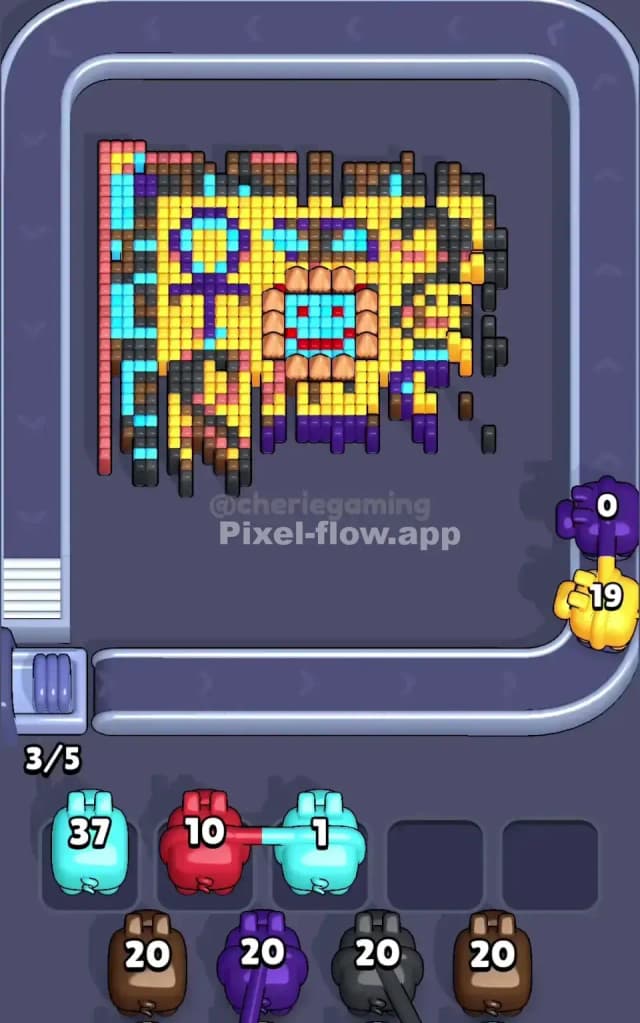
Once the red border is gone, the puzzle looks like a "striped" block. You now have access to the Cyan and Dark Brown vertical columns on the left and right edges.
This is the mid-level danger zone. You will see a lot of Yellow pigs on the belt. Ignore them. Even though yellow is the biggest color on the board, it is still acting as a "background" layer behind the symbols and the side borders. Focus entirely on the Cyan (Light Blue) and Dark Brown pigs.
- Prioritize the sides: Use Cyan and Brown pigs to eat away the vertical columns on the far left and right. This "widens" your attack surface.
- The Central Face: As you clear the sides, you might expose the brown spikes around the central blue face. Use brown pigs here carefully.
- The Ankhs: Once the side columns are down, the Purple Ankh symbols become vulnerable. Now is the time to pick up Purple pigs.
- Yellow Last: Only start grabbing Yellow pigs when you have cleared at least one major side of the tablet or the purple symbols are gone. If you grab yellow while the border is still up, your pig will shoot 2-3 blocks and then sit in your waiting slot, blocking you from winning.
Last Details You Clean Up in Pixel Flow Level 338
In the final stages, the "tablet" is usually reduced to just the central mask and scattered patches of yellow sand.
The last stubborn pixels are usually the Black symbols mixed into the yellow background or the Blue Face in the very center. The central face is often protected by those brown spikes until the very end. Save your Blue pigs for this specific moment. You will likely finish by mopping up the remaining yellow background pixels that were hiding behind the Ankhs, leaving the board completely clean. Be patient with the yellow; it feels like you should clear it earlier, but it is the glue holding the trap together.