Pixel Flow Level 345 Solution | Pixel Flow 345 Walkthrough
How to beat Pixel Flow Level 345: Video solution & walkthrough. The fastest way to pass Pixel Flow 345.
Is this the wrong level layout?🤔
Pixel Flow randomizes levels for different players. Don't worry, just upload a screenshot of your board, and our AI will find the correct video instantly.



Pixel Flow Level 345 Walkthrough
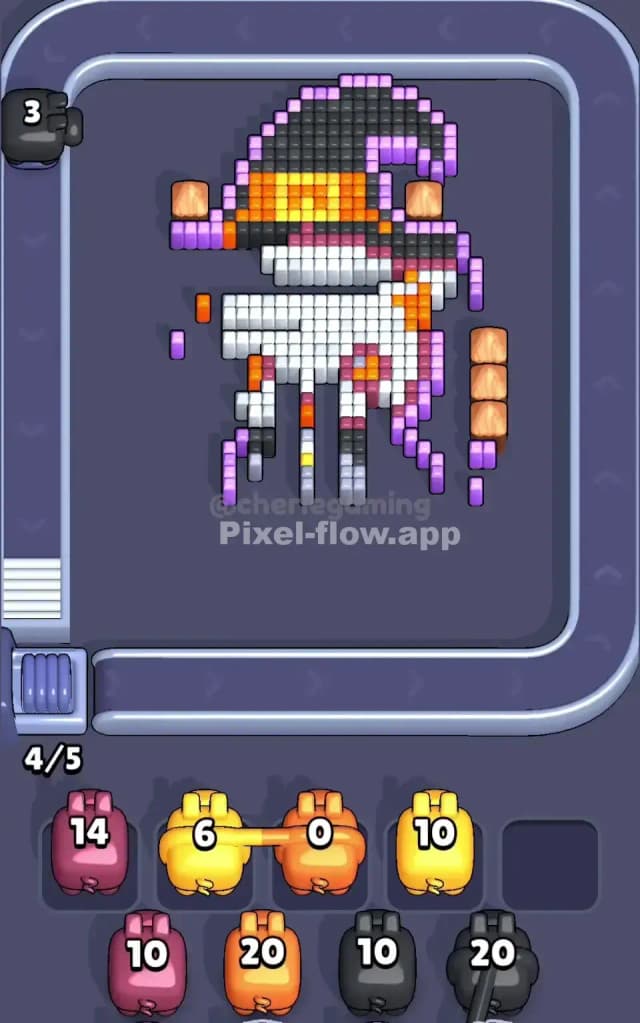
This puzzle features a pixel art character that looks like a white cat (or perhaps a small fox) dressed in a Halloween witch costume. The image is dense. The layers are tightly packed. You have a massive amount of white voxels in the center, wrapped in a black cape and hat, which is further wrapped in a thick purple outline. To beat Pixel Flow Level 345, you need to peel this character like an onion: outline first, clothes second, body third.
Is this a hard level? Yes. I would classify it as very hard. The sheer volume of white pixels in the center can easily waste your pig ammo if you don't clear the black and purple obstructions first.
Pixel Flow Level 345 Overview
The subject is a spooky-cute "Witch Cat." It sits right in the center of the board, dominating the space. The artwork is distinct because of its heavy layering.
- The Outer Shell: A vibrant Purple and Pink border runs along the bottom, curves up the right side (forming a tail), and outlines the oversized witch hat. This is your primary barrier.
- The Clothing: Inside the purple shell, you have a solid Black fill. This represents the witch's cape and the main body of the hat.
- The Core: The cat’s face and chest are a massive block of White. This is the "meat" of the level.
- The Accents: There are splashes of Orange/Yellow. You see them in the hat's buckle, the cat's ears, the eyes, and a stack of three blocks on the far right side.
The board is asymmetrical. The right side is heavier due to the tail and the stack of orange blocks. The left side is cleaner but features a "20" weight block that acts as a damage sponge. This weight block is annoying. It sits there, absorbing shots that could be going to valid pixels if you aren't careful with your angles.
Step by step solution walkthrough for Pixel Flow Level 345
First Color Zone to Erase in Pixel Flow Level 345
You must attack the Purple layer first.
Look at the bottom row and the huge curve of the hat. The purple outline is the only color completely exposed to the conveyor belt at the start. If you try to slot a white or black pig early, they will likely just sit in your waiting slots, useless, because the purple pixels are physically blocking the shots to the inner layers.
Prioritize the Purple (Pink) pigs immediately. The screenshot queue shows a Purple pig with 20 ammo. This is a gift. Drop it. It will shred the bottom row, the tail on the right, and the tip of the hat. Once that purple wrapper is gone, the black interior becomes vulnerable. Do not get distracted by the orange blocks on the right yet. They are isolated. The main goal is opening the center.
How to pass Pixel Flow Level 345 without power ups or boosters
The mid-game of Pixel Flow Level 345 is the dangerous part. This happens when the purple outline is mostly gone, and you are left with the Black cape and the giant White face.
Here is where players lose: The Orange Trap.
You will see orange pixels in the cat's eyes and the hat buckle. You will also see those orange blocks on the right. You might be tempted to drop an Orange/Yellow pig to clear those blocks. Don't force it. The orange eyes and buckle are buried deep inside the White and Black layers. If you drop an Orange pig too early, it will destroy the exposed right-side blocks and then sit in a slot with 10 ammo left, doing nothing because the eyes are still covered by white pixels.
The Strategy:
- Clear Black before White: The black hat pixels often overhang the white face. If you don't clear the black hat brim, your white pigs might waste shots hitting the top of the head at bad angles or getting blocked entirely.
- Manage the White Mass: The white section is huge. You will need multiple White pigs. Ensure you have at least two empty slots before committing to a White pig chain. If your slots are clogged with a leftover Orange pig or a Black pig with no targets, you will choke when the conveyor belt brings the White pigs you desperately need.
- The "20" Weight: Ignore it until you have a clear shot. Often, clearing the adjacent pixels is better than trying to brute-force destroy the weight itself. Let the natural flow of clearing the cape (Black) expose the area around the weight.
Last Details You Clean Up in Pixel Flow Level 345
As you approach the end of Pixel Flow 345, the board usually looks like a floating skeleton of the original image.
The White face should be mostly gone. What remains are usually the stubborn Orange bits. specifically the eyes and the vertical stripes on the chest (the tie/vest). These are "deep layer" pixels. They are the last things to be exposed.
Your final moves will likely involve:
- Using a precise Orange/Yellow pig to snipe the eyes and the hat buckle.
- Cleaning up any stray Purple pixels that might have hidden in the corners of the hat tip.
- Ensuring the "20" weight is finally destroyed if it hasn't been already.
The victory condition often hinges on having one slot open for that final Orange pig. If you clogged your slots earlier with impatient plays, you won't have room for the specific color needed to snipe the cat's eyes. Keep it clean. Clear outside in. Purple -> Black -> White -> Orange.