Pixel Flow Level 36 Solution Walkthrough | Pixel Flow 36

How to solve Pixel Flow level 36? Get instant solution for Pixel Flow 36 with our step by step solution & video walkthrough.

Share Pixel Flow Level 36 Guide:
Pixel Flow Level 36 Gameplay
Pixel Flow Level 36 Solution 1
Pixel Flow Level 36 Solution 2
Pixel Flow Level 36 Solution 3

Pixel Flow Level 36 Overview

The Board and Its Layers

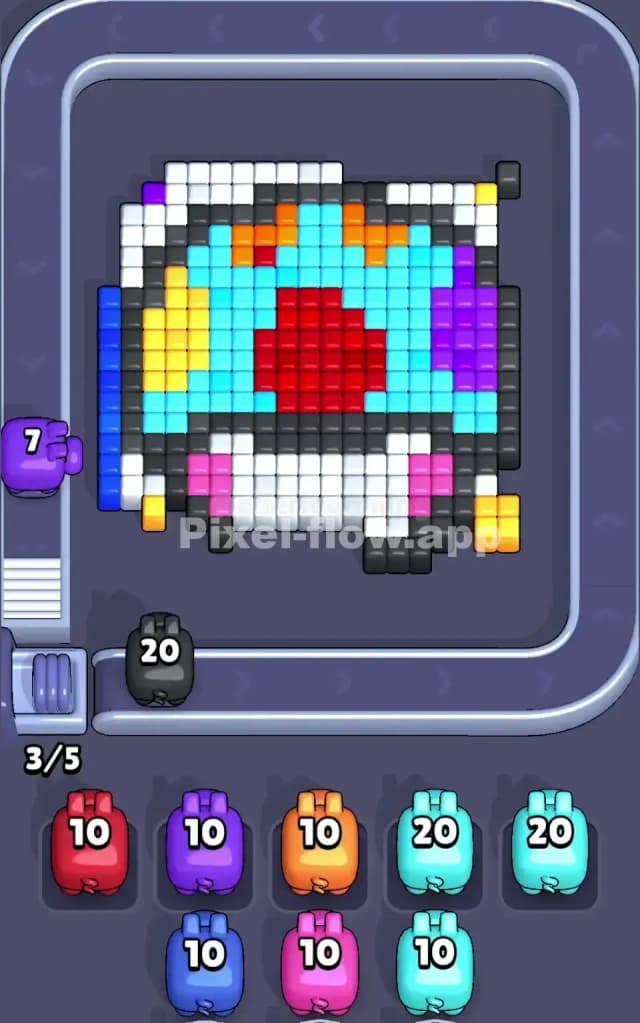
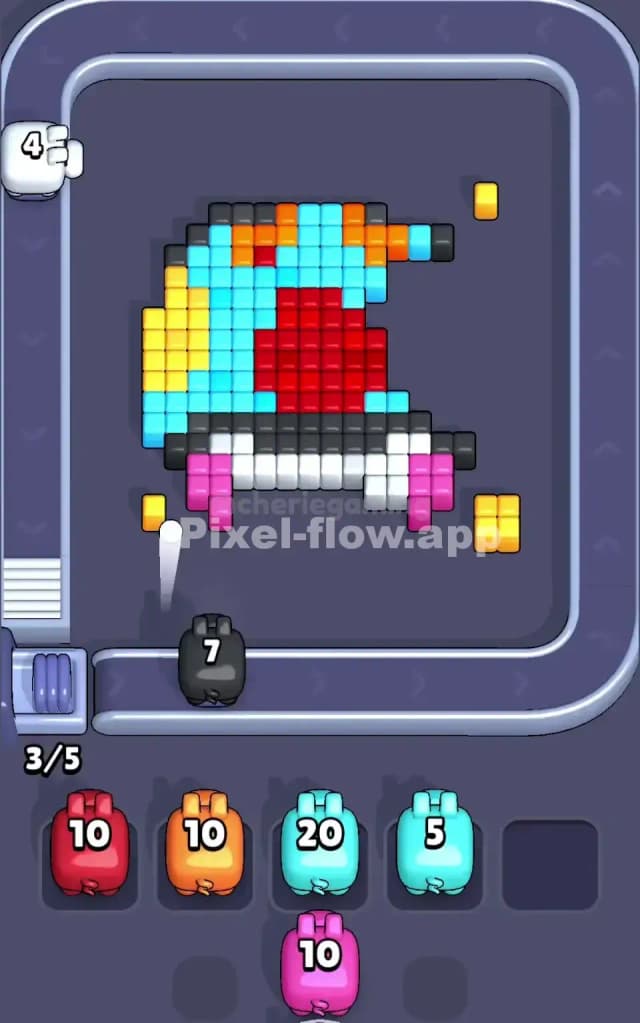
Pixel Flow Level 36 presents you with a striking pixel art composition of a stylized creature or face with a bold color palette. The dominant foreground layer is a large red shape forming the central focal point—think of it as the "hero" of your puzzle. Surrounding this red core, you'll find massive blocks of cyan that create a halo or body effect, with supporting patches of white, gray, and black forming structure and definition. The outermost layer consists of blue blocks that frame the entire composition, while yellow and magenta accents appear in the corners and edges, adding visual flavor to the design. This layered structure is key: you cannot expose and clear the cyan, white, and inner colors until you've systematically dismantled the red and outer blue regions first.

The Win Condition and Deterministic Nature

To beat Pixel Flow Level 36, you need to clear every single voxel cube on the board. Your three incoming pigs each carry exactly 10 ammo: an orange pig, a magenta pig, and a red pig. Every cube you destroy of a matching color consumes one unit of ammo from that pig. The beauty—and the trap—of Pixel Flow 36 lies in the fact that the pig order and ammo counts never change. This means your solution isn't about luck; it's about understanding the exact sequence and counting ruthlessly to ensure no pig gets stuck in the waiting slots with unspent ammo.


Why Pixel Flow Level 36 Feels So Tricky

The Red Bottleneck

The most obvious threat in Pixel Flow Level 36 is the sheer volume of red cubes stacked in the center. Your red pig arrives with 10 ammo, and you've got far more than 10 red cubes visible. Here's where new players panic: they assume the red pig will jam immediately because it can't shoot all the red it sees. But that's not how Pixel Flow works. The trick is that you must fire other pigs first to expose deeper layers and reduce the red count, or you'll deliberately use up your orange and magenta ammo on surface colors, then let the red pig drop into the waiting slots. The problem arises when you've miscounted and the red pig still has 3–4 ammo left with no valid targets—that's a guaranteed failure.

The Cyan Trap and Mid-Layer Confusion

Cyan dominates a huge swath of the board, wrapping around the red core and extending into the middle-to-outer regions. You don't have a cyan pig, so every cyan cube must be cleared by exposing the colors beneath it or letting them sit until they're no longer blocking progress. This creates a nasty psychological trap: cyan looks like it should be a priority, but it's actually a passive obstacle. If you're not careful about pig sequencing, you'll run out of orange and magenta ammo while cyan is still partially visible, leaving you with a red pig that has nowhere to shoot—and boom, you're stuck.

The Corner Clutter: Yellow and Magenta Adjacency

The yellow and magenta accents in the corners feel inconsequential until you realize they're densely packed and partially obscured by the cyan and black layers. Your magenta pig has exactly 10 ammo, but magenta cubes appear in multiple regions: some in the outer corners, some mixed with the cyan sections. If you don't plan your magenta pig's route carefully, you might clear 6 magenta cubes in the top-right corner, then have 4 ammo left when the magenta pig enters the waiting slots—and discover that the remaining 4 magenta cubes are buried behind cyan and gray that you've already cleared or locked in. That's a devastating failure.

When the Level Clicked for Me

Honestly, Pixel Flow Level 36 humbled me the first three attempts. I kept thinking I could wing it by targeting the biggest color blocks first. It wasn't until I sat down and sketched out the color distribution—counting roughly how many of each color existed and dividing by my pig ammo—that I realized the puzzle was solvable only through precise sequencing. Once I accepted that I needed to spend my orange and magenta pigs strategically to expose red and empty the waiting slots methodically, the solution became clear. It's one of those moments where Pixel Flow shifts from feeling random to feeling like elegant logic.


Step-by-Step Strategy to Clear Pixel Flow Level 36

Opening: The Magenta-First Gambit

Start by firing your magenta pig immediately. Why? Because magenta is scattered in small, isolated pockets on the board—upper left, lower edges, and tucked behind cyan regions. Magenta has the fewest overall cubes despite your pig's 10 ammo, so this is your safest first move in Pixel Flow Level 36. Magenta will engage with the visible magenta cubes on the left and right edges, then drop into the waiting slots with 5–7 ammo still in reserve. Yes, that sounds wasteful, but parking your magenta pig in the buffer now guarantees you won't get trapped later by a magenta cube hiding under cyan. At this point, you've got all five waiting slots open, so a half-spent magenta pig sitting there poses zero threat. Your goal is to keep at least two buffer slots free as you continue.

Mid-Game: The Orange Acceleration Phase

Next, send out your orange pig. Orange cubes cluster in the middle-upper region, forming part of the red creature's face and scattered around the cyan body. Your orange pig will chew through these 8–9 cubes quickly, leaving minimal ammo in reserve. Here's the critical moment: as your orange pig is firing, you're exposing layers beneath the orange—specifically, gray and black infrastructure that was holding cyan in place. This controlled destruction is exactly what you need to reduce the cyan's blocking power without directly clearing it. Once your orange pig exhausts or nears depletion, it'll drop into waiting slot number two. Now you have three slots still free and the board looks noticeably more open.

The Red Pig's Moment of Truth

Now comes the climax of Pixel Flow Level 36: your red pig. You've got a 10-ammo red pig facing a sea of red cubes in the center. But here's what's changed since the start: you've already removed the orange cubes that were layered on top, and the gray/black scaffold has been partially dismantled. The red cubes that are truly exposed and hittable are now roughly 10–12, not 30. Your red pig will systematically clear the core red block, then the secondary red structures, until it runs dry with 0–2 ammo remaining. If you've sequenced perfectly, your red pig ends with 0 or 1 ammo and drops into waiting slot three or four. If you've miscounted and it has 3+ ammo left, you're in danger of jamming—but if you've followed this Pixel Flow Level 36 strategy, you should be fine.

End-Game: Mopping Up Cyan, White, and Blue

By now, the board is dominated by cyan, white, and blue. These are "structural" colors—they don't have corresponding pigs, so they exist as passive blocks and filler. Don't panic. Watch what the board looks like after your red pig finishes. You'll notice that cyan and white are now separated and less interconnected. Continue clearing any remaining orange, magenta, or red cubes that might be lurking in the middle layers. If you've done this correctly, no new pigs will spawn because you've exhausted the three pigs in your queue (5/5 means all five waiting slots are filled). The cyan, white, blue, and gray blocks will vanish automatically once all destructible colors are gone—that's how Pixel Flow works. Confirm that all orange, magenta, and red cubes are obliterated, and Pixel Flow Level 36 is yours.


The Logic Behind This Pixel Flow Level 36 Plan

Exploiting Queue Order and Ammo Counts

The strategy above isn't random; it's rooted in hard math. Pixel Flow Level 36 has exactly three pigs, each with 10 ammo, and roughly 28–32 destructible cubes total. That means you have 30 ammo to spend on at most 30 cubes—almost no margin for error. By firing magenta first (low count, safe buffer), then orange (medium count, strategic layer exposure), and finally red (highest count, nearly all 10 ammo spent), you're working with the ammo distribution, not against it. You're not trying to three-star the level by clearing it in two moves; you're accepting that all three pigs will drop into the waiting slots and trusting that the math holds up.

Staying Calm and Counting Ahead

The mental skill that turns Pixel Flow Level 36 from frustrating to satisfying is discipline. Before you fire each pig, spend three seconds counting: "How many [color] cubes do I see? How much ammo does this pig have? Will it all be on the board after the next two pigs finish?" This forward-looking mindset prevents the panic of a half-spent pig staring at the wrong color. Watch your queue on the left side; seeing five pigs queued means three are incoming and two are waiting. Always keep a sense of "ammo budget"—if magenta has 10 and you see 5 magenta cubes, you know 5 ammo is dead weight, and that's okay. By normalizing that loss as part of the strategy, you'll never feel blindsided by Pixel Flow Level 36's deterministic nature.