Pixel Flow Level 361 Solution | Pixel Flow 361 Walkthrough
How to beat Pixel Flow Level 361: Video solution & walkthrough. The fastest way to pass Pixel Flow 361.
Is this the wrong level layout?🤔
Pixel Flow randomizes levels for different players. Don't worry, just upload a screenshot of your board, and our AI will find the correct video instantly.
Pixel Flow Level 361 Walkthrough
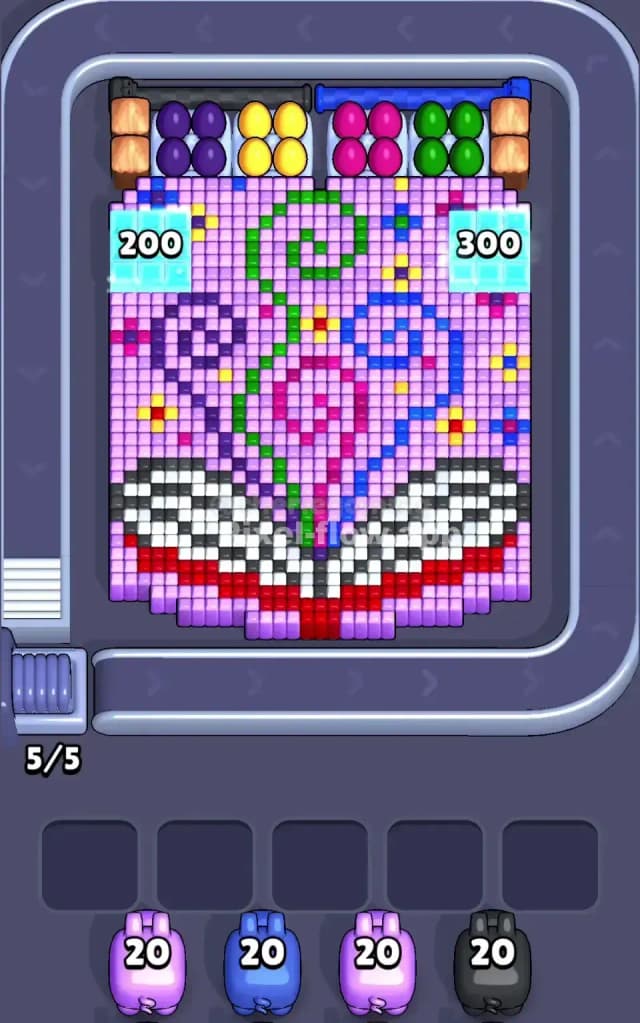
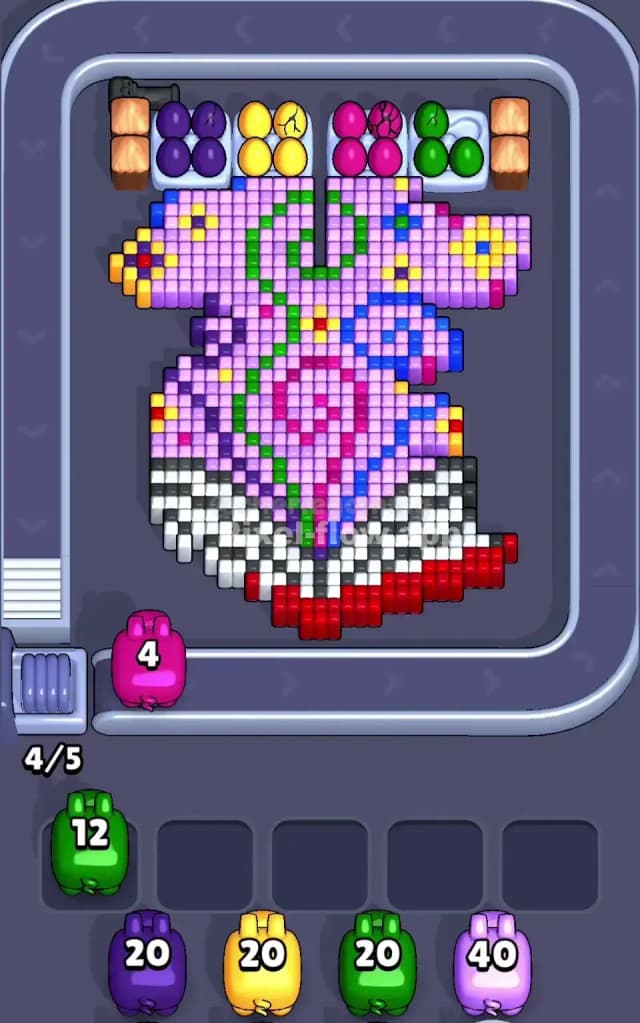
This is a tough one. The board is a massive, dense block of "Magic Spellbook" art that feels almost claustrophobic compared to earlier levels. You have a huge open book at the bottom with white pages and a red cover. Rising out of the book is a wall of Light Purple magic smoke, filled with swirls of Green, Dark Purple, and Blue, plus scattered Yellow stars. To top it off, you have two massive cyan Ice Blocks labeled "200" and "300" sitting on the upper corners like gargoyles.
Is it hard? Yes. It is a very hard level. The color mixing here is nasty. You have tiny specks of yellow and blue trapped inside a sea of pink, making it incredibly easy to clog your waiting slots with pigs that have no valid targets.
Pixel Flow Level 361 Overview
Think of this level as an excavation. You aren't just painting; you are chipping away a solid slab of stone. The subject is an open Grimoire casting a spell. The bottom third is the book itself—solid chunks of White (pages), Black (text), and Red (binding). This area is safe; it's blocky and easy to hit.
The danger zone is the upper two-thirds. It’s a chaotic mix of a Light Purple background with thin, spiraling lines of other colors running through it. Those spirals (Green, Dark Purple, Blue) are fragile. If you aren't careful, you’ll end up with a Blue pig in your slot who can only see one single blue pixel because the rest are buried behind the Light Purple wall.
Finally, look at the top. Above the pixel art, tucked behind the barriers, are nests of large colored eggs (Purple, Yellow, Magenta, Green). These don't come into play until you’ve shattered the main image, but they hint at the colors you'll need for the final cleanup.
Step by step solution walkthrough for Pixel Flow Level 361
First Color Zone to Erase in Pixel Flow Level 361
Your absolute priority is the Light Purple (Pinkish) background. Ignore everything else if you can.
Why? Look at the board. The Light Purple acts as the "mortar" holding the whole brick wall together. It touches almost every other color. If you try to clear the Green swirls or the Yellow stars first, you will fail. Those colors are disconnected and scattered. You'll fire three shots, run out of visible targets, and that pig will clog your slot forever.
By aggressively targeting the Light Purple, you do two things:
- You expose the deeper layers of the swirls, connecting those isolated pixels so your next pigs have plenty of ammo targets.
- You undermine the Ice Blocks. Those 200 and 300 HP blocks are annoying, but if you clear the Light Purple supporting pixels underneath them, the game physics often shift, or you at least open up the board geometry so you aren't forced to chip away at ice.
How to pass Pixel Flow Level 361 without power ups or boosters
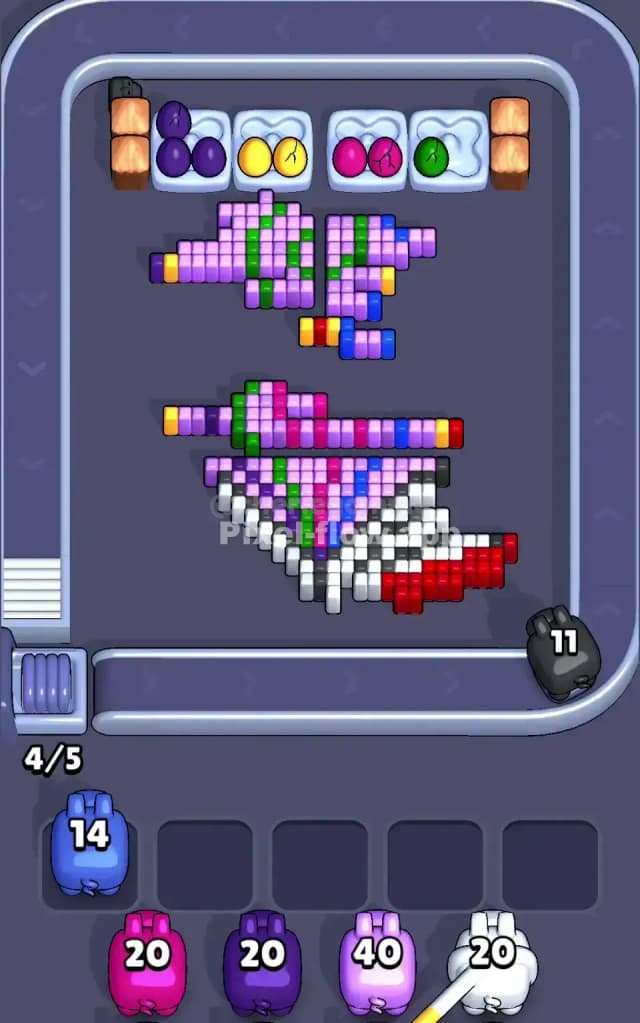
Once the massive field of Light Purple is about 50% gone, the level enters its most dangerous phase. The picture will look half-destroyed. The solid "Book" at the bottom will still be mostly intact, but the top half will be a jagged mess of floating pixels.
Here is the trap: You will see a Yellow pig. You will see a few yellow stars remaining in the magic smoke. Do not take the Yellow pig yet.
Those yellow stars are usually 1 or 2 pixels wide. A standard pig has way more ammo than that. If you take him, he shoots twice, then sits in your slot with 18 ammo and nothing to shoot. This is how you lose Pixel Flow Level 361.
Instead, shift your focus to the White and Red pixels at the bottom. The book pages are thick, solid blocks. White pigs are "safe" picks here because there are huge clusters of white pixels. Clearing the book clears space in your waiting slots. Use the high-volume colors (White, Red, Black) to cycle through your pigs until you find the specific colors (Green, Dark Purple) needed to finish off the floating swirls at the top.
Last Details You Clean Up in Pixel Flow Level 361
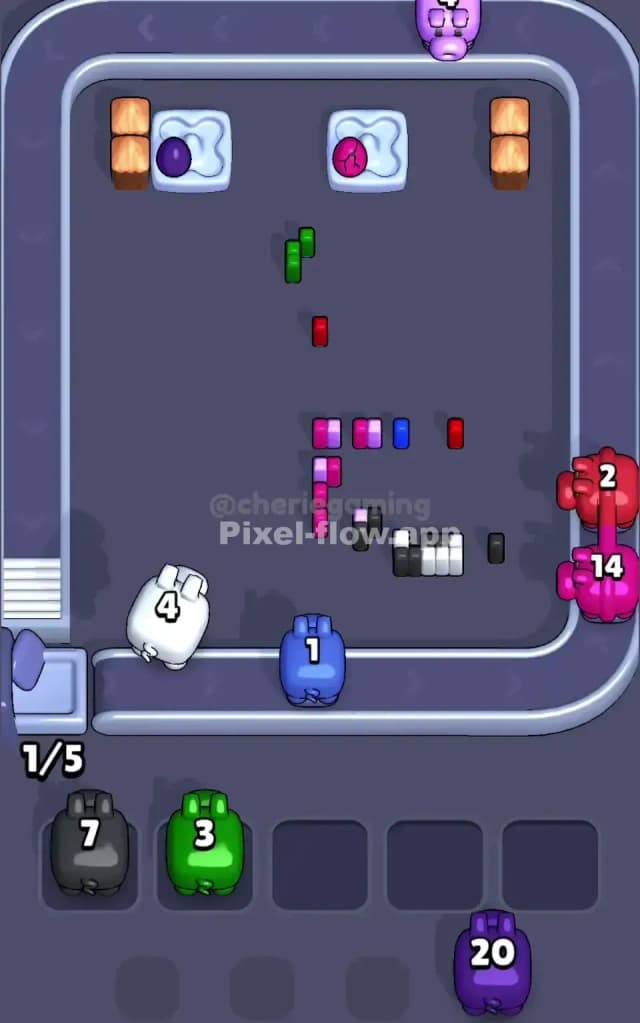
When the book is gone and the pink smoke is cleared, you’ll be left with the weird debris at the very top near the egg nests. Often, a few stubborn pixels hide right under the black bars or near the top spawners.
Watch out for the Dark Purple swirls. Because they curve, pixels often hide diagonally behind each other. You might think you’re done with Dark Purple, but one single voxel is hiding behind a Green one. Keep a "trash" pig (like a White or Red one that still has ammo) in one slot if possible, so you can keep cycling the conveyor belt to find the exact color you need for that last hidden pixel. Don't fill all 5 slots with empty pigs right at the end. Keep it flowing.