Pixel Flow Level 378 Solution | Pixel Flow 378 Walkthrough
How to beat Pixel Flow Level 378: Video solution & walkthrough. The fastest way to pass Pixel Flow 378.
Is this the wrong level layout?🤔
Pixel Flow randomizes levels for different players. Don't worry, just upload a screenshot of your board, and our AI will find the correct video instantly.

Pixel Flow Level 378 Walkthrough
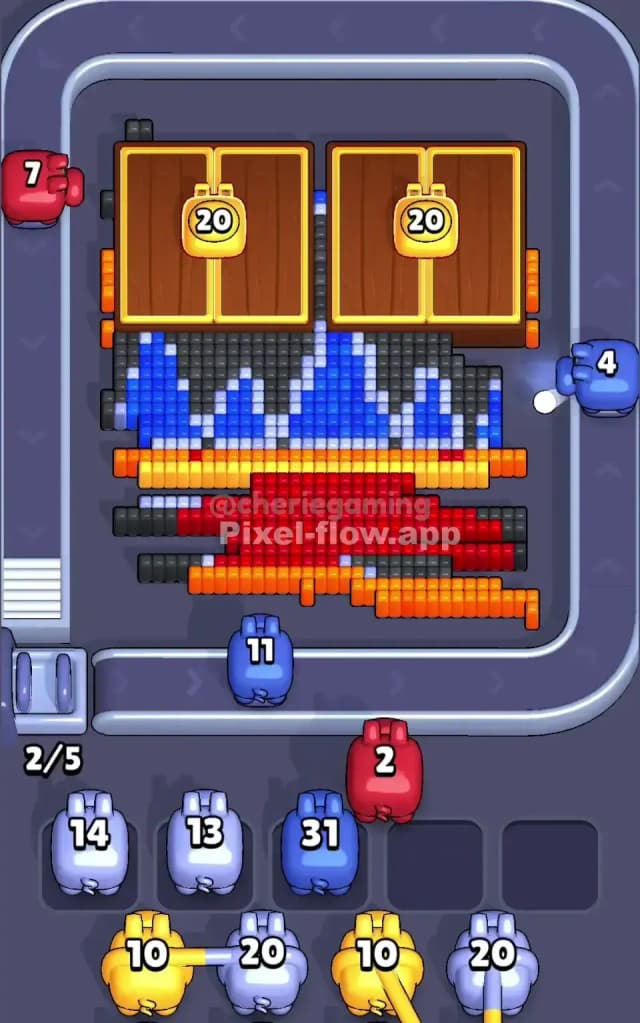
This level is a massive roadblock disguised as a puzzle. You are looking at a mostly obscured board where four giant wooden gates block about 80% of the usable pixels. The top two gates have 30 HP and the bottom two have 60 HP.
Your main enemy here isn't the complex geometry of the pixel art; it's the "waiting game." You cannot hurt those doors immediately. You have to churn through a specific sequence of colors on the outer rim to even find the ammunition capable of breaking the wood. If you aren't efficient with your slot management, you will choke your board with useless pigs before you even scratch the paint on those doors.
Is this a hard level? Yes, Pixel Flow Level 378 is a very hard level because it forces you to play defensively for the first half, just trying to survive until the heavy artillery arrives.
Pixel Flow Level 378 Overview
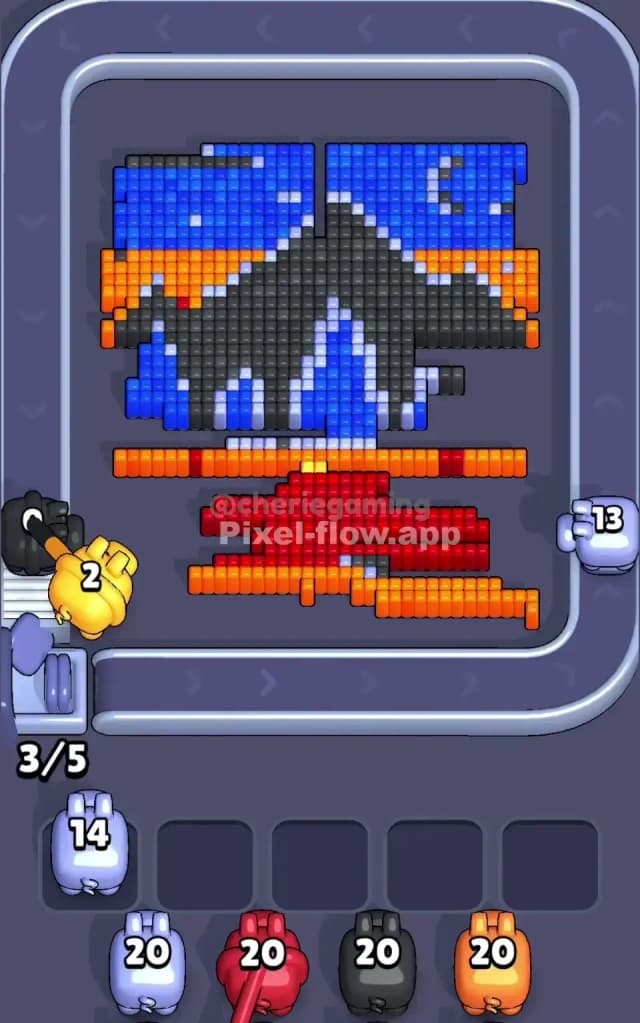
Imagine a dark, jagged mountain peak silhouetted against a deep blue night sky. That is the picture hiding behind the wood. The scene feels cold at the top, dominated by blues and blacks, but the bottom is hot. There is a thick band of orange (maybe a sunset horizon) and a dense core of red at the very bottom, likely lava or a reflection.
The asymmetry here is vertical. The top half is "lighter" work—the sky and the mountain tip. The bottom half is heavy and dense. The wooden gates reflect this: the top gates only take 30 hits to break, while the bottom ones are twice as durable at 60 hits. This means the top of your picture will likely be exposed and vulnerable long before you crack open the bottom section. This imbalance is dangerous because you might run out of valid targets at the top while the bottom is still locked tight.
Step by step solution walkthrough for Pixel Flow Level 378
First Color Zone to Erase in Pixel Flow Level 378
You have zero choice in the beginning. Look at your queue. You likely have Black, Orange, and Blue pigs. None of these can hurt the wooden doors (which require Yellow/Gold pigs).
I start by aggressively shaving off the Black border and the Orange strip at the bottom.
Here is the logic:
- The Churn: The Yellow pigs needed to break the doors are buried deep in your conveyor belt queue. They will not appear until you clear the current pigs.
- Space Management: The wooden doors block the inner layers. If you pull a Blue pig but the Blue pixels are behind a door, that pig sits in your waiting slot, useless. You cannot afford dead slots.
- The Safe Targets: The Black pixels form a frame around the doors, and the Orange pixels are a solid block at the bottom outside the doors. These are the only safe places to dump ammo.
Focus entirely on the edges. Do not worry about the center yet. If you see a Black pig, grab it immediately to clear the frame. If you see Orange, clear the bottom line. You are strictly trying to cycle your deck to find Gold.
How to pass Pixel Flow Level 378 without power ups or boosters
The mid-game of Pixel Flow Level 378 is where most players lose. Once you have cleared the outer frame, the Gold (Yellow) pigs will finally arrive.
Now the board looks strange: the outer edges are empty, but the four doors remain. You must prioritize the Top Doors (30 HP).
Why? Because the top doors are weaker. Breaking them quickly exposes the Blue sky and the top of the Black mountain. This gives your Blue and Black pigs valid targets again. If you focus on the bottom doors (60 HP) first, it takes too long. While you chip away at 60 HP, your queue will fill up with Blue pigs that have nothing to shoot because the sky is still locked behind the top doors.
The Stall Strategy: Sometimes you will have a slot clogged with a Red pig. The Red pixels are buried deep at the bottom, likely behind the 60 HP doors and behind an Orange layer. This pig is dead weight. Ignore it. Work around it. Do not pull a second Red pig if you can help it.
Keep your slots open for Gold pigs. When a Gold pig appears, it doesn't matter which door it hits, just get it on the board. The moment a door breaks, immediately switch focus to whatever color was hiding behind it (usually Blue or Black) to clear space in your slots.
Last Details You Clean Up in Pixel Flow Level 378
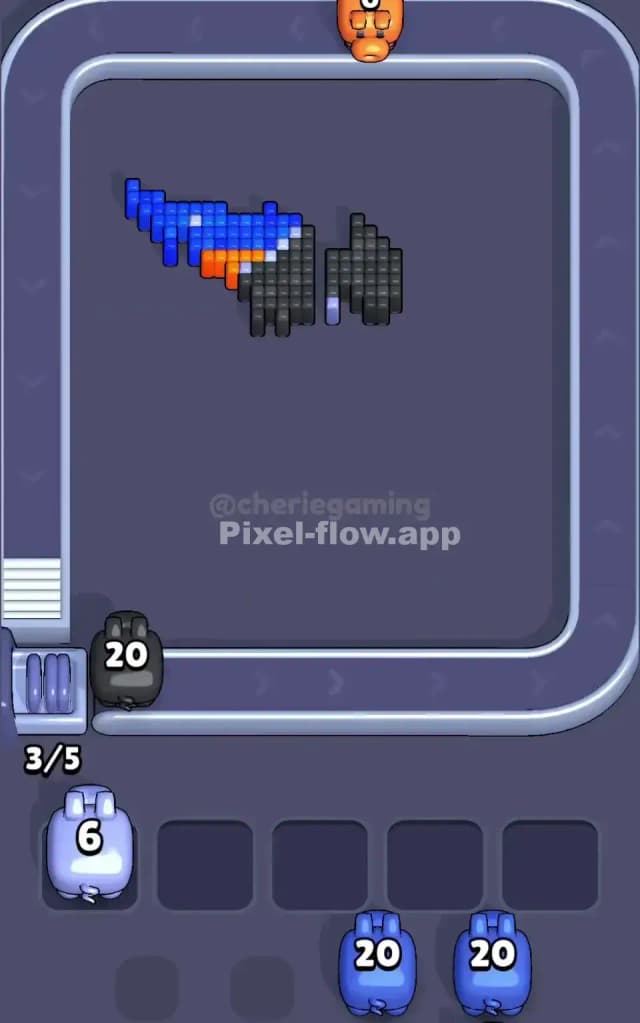
The end of Pixel Flow Level 378 is a grind at the bottom of the screen.
By now, the top doors are woodchips, the sky is gone, and the mountain is mostly erased. But those bottom 60 HP doors might still be standing, or just recently destroyed. Behind them lies a stubborn block of Red pixels mixed with the remaining Orange.
The final few moves usually involve clearing that dense Red core. It sits at the very bottom center, acting like the foundation of the mountain. It’s often the last thing to go because it was protected by the strongest doors and buried under the Orange horizon line. Watch out for stray single pixels of Blue or Black hiding in the corners where the doors used to meet the frame—these "orphan" pixels can force you to keep a pig on the board for just one shot, wasting a slot. Clear them as soon as you see them.