Pixel Flow Level 395 Solution Walkthrough | Pixel Flow 395
How to solve Pixel Flow level 395? Get instant solution for Pixel Flow 395 with our step by step solution & video walkthrough.


Pixel Flow Level 395 Overview
The Board and Its Color Layers
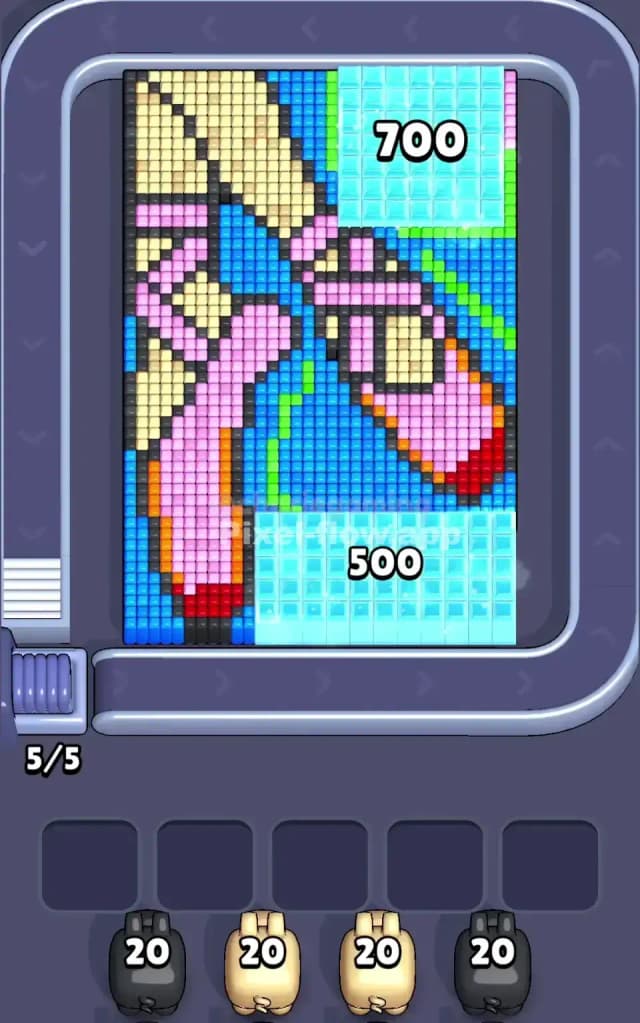
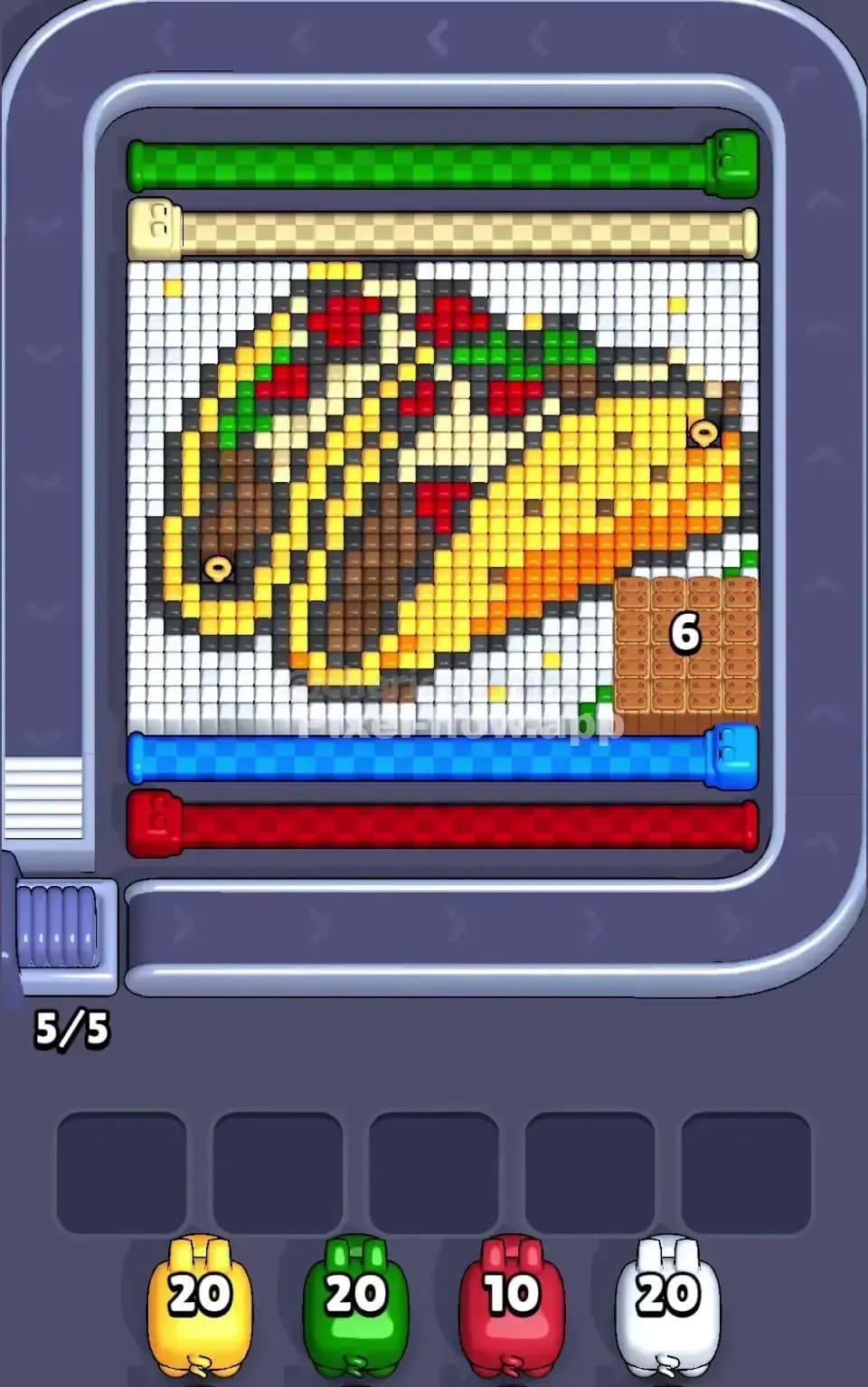
Pixel Flow Level 395 presents you with a gorgeous pixel art leprechaun—a detailed, multi-layered character that's going to test your planning skills. The main subject is rendered in warm yellows, browns, and creams that form the leprechaun's body and hat, with rich red accents on the hat's brim and a green base that represents the landscape or clothing details. What makes Pixel Flow 395 visually dense is that white space is everywhere—it's the dominant background color and also appears woven throughout the character itself, creating pockets of separation between the colored regions. You'll also notice smaller patches of green scattered across the board and a tan or beige secondary layer that sits behind some of the main yellow and brown cubes.
Your job in Pixel Flow Level 395 is to clear every single cube on this board by leveraging your four incoming pigs: a yellow pig with 20 ammo, a green pig with 20 ammo, a red pig with 10 ammo, and a white pig with 20 ammo. The win condition is straightforward—reduce the entire board to nothing—but the arrangement of colors and the finite ammo pool make the execution anything but simple. Because each pig shoots only its own color, you can't afford to waste a single shot, and you absolutely cannot let your waiting slots fill up with stuck pigs before the board is cleared.
Understanding the Challenge
The real difficulty in Pixel Flow Level 395 lies in the sheer volume of white cubes and the way they splinter the board into isolated color zones. White is your largest color group, and you're relying on a single white pig with exactly 20 ammo to handle all of it. If you misjudge your approach and force the white pig into a waiting slot before all white cubes are destroyed, you've potentially locked yourself out of victory because the remaining white cubes will never be shootable. The leprechaun's design also features internal layers—there's depth to this pixel art—so some colors only become visible once you've cleared the cubes sitting in front of them.
Why Pixel Flow Level 395 Feels So Tricky
The White Cube Bottleneck
Let's be honest: the white cubes are the elephant in the room for Pixel Flow Level 395. They're scattered all over the board—framing the leprechaun, filling background gaps, and anchoring the entire visual composition. With a single white pig carrying exactly 20 ammo, you're essentially working with a fixed budget that must account for every white cube on the board. If even one white cube remains when your white pig runs dry of targets, that pig drops into the waiting queue and becomes a permanent dead weight. I've felt that panic creeping in during my first few attempts at Pixel Flow Level 395 when I realized I'd already burned the white pig on scattered cubes and still had a cluster of whites blocking access to deeper colors. That's when it clicked for me: you cannot shoot white cubes reactively. You have to count them, plan the pig sequence so whites are cleared last, and commit to a deliberate path.
Awkward Color Pockets and Layer Exposure
The yellow and brown regions, while plentiful, aren't continuous. There's yellow in the hat, yellow in the body, yellow scattered across the background—and some of those yellow cubes are separated by white or green buffers. Your yellow pig arrives with 20 ammo, which sounds generous until you realize it needs to clear yellow cubes that might be blocked by other colors. Similarly, red is concentrated but sparse (just 10 ammo available), making it a precision tool rather than a workhorse. The green patches, while not overwhelming, are tucked into corners and edges of the board. The frustrating part of Pixel Flow Level 395 is that you can't simply blast colors in the order they appear; you have to thread the needle by clearing blocking colors first so the remaining targets become accessible.
There's also a subtle trap with the underlying tan or beige layer I mentioned—it hides behind some of the main colors, and if you're not careful about which pig you send out when, you'll expose that layer too early and jam yourself with a pig that has no matching targets.
The Personal Breakthrough
I'll admit my first dozen runs at Pixel Flow Level 395 felt chaotic. I was reacting to which pigs arrived, shooting whatever was visible, and invariably ended up with two or three pigs stuck in the waiting slots while a handful of cubes laughed at me from the board. The level felt punishing until I stopped treating it like a reflex game and started treating it like a puzzle. Once I grabbed a pencil and sketched out the approximate color counts and pig order, everything shifted. I realized the solution was already baked into the pig sequence; I just had to respect it and sequence my moves accordingly.
Step-by-Step Strategy to Clear Pixel Flow Level 395
The Opening: Establish a Safe Buffer and Target Yellow First
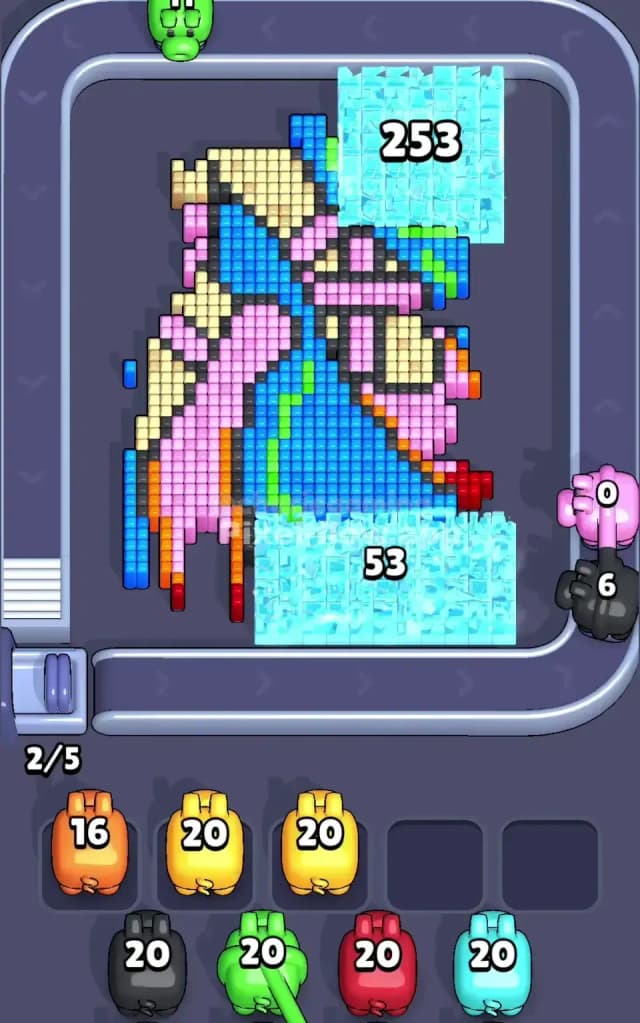
Your first move in Pixel Flow Level 395 should be to deploy the yellow pig. Yellow is your largest color group after white, and shooting yellow cubes early serves multiple purposes: it reduces the visual clutter, it begins to expose the interior layers beneath the leprechaun's outline, and it keeps your waiting slots empty. Fire the yellow pig and let it burn through as many yellow targets as possible before it runs out of ammo. Don't worry about efficiency here; yellow is abundant, and the yellow pig will find targets across the hat, body, and background. Watch the waiting slots—they should still be empty after the yellow pig finishes. This gives you flexibility for the next two pigs.
After yellow, immediately send in the green pig. Green patches are much smaller and more isolated, so the green pig will either clear all greens and drop into a waiting slot (which is fine because you still have two slots free) or it'll run out of ammo while still targeting cubes. Either way, green is now mostly cleared, and you've opened up more internal layers.
Mid-Game: Sequence Red Carefully and Manage the Brown Layer
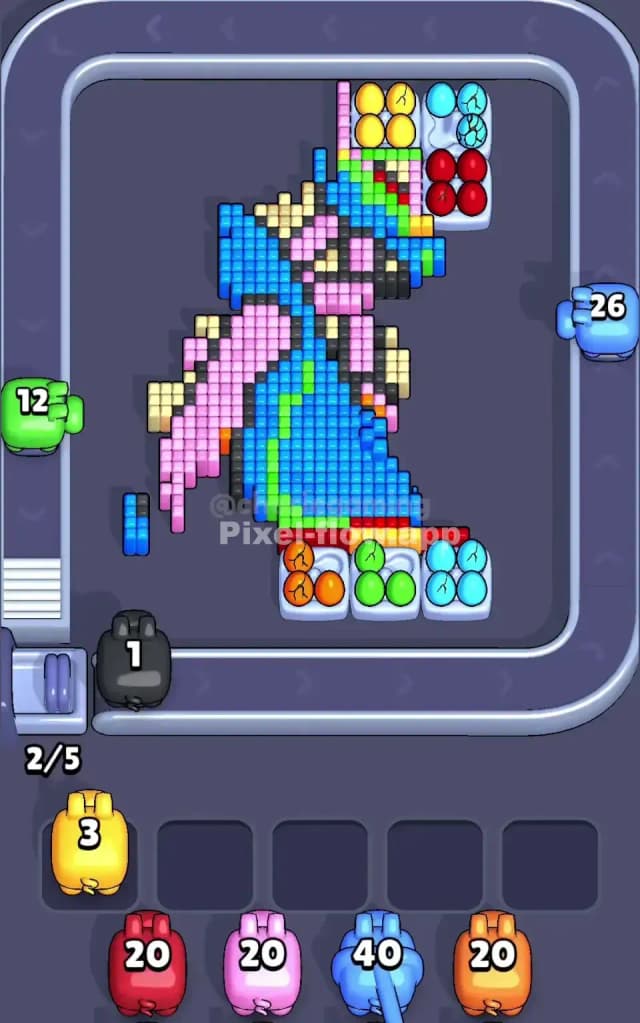
Here's where Pixel Flow Level 395 demands precision. The red pig has only 10 ammo, making it the scarcest resource on the board. Don't deploy the red pig until you're confident that all red cubes are exposed and accessible. If the red pig drops into a waiting slot with ammo still remaining, you've wasted a slot and gained nothing. Wait until the yellow and green pigs have cleared enough clutter that the reds—clustered on the leprechaun's hat and scattered elsewhere—are all fully visible and shootable in one go. Fire the red pig third, and watch it mop up the reds cleanly.
The brown layer is interesting because it's both substantial and somewhat hidden. Some brown cubes are part of the leprechaun's design, but others sit beneath the yellow exterior. As you clear yellow and red, the brown naturally becomes more visible. You might find that the brown is already cleared by the time you reach the end game, or you might need to address it with secondary passes. Don't obsess over brown; it'll fall into place as the board opens up.
End-Game: Finish with White and Avoid the Jam
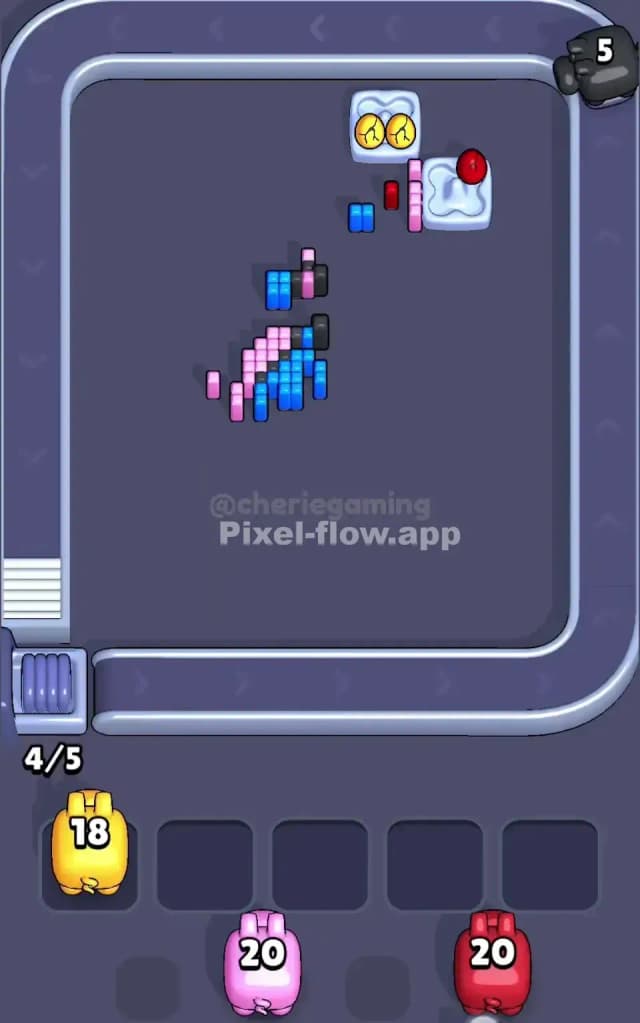
By the time you're in the final stretch of Pixel Flow Level 395, your white pig should be the only player left in the queue. All other colors should be cleared or nearly cleared. Now it's time to deploy the white pig and systematically shoot every single white cube remaining on the board. Since you've already removed the obstacles, the white cubes should be accessible in clusters and lines—much easier to target than they were at the start. Fire methodically, count each shot, and confirm that the board empties completely.
If you've followed the yellow-green-red-white sequence and maintained at least one empty waiting slot throughout, you should glide into victory without any stuck pigs or blocked cubes.
The Logic Behind This Pixel Flow Level 395 Plan
Why This Sequence Works
Pixel Flow Level 395 isn't random. The pig order and ammo values are deterministic, designed to create a solvable puzzle if you respect the game's rules. By firing pigs in the order yellow-green-red-white, you're working with the board's structure rather than against it. Yellow clears the majority and opens sight lines; green handles the corner pockets; red finishes the accent details; white cleans up the framework. This sequence ensures that every pig has targets when it arrives and that you never accidentally trap a pig in the waiting slots before its work is done.
The deeper logic is that Pixel Flow Level 395 rewards foresight over reflexes. The game gives you four pigs and a fixed board; everything is knowable in advance if you take thirty seconds to scan the layout before firing. The white cubes are the kingpin—they're numerous, they're scattered, and they form the backbone of the visual design. By saving the white pig for last, you guarantee it will always have targets, and you avoid the catastrophic scenario where it runs dry and locks you out of victory.
Staying Calm and Counting Ahead
The biggest mental shift for mastering Pixel Flow Level 395 is slowing down and counting. Before you fire your first pig, count the approximate white cubes on the board and confirm that the white pig's 20 ammo is sufficient—it should be, comfortably. Watch the queue at the bottom and know which pigs are coming next. As each pig fires, anticipate which colors will be exposed and whether the next pig will have viable targets. This two or three pig look-ahead isn't difficult; it just requires a moment of planning.
Pressure and frustration are your enemies in Pixel Flow Level 395. If you feel stuck, pause, zoom out mentally, and ask yourself: "Which pig is queued next, and will it have valid targets?" Answer that question correctly, and the path forward becomes clear. You've got this.