Pixel Flow Level 407 Solution Walkthrough | Pixel Flow 407
How to solve Pixel Flow level 407? Get instant solution for Pixel Flow 407 with our step by step solution & video walkthrough.


Pixel Flow Level 407 Overview
The Starting Board and Visual Layout
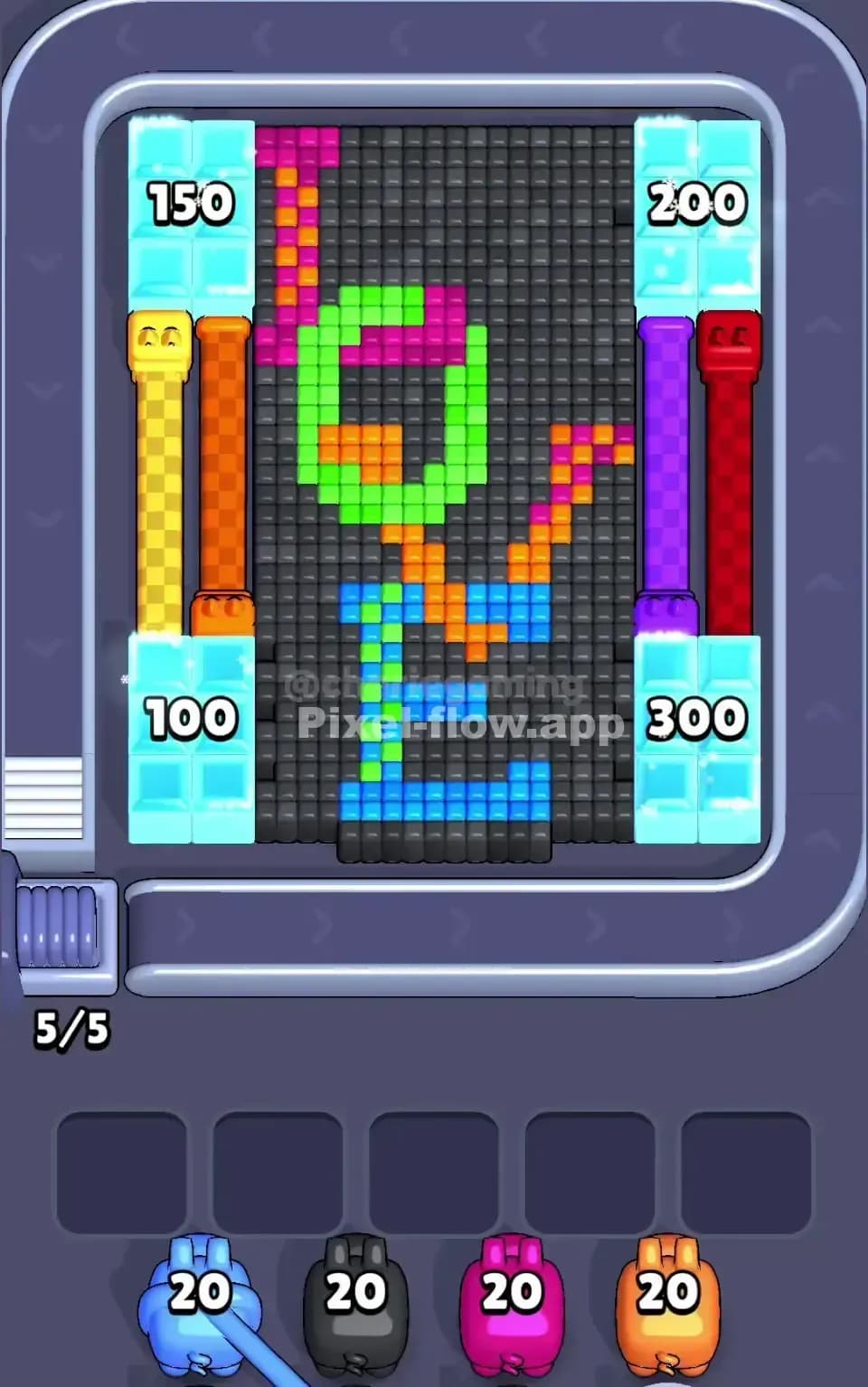
Pixel Flow Level 407 presents a challenging voxel puzzle featuring a large green circular or ring-shaped structure as the primary focal point, surrounded by layers of colorful blocks in magenta, orange, blue, cyan, and dark gray. The board is densely packed, with the green ring dominating the center and acting as the visual anchor around which other color patches cluster. You'll notice that the dark gray blocks form a thick border or frame, making the playable area feel compressed and strategically dense. The color distribution isn't evenly spread—certain hues like orange and blue are concentrated in specific regions, while magenta and cyan appear scattered across multiple depths, signaling that you'll need to work layer by layer to expose and clear everything efficiently.
Your four pigs are lined up in the queue with these ammo counts: a blue pig with 20 ammo, a gray pig with 20 ammo, a magenta pig with 20 ammo, and an orange pig with 20 ammo. You've got five waiting slots available (currently showing 5/5 at the bottom), which means you have breathing room initially—but that safety net will tighten fast if you're not deliberate about clearing cubes and moving stuck pigs through.
Win Condition and Determinism
Your goal in Pixel Flow Level 407 is straightforward: destroy every single colored voxel cube on the board. The win condition requires a completely empty playing field with no blocks remaining. The critical insight here is that everything in Pixel Flow Level 407 is deterministic—your pig order never changes, their ammo counts are fixed, and the cubes don't move or regenerate. This means there's always a solution; you just need to find the right sequence. Every pig will automatically fire at matching-colored cubes in front of it, and when a pig runs out of targets despite having ammo left, it slides into a waiting slot. Your job is to orchestrate the pig order so that ammo depletes naturally and no waiting slots overflow.
Why Pixel Flow Level 407 Feels So Tricky
The Layering and Color Exposure Bottleneck
The biggest threat in Pixel Flow Level 407 is that the dense layering means you can't see deeper colors until you clear the surface. The dark gray blocks form a thick, almost impenetrable-looking barrier, and the green ring's dominance makes it tempting to focus there first—but if you do, you'll expose layers underneath that demand colors you haven't yet introduced. This creates a classic bind: you clear surface blocks and suddenly face a wall of blue or magenta for which you have no pig available yet. The waiting slots fill up with half-spent pigs (like your blue pig with 5 ammo remaining) because they've cleared all visible targets, and now you're locked out of progress. That's the core frustration of Pixel Flow Level 407—the board's visual complexity masks a rigid sequencing requirement, and one wrong move jams the whole flow.
Awkward Color Patches and Ammo Mismatches
You'll encounter at least two painful problem spots in Pixel Flow Level 407. First, there's a scattered magenta patch in the upper-middle area that's visually disconnected from the main green ring; if you send your magenta pig too early, it'll clear those cubes and then have nowhere to go because the deeper magenta blocks remain hidden. Second, the orange blocks are grouped in two distinct zones—one near the green ring and another lower down—so your orange pig might clear the visible orange cubes and then stall, waiting for the second wave to be exposed. These design choices aren't mistakes; they're intentional tests of your planning. You can't just rush pigs out in queue order and expect success in Pixel Flow Level 407. You have to think two or three moves ahead and predict which colors will become accessible as you peel back layers.
That Moment When It Clicks
I'll be honest—my first three attempts at Pixel Flow Level 407 felt frustrating because I kept sending the blue pig out early, thinking I'd clear the blue cluster at the bottom quickly. Instead, the pig ran out of targets halfway through, dropped into a waiting slot, and suddenly I had four waiting slots filled with stuck pigs and no way to continue. The ammo was there, but the cubes weren't visible. It was only when I stepped back and traced through the board layer by layer—asking "what color sits beneath this dark gray border?"—that Pixel Flow Level 407 finally made sense. Once I realized I needed to expose the inner layers strategically before committing certain pigs, the solution snapped into focus.
Step-by-Step Strategy to Clear Pixel Flow Level 407
Opening: Expose the Inner Ring First
Start Pixel Flow Level 407 by deploying your blue pig first, but not because blue is your strongest color. The reason is that the blue pig has exactly the right ammo count (20) to clear the visible blue cubes at the board's bottom, which act as a foundational layer. Those blue blocks are sitting in front of the deeper structure, so clearing them will expose what lies beneath—likely more colors that are currently hidden. Send the blue pig out, let it fire methodically, and watch as it exhausts its ammo cleanly on the visible blue cluster. The blue pig should not enter a waiting slot after this move; it should emerge victorious and leave the queue. If it does drop into a slot with remaining ammo, stop and reconsider your strategy—it means you miscounted or there's a hidden layer of blue you didn't account for.
Next, deploy your gray pig. Gray blocks form the thick border and scattered interior sections of Pixel Flow Level 407, so your gray pig has plenty of targets. Gray is your "workhorse" color in this level—it'll chip away at the structural elements and help you expose the central areas. Let the gray pig fire through its ammo and clear as much gray as possible. Again, aim for a clean exit with zero ammo remaining.
Mid-Game: Sequence Colors to Expose Layers
Now that blue and gray are cleared, your magenta pig becomes crucial. In Pixel Flow Level 407, magenta appears in two regions: the upper area and scattered deeper within. Send out your magenta pig and watch it target the visible magenta blocks around the green ring. The magenta pig's 20 ammo should handle the exposed magenta cubes, but here's the key: don't expect it to clear everything magenta on the board. Some magenta blocks are hidden behind other colors and will only become targets once you've cleared their overlays. This is fine—let the magenta pig work through its ammo and, if it has leftovers, park it in a waiting slot temporarily. You've still got slots available, so there's no immediate pressure.
Here's where Pixel Flow Level 407 really tests your patience: your orange pig is fourth in line, and orange blocks are plentiful but spread across the board. Before you send the orange pig out, take a moment to mentally map the orange clusters. The orange pig has 20 ammo, which is likely just enough—or barely enough—to cover the visible orange blocks and the ones that are about to become visible as other colors get cleared. Send your orange pig out and let it fire. It may also end up in a waiting slot if the inner orange layers are still obscured.
End-Game: Clean Up and Avoid the Final Jam
By now, you've probably got at least two pigs in waiting slots with varying amounts of ammo remaining. This is the critical moment in Pixel Flow Level 407. You need to assess what's left on the board. Are there still gray blocks? Is magenta or blue re-exposed in deeper layers? Your next move is to cycle a waiting pig back into the queue if a new target color becomes available, or to introduce a fresh pig if the queue still has capacity. The goal is to create a cascade: as you clear surface layers, deeper layers emerge, matching pigs in the slots become relevant again, and they cycle back into play without jamming the system.
In the final push of Pixel Flow Level 407, you're looking for a moment where all remaining blocks can be cleared by the pigs still in the queue or waiting slots. If you've planned correctly, the last pig should fire its final shot and the board should go completely empty with no pigs stuck and no unfired ammo wasted. If you end up with a pig in a waiting slot that has 5+ ammo but no targets, you've hit a failure state—the board is incomplete, and you can't proceed.
The Logic Behind This Pixel Flow Level 407 Plan
Exploiting Determinism and Ammo Alignment
The strategy above works because it respects Pixel Flow Level 407's deterministic nature. You're not guessing or improvising; you're reading the board, counting ammo, and predicting outcomes. Each pig's ammo count is a precise tool, and the goal is to match each tool to its job. Blue gets 20 because there are roughly 20 blue cubes in accessible layers. Gray gets 20 because gray is the structural filler and needs serious firepower. Magenta and orange both have 20 ammo because they're distributed and layered, requiring you to clear some, wait for exposure, and then resume. By honoring these numbers and not forcing pigs out randomly, you're working with the level's design, not against it.
The waiting slots are your buffer and your pressure gauge. Having all five slots empty feels safe, but it's an illusion—filling them is inevitable and even necessary. What matters is that you fill them strategically and then empty them by creating targets for the stuck pigs. If you can keep at least one slot free at all times during mid-game, you've got wiggle room. If slots start filling faster than you can empty them, you've made a sequencing mistake, and you need to reset.
Planning Ahead and Staying Calm
The emotional challenge of Pixel Flow Level 407 is resisting the urge to tap pig buttons rapidly and "see what happens." Instead, pause before each pig launch. Ask yourself: What will this pig clear? Will it exhaust its ammo completely, or will it get stuck? If it gets stuck, which other pig's actions will eventually unlock new targets for it? By running through this three-move look-ahead, you're essentially pre-solving the level in your head. It's meditative and methodical, and it transforms Pixel Flow Level 407 from a frustrating scramble into a satisfying logic puzzle. You're not at the mercy of randomness—you're the architect, and every pig's path is predetermined.
The final skill is counting. Count the visible cubes of each color, compare that to the ammo count, and trust the math. If your blue pig has 20 ammo and you see only 15 visible blue blocks, the other 5 are hidden deeper. That's not a problem; it's a hint about the level's structure. Pixel Flow Level 407 rewards this methodical approach, and once you've internalized the pattern, later levels become significantly easier.