Pixel Flow Level 417 Solution Walkthrough | Pixel Flow 417
How to solve Pixel Flow level 417? Get instant solution for Pixel Flow 417 with our step by step solution & video walkthrough.


Pixel Flow Level 417 Overview
The Board Layout and What You're Clearing
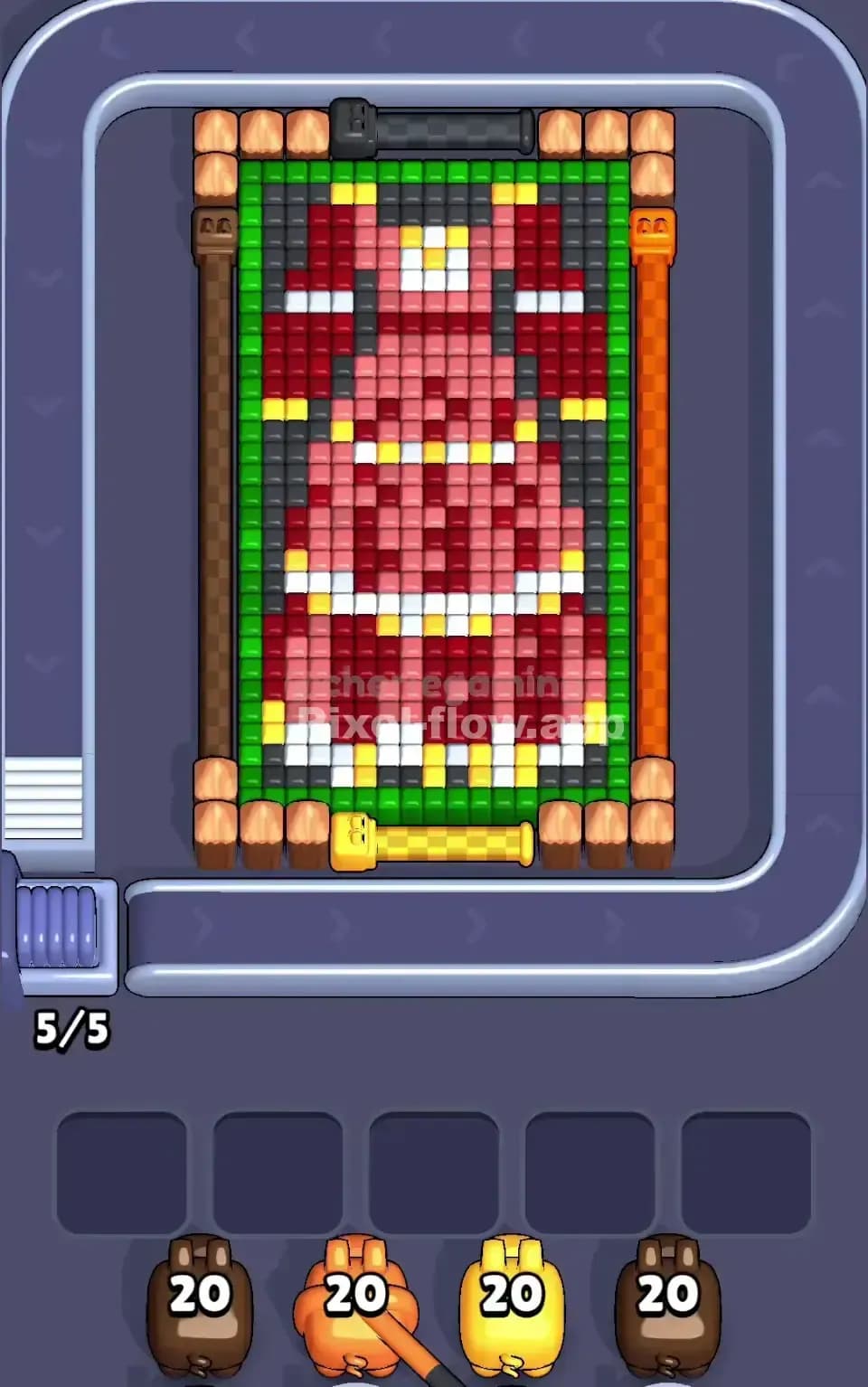
Pixel Flow Level 417 presents a challenging voxel puzzle featuring a detailed character portrait rendered in layers of color. The dominant palette includes deep reds and pinks forming the main subject (think a face or bust), with strategic accents of white, yellow, gray, and green creating depth and definition. A bright green border frames the entire playfield, and you'll notice brown and white tiles lining the sides—these are part of the outer "frame" that you'll need to clear methodically. The pixel art itself is dense and intricate, meaning multiple overlapping color zones demand careful sequencing rather than brute-force clearing.
When you start Pixel Flow Level 417, you're looking at a full board with no empty spaces. Your goal is straightforward: eliminate every single cube on the board by unleashing the correct sequence of color-matching pigs. Each pig arrives from the queue with a fixed ammo count, and that's all the shots you get. Once all cubes vanish, you've won the level and can move forward.
Win Condition and Deterministic Mechanics
Here's what makes Pixel Flow Level 417 strategic rather than random: the pig order and ammo counts never change. You can't wish for more brown ammo or hope a different color shows up next. Instead, you're working with a fixed deck, and your job is to orchestrate the sequence so that every pig's ammunition lands on valid targets and no pig gets stranded with unused shots. The moment all five waiting slots fill with pigs that have no targets left, you're locked in failure—game over. So your real challenge in Pixel Flow Level 417 is puzzle-solving through careful planning.
Why Pixel Flow Level 417 Feels So Tricky
The Bottleneck: Red Dominance and Hidden Layers
The biggest threat in Pixel Flow Level 417 is the sheer volume of red and pink cubes. They're everywhere—clustered in the center, scattered across the middle layers, and creating what feels like an immovable wall. The problem? You probably don't have a red pig in your queue, or if you do, its ammo count won't match the number of red cubes you can actually see and hit early on. This creates a nasty catch-22: you can't clear enough red to expose the cubes underneath, so other colors stay hidden. Meanwhile, non-red pigs arrive, can't find targets, and start filling your waiting slots. Before you know it, your buffer is clogged and you're stuck.
Subtle Problem Spots
The first tricky zone in Pixel Flow Level 417 is the green border itself. You might think you should clear it first, but that's a trap. Green has its own ammo count, and if you burn it all on the perimeter early, you won't be able to clear green cubes tucked deeper in the puzzle. The white and yellow accents scattered throughout add another layer of complexity—they're plentiful enough to tempt you, but they're also the "glue" holding the red sections together. Clear white too eagerly and you'll expose red cubes that no pig can hit yet. Push yellow too hard and you'll fracture the puzzle in ways that strand future pigs without targets.
Another subtle trap in Pixel Flow Level 417 is the brown tiles on the left and right sides. They look minor, but they're anchoring the entire frame. If your brown pig arrives with 20 ammo and there are only 15 brown cubes visible, you've got a 5-ammo surplus with no way to spend it—welcome to a dead buffer slot. That's why you must plan several moves ahead and trust that exposing deeper layers will reveal more brown (or whatever color) targets underneath.
The "Click" Moment
Honestly, Pixel Flow Level 417 frustrated me until I stopped treating it like a reflex game and started treating it like a logic puzzle. I was firing pigs as they arrived, hoping the board would cooperate. It didn't. The turning point came when I realized I could deliberately park pigs in the waiting slots—holding them there while other colors moved the puzzle forward, then bringing them back into play once new targets appeared. That single mindset shift transformed Pixel Flow Level 417 from a frustrating slog into a satisfying tactical challenge. Once you accept that waiting is a strategy, not a failure, the level stops feeling chaotic.
Step-by-Step Strategy to Clear Pixel Flow Level 417
Opening: Establishing Your Buffer and Targeting Green First
Don't rush into the red core. Instead, start with the green border. Yes, it's the frame, but it's also your first safe target—green is visible everywhere, clearly defined, and finite. Fire your first green pig and watch how many green cubes vanish. Count the remaining green. If you've got more than one green pig in the queue, you're in good shape. The key here is to keep at least two waiting slots empty as you move through the opening. If a non-matching pig arrives and there's no target for it, you must have room to park it safely. So after your first or second move, check your buffer. If all five slots are empty or near-full, you're moving too slowly. If two or three are free, you're on pace.
Once green is mostly cleared, pivot to white. White is scattered but finite, and clearing it exposes the red sections underneath. This is the bridge between the safe outer layers and the dangerous core. Don't burn all your white pig's ammo at once—fire and assess. Does white have more targets than the pig's ammo? If yes, you're in a great spot. If no, be cautious; that pig might fill a waiting slot with unspent ammo.
Mid-Game: Sequencing and Exposing Layers
Now you're in the thick of Pixel Flow Level 417, and this is where discipline matters most. Your yellow and brown pigs are arriving, and the red core is starting to show. Here's the critical move: don't commit all your yellow and brown ammo to what you can see right now. Instead, fire one or two pigs and observe what new layers open up. The red cubes you couldn't target might suddenly become accessible once you clear the white and yellow scaffolding around them.
Watch your waiting slots obsessively. If a pig lands there without a target, it's a warning sign. You fired the wrong color too early, or you skipped a sequence. Pause, reassess, and think about what the next two pigs in the queue can do. Can the incoming color create targets for the stranded pig? If yes, stay calm—you can recover by parking another pig or two until the board shifts. If no, you might be in trouble, but don't panic. Pixel Flow Level 417 is still solvable if you're strategic.
The mid-game is also where half-spent pigs become your friends. If a pig has ammo left but fewer visible targets, let it sit in the waiting buffer. Don't force it. Soon enough, the next color will expose more cubes, and that "stuck" pig suddenly has work to do. This is the emotional core of mastering Pixel Flow Level 417—trusting the process rather than panicking.
End-Game: Emptying the Buffer and Final Precision
As you approach the last 10–15% of Pixel Flow Level 417, your waiting slots will feel like a minefield. You've got three or four pigs parked, each with dwindling ammo, and new pigs keep arriving. The endgame hinges on perfect sequencing of the last two or three colors. Usually, it's the remaining red, maybe a stray green or brown, and perhaps a final white or yellow accent. Fire each incoming pig carefully. Count the ammo. Count the visible targets. They should match or be slightly over (not under, which means stranded ammo).
In the final moves of Pixel Flow Level 417, you're aiming to empty all waiting slots and clear the board simultaneously. It's like a puzzle where every piece has to fit. If you've played patiently up to this point, you'll have the ammo counts and sequences memorized. The last pigs arrive, fire, and boom—board clear. If you're one or two ammo short or one or two cubes over, you've made a sequencing error earlier, but now you know what to adjust on your next attempt.
The Logic Behind This Pixel Flow Level 417 Plan
Why This Strategy Exploits the Game's Rules
Pixel Flow Level 417 isn't random because the pigs, ammo counts, and cube layouts are all fixed. That means there is always a winning solution—you just have to find it. This strategy works because it respects three core mechanics: (1) pigs must hit matching colors, (2) waiting slots are a resource, not a penalty, and (3) exposing deeper layers is the key to finding hidden targets. By starting with green and white (safe, visible colors), you buy time and clarity. By mid-game parking pigs in the waiting buffer, you're actively using the mechanic to your advantage instead of fighting it. By the endgame, you're executing a predetermined sequence rather than improvising.
The logic also assumes you're not trying to clear everything as fast as possible. Speed is the enemy in Pixel Flow Level 417. Patience and observation are your allies. Every pig you fire teaches you something about what's underneath. Use that information.
Staying Calm and Playing Two Pigs Ahead
The mental game is half the battle in Pixel Flow Level 417. Watch your incoming queue and think two or three pigs ahead. If the brown pig is next and you can see brown targets, fire it. But also glance at the pig after that. If it's green and there's no green visible, you know you need to prep a waiting slot or expose green cubes before that pig arrives. This forward-thinking mindset prevents surprise jams and keeps you in control. Count ammo like it's currency—spend it wisely, never carelessly. And remember, if you're ever unsure, park the pig and wait. A single move of observation beats a dozen moves of panic.