
Pixel Flow Level 447 Solution | Pixel Flow 447 Walkthrough
How to beat Pixel Flow Level 447: Video solution & walkthrough. The fastest way to pass Pixel Flow 447.
Is this the wrong level layout?🤔
Pixel Flow randomizes levels for different players. Don't worry, just upload a screenshot of your board, and our AI will find the correct video instantly.


Pixel Flow Level 447 Walkthrough
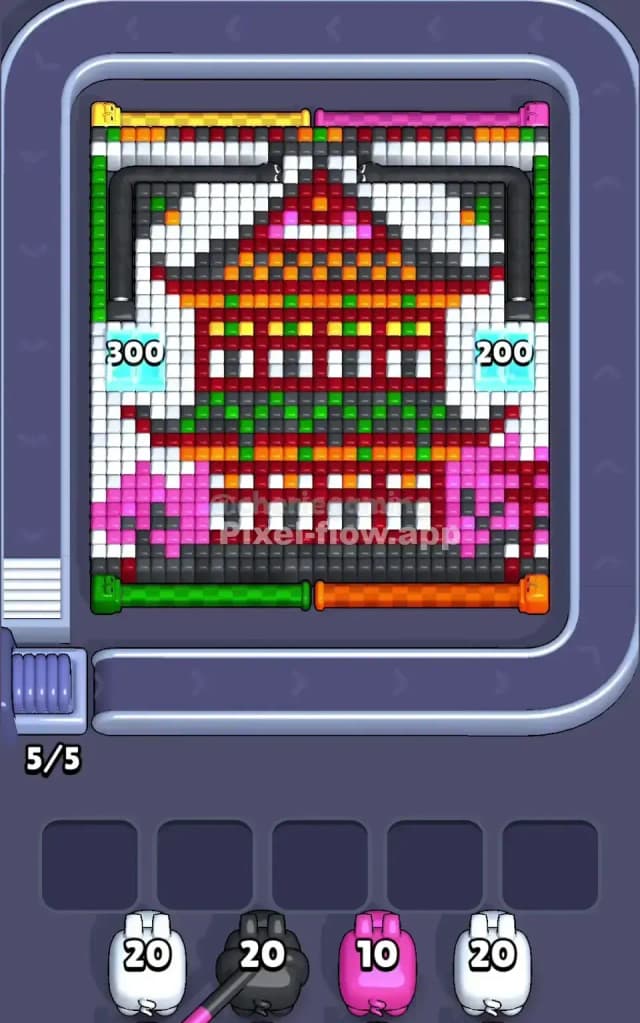
This level features a stunning, multi-tiered pagoda temple set against a stark white background. The structure is intricate. You have a heavy red foundation and roof system, accented with orange tiles, green eaves, and pink cherry blossom clusters at the base. To beat Pixel Flow Level 447, you must strip away the massive white background and the dark grey foundation to access the colorful, layered interior of the temple. The presence of the "Frozen Zones" (marked 300 and 200) on the sides adds a layer of obstruction. This is a very hard level.
Pixel Flow Level 447 Overview
Imagine standing before an ancient, pixelated temple in winter. The scene is dominated by the central pagoda. It rises up in layers: a dark base, followed by red walls, and stacked roofs striped with orange and green.
The background isn't just empty space; it's filled with white pixels representing the sky or snow. These white blocks act as a massive shield, wrapping around the entire top half of the pagoda. At the bottom, asymmetry kicks in. The left and right corners are anchored by vibrant pink cherry blossoms, but the base itself is a solid slab of dark grey/black pixels.
The "Ice Blocks" on the flanks are the real headache. They sit right over the mid-section of the temple, effectively shielding the intricate red and white patterns behind them. You can't just snipe the middle early on. You have to work from the extreme top (white sky) and extreme bottom (dark foundation) to pinch the structure in the middle. The color density is high here; a single Red pig might have 50 targets, while a Green one might only find 5 exposed pixels. Misjudging this ammo count is fatal.
Step by step solution walkthrough for Pixel Flow Level 447
First Color Zone to Erase in Pixel Flow Level 447
I start by targeting the White pixels immediately. This choice is strictly logical.
The white area forms the "sky" and surrounds the upper half of the pagoda. It is the most exposed layer, meaning your White pigs will almost never run out of targets before their ammo depletes. There is zero risk of a "clog" here. If you ignore the white sky, those pixels will physically block shots meant for the red roof and the upper yellow pipe sections. By clearing the white first, you essentially "uncrate" the top of the temple, giving you clear lines of sight into the upper red and orange tiers.
If White isn't available in your queue, go for the Dark Grey/Black at the very bottom. Like the white sky, the foundation is a solid, contiguous block. It doesn't hide behind anything. Clearing the black base exposes the bottom of the pink cherry blossoms and the lowest red floor of the temple. Do not touch the Red or Orange pigs yet; those colors are layered like a sandwich in the middle and are dangerous to pick this early.
How to pass Pixel Flow Level 447 without power ups or boosters
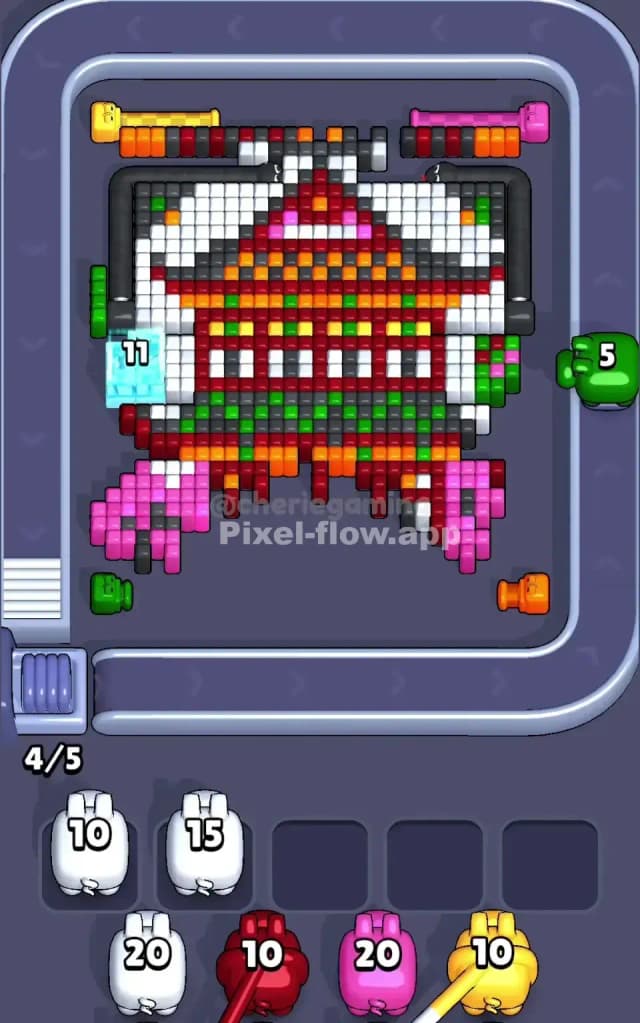
Once the white sky and black foundation are gone, the board looks drastic. You have a floating pagoda with exposed pink corners. Now the difficulty spikes. You must tackle the Pink zones next.
The pink pixels form the cherry blossom trees on the bottom left and right. They are thick clusters, easy to hit. Why clear them now? Because they block the "side entrances" to the temple's lower levels. If you try to shoot Green or Orange pixels while the Pink trees are still standing, your shots will likely get blocked or you'll run out of valid targets because the angle is bad. Clear the pink to open up the bottom corners.
At this mid-stage, avoiding power ups means you have to be paranoid about the Red and Orange layers. The roof uses an alternating pattern: Red, Orange, Red, Green. It is visually confusing. Before you drop a Red pig, look closely at the "eaves" of the roof. Are the red pixels actually on the outside, or are they tucked behind a row of green pixels? In Pixel Flow 447, the Green stripes often protrude slightly. If you pick Red too early, your pig will fire three shots, run out of visible red pixels, and then drop into your slot, clogging it.
Always play the "protruding" color. If the Green roof edge is sticking out, clear Green. If the Orange tiles are on top of the Red, clear Orange. Peel the roof like an onion.
Last Details You Clean Up in Pixel Flow Level 447
The end game of Pixel Flow Level 447 is usually a mess of scattered Yellow and deep Red pixels.
The Yellow pixels are tricky. They are located near the top pipes and often act as small decorative accents on the roof windows. They are tiny targets. You might save a Yellow pig for the very end, thinking you have plenty of ammo, only to find there are only 4 yellow pixels left on the board.
The final few moves will likely involve clearing the internal support columns of the pagoda, which are usually deep Red or sometimes a hidden White pixel that was trapped inside the structure. Watch out for the "pipe connectors" at the top corners (Yellow and Pink pipes). Sometimes a single pixel hides right next to the pipe exit, shielded by the pipe graphic itself. Scan the corners. Once that central red mass is gone, the level ends.