
Pixel Flow Level 450 Solution | Pixel Flow 450 Walkthrough
How to beat Pixel Flow Level 450: Video solution & walkthrough. The fastest way to pass Pixel Flow 450.
Is this the wrong level layout?🤔
Pixel Flow randomizes levels for different players. Don't worry, just upload a screenshot of your board, and our AI will find the correct video instantly.



Pixel Flow Level 450 Walkthrough
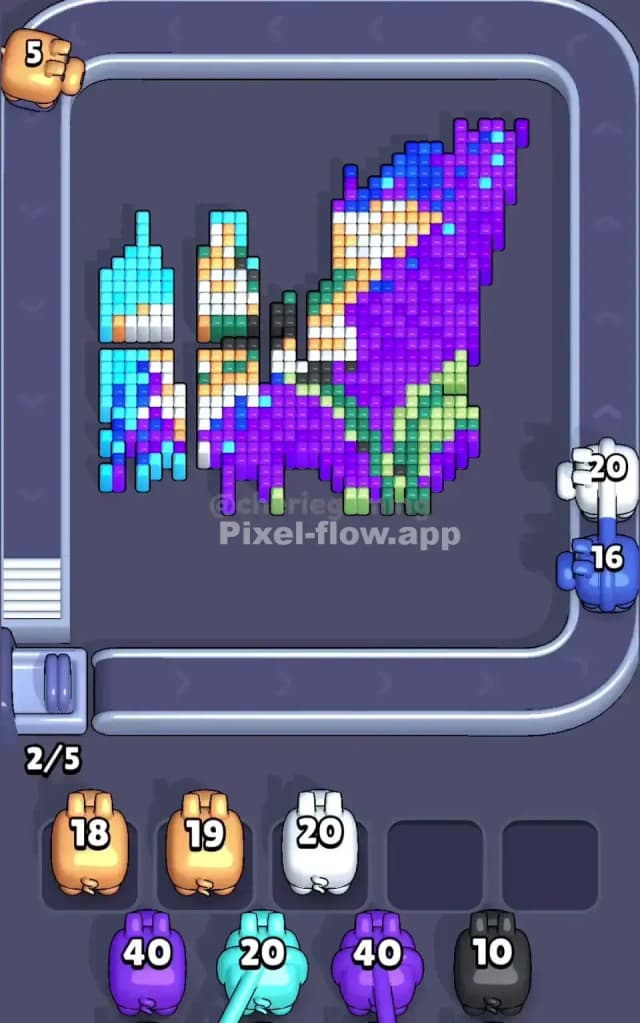
Pixel Flow Level 450 depicts a blooming white lily flower set against a dual-colored background. This board is dense. The voxel layers are thick, meaning you have to strip away a massive amount of "sky" before you can even touch the flower itself.
The rule here is simple but punishing: clear the massive outer blocks of color to reveal the delicate details inside. If you try to snipe the flower petals too early, you will clog your waiting area. Because of the sheer volume of pixels and the strict layering of the background, I judge this to be a very hard level. One mistake in prioritizing the background colors can end your run instantly.
Pixel Flow Level 450 Overview
Imagine a diagonal line cutting the board in half from the top right to the bottom left. Everything above that line is a bright Cyan sky. Everything below it is a deep, solid Purple void. Sitting right in the middle is a large white lily with orange-tipped petals and a sturdy green stem.
The visual weight of this level is deceptive. The flower looks like the main event, but the background colors (Cyan and Purple) actually account for about 60% of the total voxel count.
The board is highly asymmetric. The top left corner is a massive, uninterrupted block of Cyan. The bottom right is a solid chunk of Purple. However, the middle is messy. The green leaves and white petals jut out into both background colors, creating "islands" of background pixels that can get trapped if you aren't careful. You might clear the main sky but leave a single Cyan pixel stuck between two white petals. That single pixel will ruin you later when a Cyan pig arrives and has nothing to shoot.
Step by step solution walkthrough for Pixel Flow Level 450
First Color Zone to Erase in Pixel Flow Level 450
Your absolute priority must be the Cyan and Purple background zones.
Mechanically, the game starts you off with high-capacity pigs (often carrying 20 ammo) for these two colors. Narratively, you are "clearing the air" around the flower. Start with the Cyan top-left quadrant. This area is usually the thickest and covers the top petals of the lily.
By focusing on Cyan first, you expose the white petals underneath. If you ignore the Cyan and Purple pigs to save them for later, they will occupy your five holding slots. Since these pigs have huge ammo pools, they take forever to deplete if you use them on scattered pixels. You need to drop them while the background is solid so they can unload their entire clip in seconds. If you see a Purple pig, drop it immediately on the right side. If you see Cyan, drop it on the left. Do not hesitate.
How to pass Pixel Flow Level 450 without power ups or boosters
Once the main blocks of Cyan and Purple are gone, the board looks like a floating, jagged flower skeleton. This is the danger zone. You will see layers of White (petals), Green (stem/leaves), and patches of Orange (shading).
The trap in Level 450 is the White vs. Orange layering. The White pixels usually form the outer crust of the petals, covering the Orange shading inside.
Here is the strategy when you refuse to use power ups:
- Prioritize White Pigs: You need to peel the white layer to reveal the orange. If you have a choice between a Green pig and a White pig, play the White one. It opens up more board space.
- Hold the Orange: You will inevitably draw an Orange pig before the orange pixels are fully exposed. Do not panic. Keep it in your slot. Do not try to force it onto the board if it only has 1 or 2 valid targets. Wait until you have cleared enough White pixels that the Orange pig can fire at least 5-10 shots.
- Watch the Stem: The Green leaf at the bottom right is tricky. It often hides the last few Purple pixels. If you have a Purple pig stuck in your queue, check the edges of that green leaf. You likely missed a spot there.
Last Details You Clean Up in Pixel Flow Level 450
As you enter the final phase, the flower looks withered. The beautiful white petals are gone, leaving only the dark core.
The last elements to clean up are almost always Black and Dark Green. These colors make up the pistils and the deep veins of the flower center. They are the deepest layer of the voxel art.
At this stage, your pigs will have very low ammo counts (usually 3 to 5). This is fine. The danger of clogging is low now because there are very few valid targets left. Just be careful not to miss a tiny speck of Orange hidden near the center Black pixels. Sometimes the game hides a single voxel of shading behind the main stem. Scan the center vertical line of the board carefully before dropping your final pigs to ensure you aren't wasting a slot on a color that is still buried.