Pixel Flow Level 48 Solution | Pixel Flow 48 Walkthrough
How to beat Pixel Flow Level 48: Video solution & walkthrough. The fastest way to pass Pixel Flow 48.
Is this the wrong level layout?🤔
Pixel Flow randomizes levels for different players. Don't worry, just upload a screenshot of your board, and our AI will find the correct video instantly.


Pixel Flow Level 48 Walkthrough
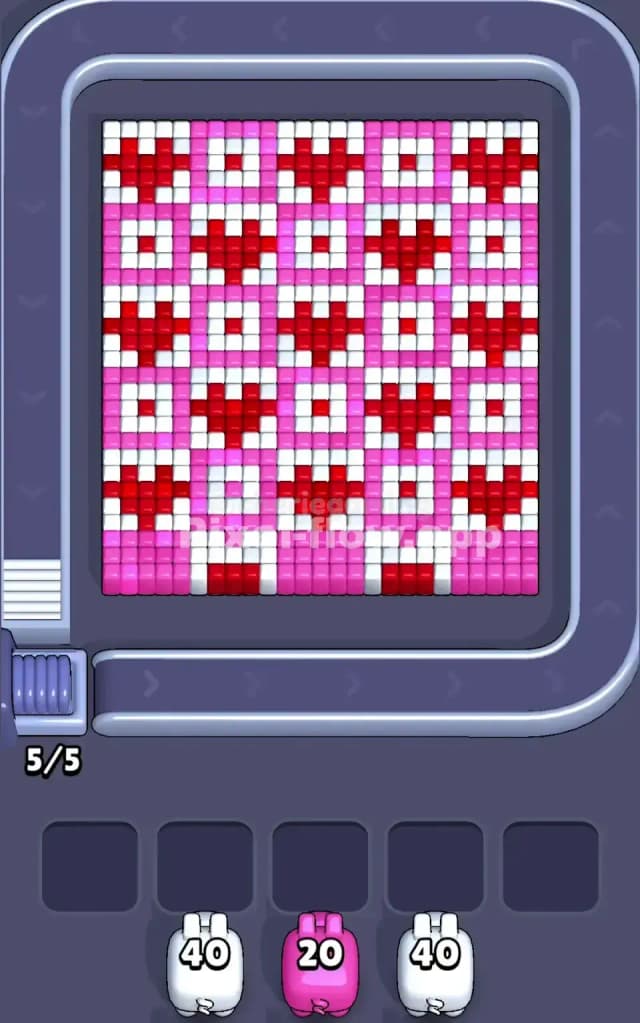
Pixel Flow Level 48 is a headache disguised as a valentine. You are looking at a flat, dense wall of voxels arranged in a "Love Quilt" pattern. The board is a massive checkerboard of Red hearts on White backgrounds, alternating with Pink frames surrounding smaller Red dots.
The rule here is strict vertical alignment. Because the pattern is so repetitive, every column is slightly different, and the pigs on the conveyor belt move fast. You need to match the pig color to the specific vertical strip currently facing you. If you get out of sync, your waiting slots will fill up instantly. This is a very hard level because of the sheer density of the board; there are almost no "easy" layers to peel off. You have to chip away at the front face evenly.
Pixel Flow Level 48 Overview
Imagine a pixelated picnic blanket or a grandmothers quilt. That is the vibe of Pixel Flow 48. The image is perfectly symmetrical, defined by alternating blocks.
- Block Type A: A big Red heart sitting on a White square.
- Block Type B: A hollow Pink square with a tiny Red dot in the center and White filler.
These blocks alternate across the entire grid. Visually, this creates distinct "lanes" for your pigs.
- Heart Lanes: These vertical columns contain heavy chunks of Red and White.
- Frame Lanes: These columns are dominated by Pink and White, with very little Red.
The asymmetry lies in the ammo counts versus the column composition. You will often get a Pink Pig (20 ammo) while the conveyor belt is rotating past the Heart Lanes (which have zero pink). If you fire there, you hit nothing and waste time. If you slot the pig, you lose a space. The challenge is patience. You cannot force a color where it doesn't exist.
Step by step solution walkthrough for Pixel Flow Level 48
First Color Zone to Erase in Pixel Flow Level 48
Ignore the Red hearts for a moment. Focus entirely on the White background.
Here is why: White is the only color that exists in both types of columns. Whether you are aiming at a "Heart Lane" or a "Frame Lane," there is white pixel coverage.
- When a White Pig (usually holding 40 ammo) spawns, you can fire it almost anywhere.
- Do not spam click. Tap rhythmically as the board rotates.
- Your goal is to strip the white "mortar" holding this quilt together.
By erasing the White first, you isolate the other colors. The Red hearts become free-standing islands. The Pink frames become hollow boxes. This separation is vital. If you leave the white connecting everything, you risk accidentally hitting a white block when trying to snipe a red one, wasting valuable colored ammo.
How to pass Pixel Flow Level 48 without power ups or boosters
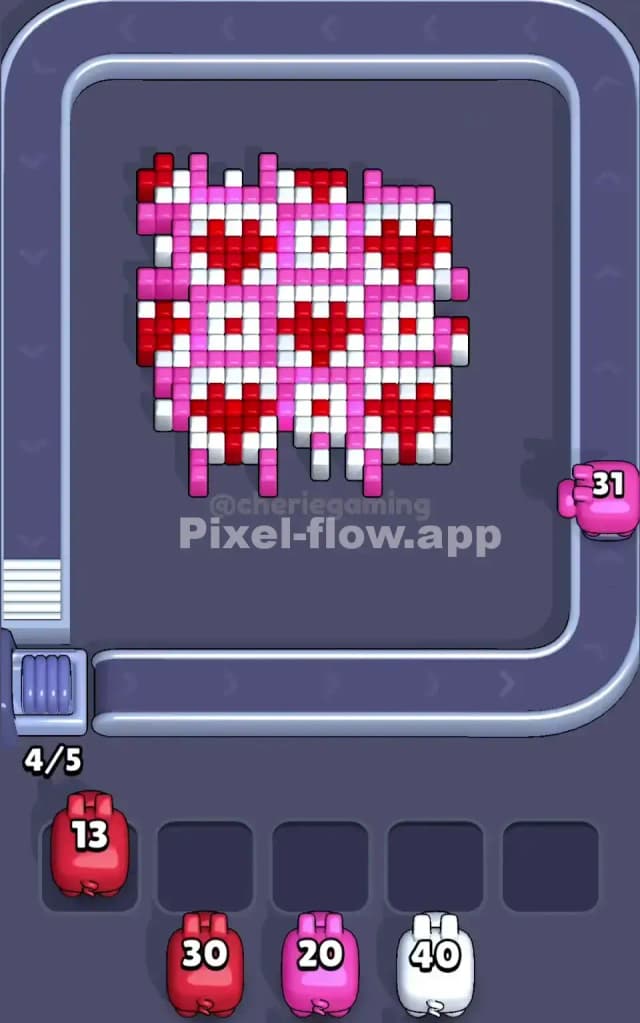
Once the White is mostly gone, the board looks like a ruined fence. You have vertical stripes of Red Hearts and vertical stripes of Pink boxes. This is the danger zone.
- The Slot Trap: You will frequently draw a Pink Pig while the board is rotated to show you the Red Hearts. Do not slot the pig immediately. Let the board spin. The rotation in Pixel Flow Level 48 is your best friend. Wait until the "Frame Lanes" (the pink ones) align with your shooter.
- Ammo Conservation: You have limited ammo for Red and Pink. You cannot afford to miss.
- Use Red Pigs only on the columns that used to hold the big hearts. These are distinct, thick targets.
- Use Pink Pigs specifically on the columns between the hearts.
- Dealing with Clogs: If your waiting slots are 4/5 full, stop firing completely. Look at the next pig in the queue. Find the exact column where that color exists. Wait for it. If you panic-fire to clear the queue, you will run out of ammo before the level ends.
Last Details You Clean Up in Pixel Flow Level 48
The end game of Pixel Flow 48 is usually messy. You will likely have a few Red dots floating in mid-air (remnants of the Frame Lanes) and perhaps the bottom row of the Pink frames.
The most common leftover pieces are the single Red pixels that were inside the pink squares. They are tiny targets.
- Do not waste a fresh Red Pig (13+ ammo) on a single pixel if you can avoid it.
- Check your waiting slots. If you have a damaged Red Pig (low ammo) saved from earlier, use that one.
- Watch the bottom corners. The rotation makes the bottom-left and bottom-right corners hard to hit because they move the fastest relative to your perspective. Prioritize clearing those corners whenever a valid color aligns, or they will be the last two pixels standing between you and victory.