Pixel Flow Level 488 Solution | Pixel Flow 488 Walkthrough
How to beat Pixel Flow Level 488: Video solution & walkthrough. The fastest way to pass Pixel Flow 488.
Is this the wrong level layout?🤔
Pixel Flow randomizes levels for different players. Don't worry, just upload a screenshot of your board, and our AI will find the correct video instantly.




Pixel Flow Level 488 Walkthrough
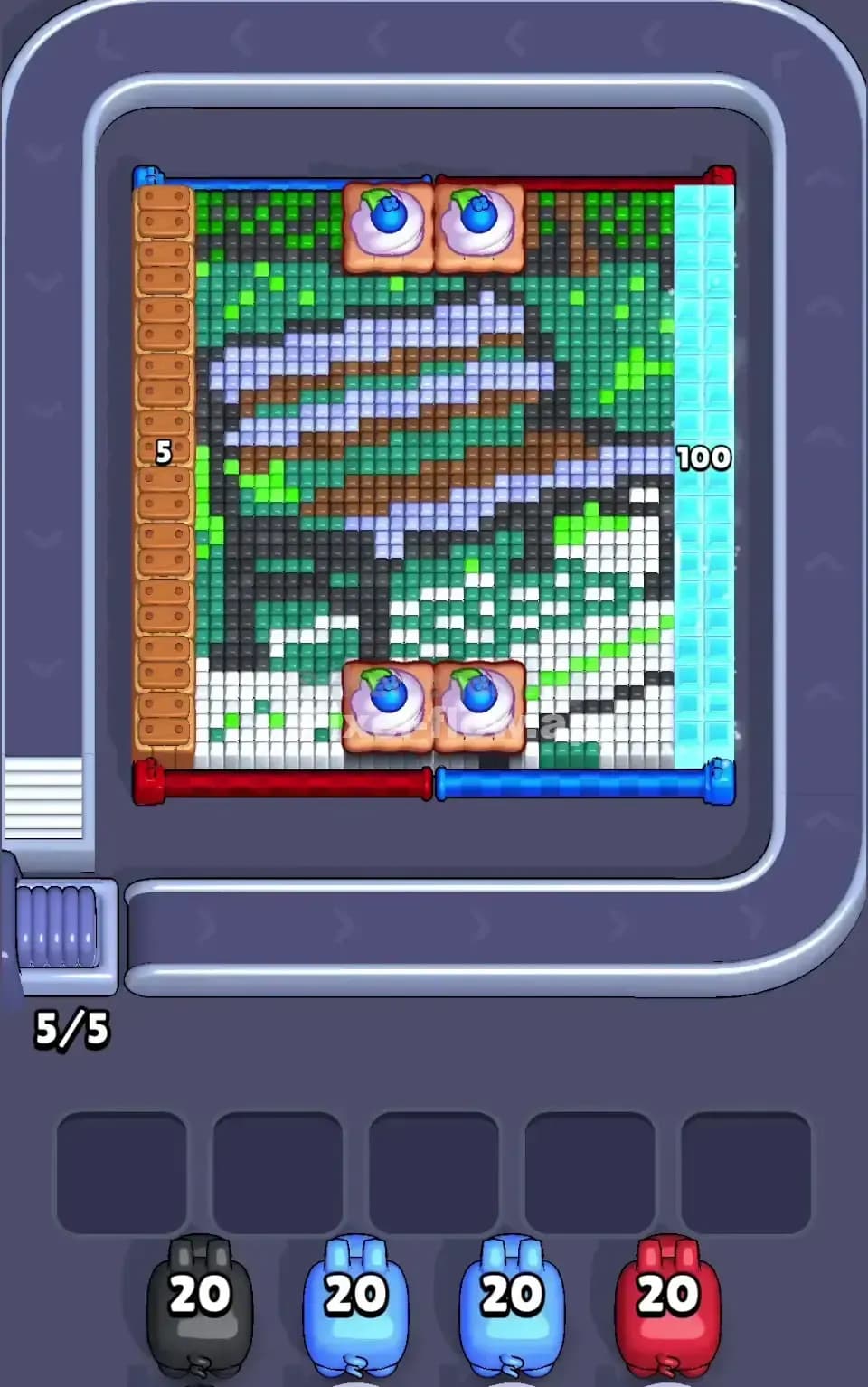
This level features a beautiful, circular "stained glass" design of two mushrooms set against a starry night sky. The scene is enclosed in a tight circle, meaning you have no corners to nibble at; you have to attack the curve directly. The colors are dense: deep blues for the night, bright pinks for the mushroom caps, light blue for foliage, and white for the thick stems.
To beat Pixel Flow Level 488, you must peel this circle like an onion. The outer layers protect the white stems in the center. If you try to drill straight to the center without clearing the perimeter, your slots will clog instantly. Because of the scattered "star" pixels that require specific colors at awkward times, I judge this to be a very hard level.
Pixel Flow Level 488 Overview
Think of this board as a magical forest badge. You have two large mushrooms dominating the center. They are slightly tilted away from each other. Their caps are striped with Pink and Magenta, while their stems are solid, thick blocks of White.
Surrounding these fungi is a night sky made of Dark Blue (or Indigo) pixels. This background isn't solid; it's speckled with single Yellow blocks representing stars or fireflies. This is the danger zone.
There is asymmetry here that matters.
- The Leaves: Large Light Blue leaves jut out on the top right and bottom left. These are shallow layers. They sit right on top of the background.
- The Rim: The bottom edge of the circle is a heavy band of Magenta, while the top edge blends into the Dark Blue sky.
- The Trap: The yellow stars are not connected. They are "islands." A Yellow pig usually has high ammo, but if you summon him when only one star is visible, he wastes a slot forever.
Step by step solution walkthrough for Pixel Flow Level 488
First Color Zone to Erase in Pixel Flow Level 488
You have no choice but to attack the Light Blue leaves and the Magenta bottom rim first.
Look at your starting conveyor belt. You will likely see Light Blue and Pink/Magenta pigs early on. This is perfect. Focus on the Light Blue leaves in the top-right and bottom-left quadrants. These clusters are dense and easy to hit. They act as "armor" for the inner dark blue layer. By clearing the leaves, you expose the dark blue background underneath.
Simultaneously, use any Pink pigs to shave off the bottom curve of the circle. This area is thick with pink blocks. Clearing the bottom rim prevents "orphan" pixels from hiding down there later. Do not try to snipe the Yellow stars yet. Ignore them. If a Yellow pig comes down the pipe, let it pass unless you are absolutely sure you can clear 10+ blocks with it.
How to pass Pixel Flow Level 488 without power ups or boosters
The mid-game of Pixel Flow 488 is brutal. You will reach a point where the Light Blue leaves are gone, and the Pink mushroom caps are half-eaten. The board will look messy.
Here is the priority shift:
- Hunt the Dark Blue: Once the leaves are gone, the Dark Blue sky is the glue holding the picture together. It connects everything. Prioritize Dark Blue pigs to clear the space between the two mushrooms.
- Expose the White Stems: You cannot clear the white stems until the Pink caps above them are removed. Focus on peeling the pink layers back.
- Slot Management: This is where players lose. You will likely have a White pig drop into your slot waiting for the stems to be exposed. That is fine. But if you also let a Yellow pig and a Light Blue pig sit in the slots while waiting for valid targets, you are dead. Keep at least two slots open at all times. If the belt offers a color you can't use immediately to clear a large chunk, let it loop.
Do not panic when the White stems look touchable but aren't clearing. There is often a single Dark Blue pixel hiding in front of them. Find it. Kill it.
Last Details You Clean Up in Pixel Flow Level 488
The end of Pixel Flow Level 488 is usually a standoff between you and the White stems.
Once the sky and caps are gone, the White stems are just big, dumb targets. A single high-ammo White pig can often wipe out an entire stem in seconds. However, the real final boss is usually the Yellow stars.
Because the stars were scattered throughout the Dark Blue sky, you might have one or two single yellow blocks left floating in space. Hopefully, you saved a low-ammo Yellow pig in your slots for this exact moment. If you didn't, you'll have to cycle through the belt frantically hoping for a match. Clear the heavy white blocks first to improve visibility, then snipe the final stars to finish the level.