Pixel Flow Level 497 Solution Walkthrough | Pixel Flow 497
How to solve Pixel Flow level 497? Get instant solution for Pixel Flow 497 with our step by step solution & video walkthrough.

Pixel Flow Level 497 Overview
The Starting Board and Visual Structure
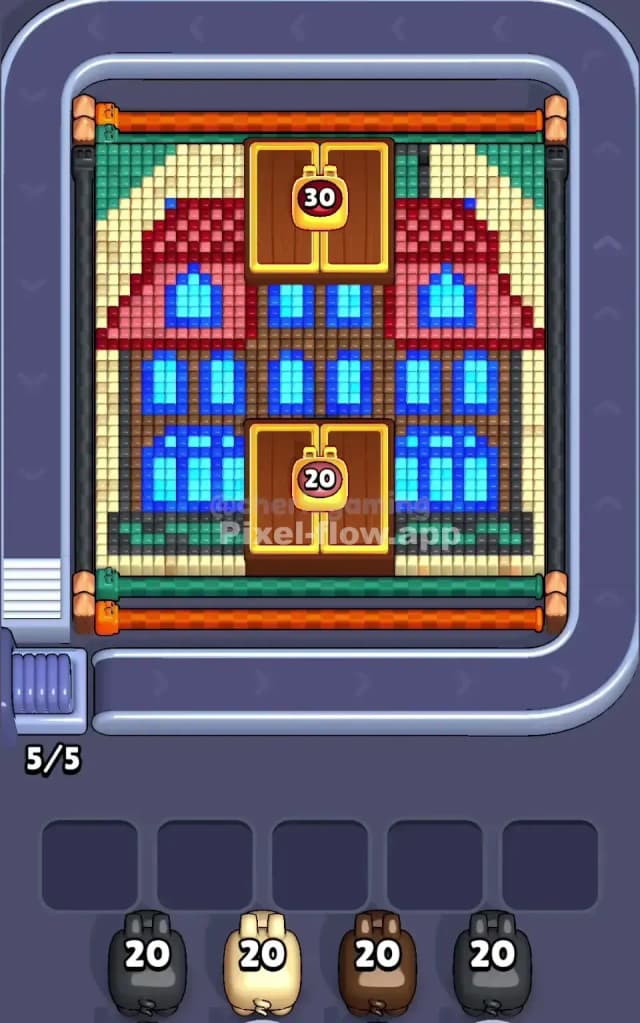
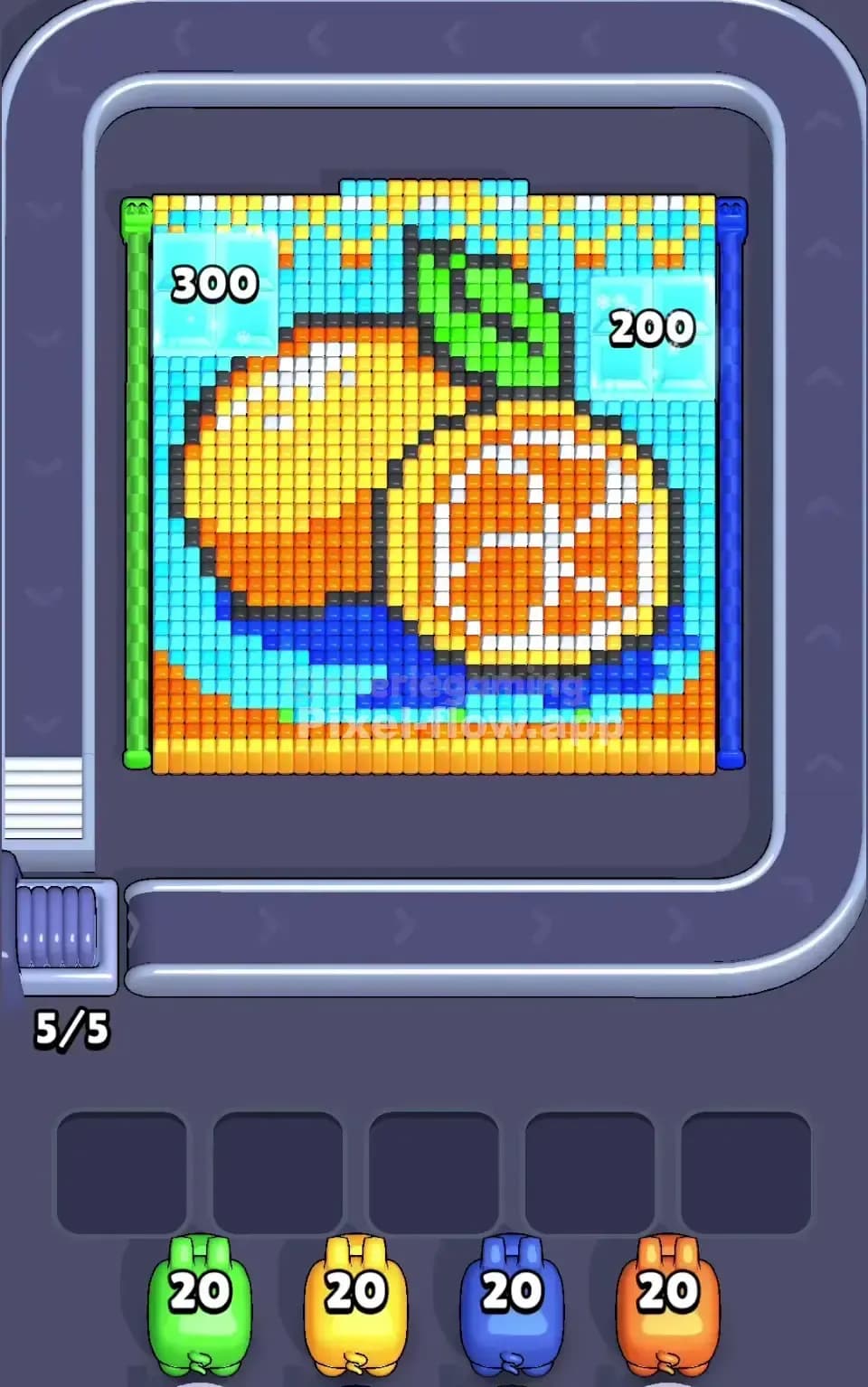
Pixel Flow Level 497 presents a vibrant, multi-layered voxel illustration dominated by a stylized character or creature rendered in distinct color bands. The board starts densely packed with cyan at the top, white and black outline details forming the character's features in the upper-middle section, then transitions into warm tones—orange and yellow—in the mid-section, before dropping into bright green, magenta, purple, and finally deep blue at the bottom. This is a classic "stacked difficulty" level where surface layers mask deeper color problems underneath. The cyan forms an extensive perimeter, while magenta and white chunks occupy the central region, creating visual bottlenecks. You'll notice the waiting slots below show your incoming pig queue: a magenta pig with 10 ammo, a yellow pig with 10 ammo, a white pig with 10 ammo, and a green pig with 10 ammo—all four pigs equally armed and ready to fire.
Win Condition and Deterministic Nature
Your goal in Pixel Flow Level 497 is straightforward: clear every single voxel cube from the board. Unlike many puzzle games that reward speed or style, Pixel Flow 497 demands precision sequencing because each pig's ammo count is fixed and deterministic. The magenta pig will always fire exactly 10 times, the yellow pig 10 times, white 10 times, and green 10 times. That's 40 total shots to eliminate however many cubes exist on the board. You can't negotiate with the game or reverse a choice—once a pig fires, it spends ammo. This means Pixel Flow Level 497 isn't about reflexes; it's about planning ahead and respecting the constraints of your resources.
Why Pixel Flow Level 497 Feels So Tricky
The Central Bottleneck
The biggest threat in Pixel Flow Level 497 is the dense white and magenta cluster sitting right in the heart of the board. These two colors form the character's body and create a visual tangle that obscures which colored cubes lie behind them. When you fire your magenta pig early (which seems logical), you'll expose some inner layers, but you risk running out of valid targets partway through your ammo count. If magenta still has 3 or 4 ammo left but all visible magenta cubes are gone, that pig drops into a waiting slot with ammo still loaded—a "stuck" pig. Multiply this across even two pigs, and you've filled up half your waiting slots with nowhere to put subsequent pigs. Then the game jams. This is the cruel logic of Pixel Flow Level 497: being impatient with color clearing invites a catastrophic failure.
Awkward Color Pockets and Layer Misalignment
Pixel Flow 497 hides several subtle traps. The orange and yellow cubes occupy both the upper-right and lower-left quadrants, but they're not continuous—there's a gap of white and green between them. If you fire your yellow pig too early, you'll clear the upper pocket and then face five moves of nothingness while the pig searches for more yellow targets. Similarly, the purple cubes sit almost exclusively at the bottom, but the white cubes create a visual barrier. You can't simply work bottom-to-top; you have to weave through layers. The green cubes spread across the lower half in a scattered pattern, making it tempting to shoot green early, but doing so often exposes magenta underneath—and if magenta is still loaded in the queue, you've just sabotaged your own sequencing.
Personal Reaction and the "Click" Moment
I'll be honest: Pixel Flow Level 497 frustrated me for a good dozen attempts. I kept thinking I could bulldoze through it by shooting the most visible color first, and I kept ending up with two stuck pigs and a game over screen. The real "click" moment came when I stopped looking at the board as a picture and started reading it as a depth map. I realized that every cube has a z-coordinate; I wasn't just clearing colors, I was excavating layers. Once I accepted that Pixel Flow 497 required me to skip my first instinct and instead map out a three-pig sequence before making a single move, the solution revealed itself.
Step-by-Step Strategy to Clear Pixel Flow Level 497
Opening: Establish Breathing Room
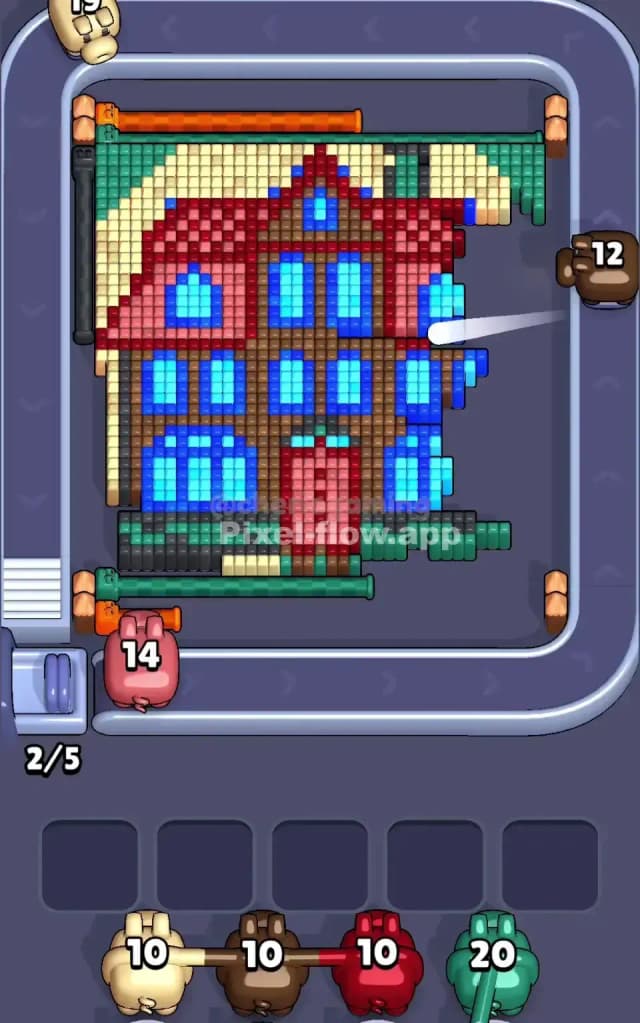
Start Pixel Flow Level 497 by avoiding the white pig immediately. I know the white pig is the third in queue, but white cubes are everywhere and their ammo won't stretch far enough to clear them all. Instead, launch your magenta pig first. Magenta has exactly 10 shots, and while there are magenta cubes scattered across the board, the initial visible concentration near the center will consume about 6 or 7 ammo. This clears a critical visual barrier and exposes deeper colors without overfilling your waiting slots. Keep at least two waiting slots free after this move. Magenta will likely stick around with 3–4 ammo remaining; park it in a slot. Next, send in the yellow pig. Yellow cubes cluster in the upper-right corner and scattered lower-left patches. Fire yellow to clear the upper-right pocket completely—this costs about 4 or 5 ammo and opens the northeast quadrant, allowing you to see what's hidden beneath the cyan layer. Yellow will also park in a waiting slot with ammo remaining.
Mid-Game: Exposure and Sequencing
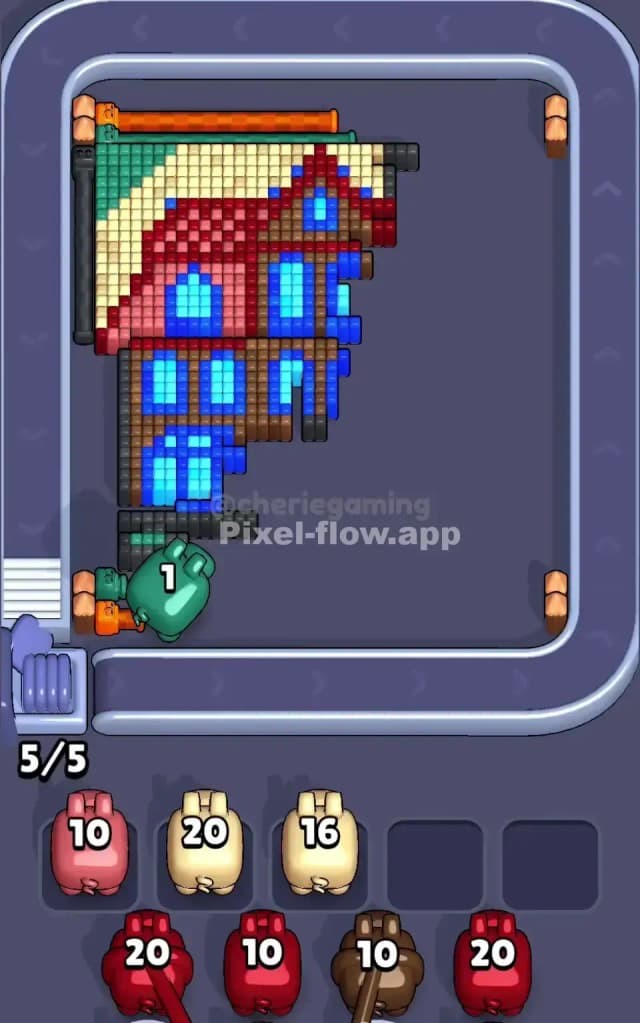
This is where Pixel Flow Level 497 demands your full attention. After magenta and yellow have fired, you should have only 1 or 2 waiting slots occupied and two pigs left in queue: white and green. Now fire white. White cubes form outlines and fill scattered interior spaces. You've got 10 ammo and probably 12–15 visible white cubes still on the board (after yellow and magenta exposed new layers). Carefully aim to spend about 8 ammo on white, clearing the obvious clusters on the character's face and body, but intentionally leave 1 or 2 white shots unfired. This is counterintuitive, but it's essential: you want white to park in a slot with ammo remaining so it doesn't jam up your queue. At this point, your board should show significantly more cyan, green, orange, and a full view of the bottom purple section. Send in the green pig. Green has a wide distribution across the lower-middle regions. Spend 7 or 8 ammo here, clearing the bright green patches and opening sightlines to purple below. Again, park green in a waiting slot with 2–3 ammo left.
End-Game: The Critical Finish
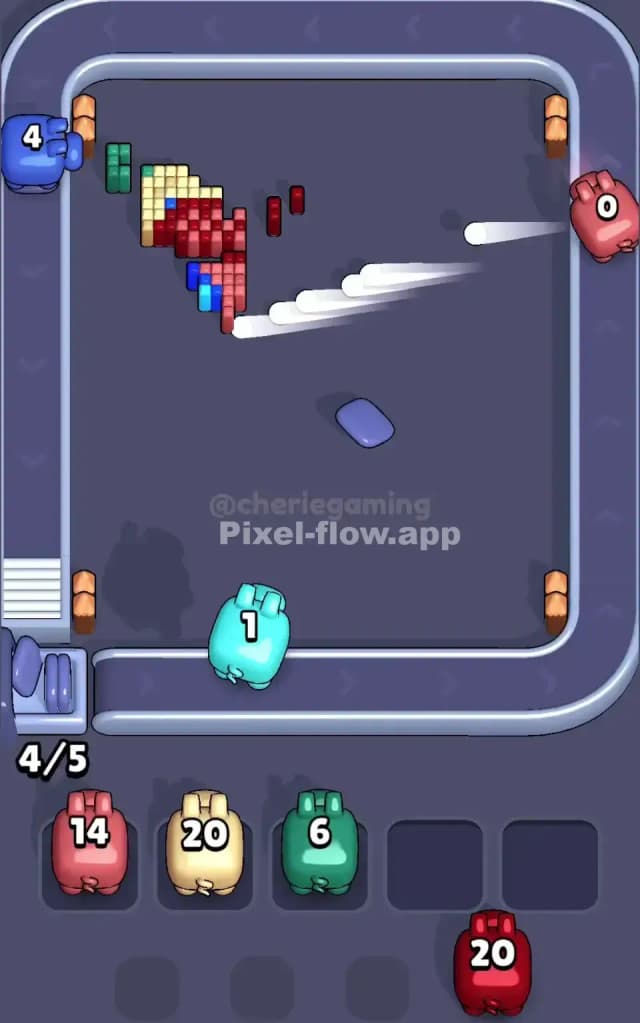
You've now got four pigs in your waiting slots, each with a few ammo remaining. Here's the magic: the remaining visible cubes—cyan, orange, and purple—are now fully exposed, and you have accumulated ammo across your parked pigs to finish them off. Cycle through your pigs in a specific order. Pull magenta again and spend its remaining 3–4 shots on any magenta cubes that appeared in deeper layers (there usually are some). Pull yellow next and spend its last 2 ammo on any new yellow cubes exposed by your prior clears. Fire white again to mop up remaining white outlines. Finally, cycle back to green if needed. By this sequencing, you're never forcing a pig to stay seated with full ammo; you're grinding down the buffer and the board in tandem. When purple, cyan, and orange remain at the end, they're the only pigs you haven't sent yet—oh wait, you don't have purple, cyan, or orange pigs. So all remaining cubes must be cleared by your existing four pigs. If you've managed your ammo correctly, this is always possible. The final moves in Pixel Flow 497 are anticlimactic: you'll empty the last few cubes and watch the board clear cleanly.
The Logic Behind This Pixel Flow Level 497 Plan
Resource Allocation and Pig Order Exploitation
The beauty of Pixel Flow Level 497 is that its difficulty is entirely artificial—the game isn't harder because the board is large, but because players waste ammo. By forcing yourself to park pigs with remaining ammo early and cycling through them later, you're respecting the game's true constraint: waiting slot capacity. You have five slots, but only four pigs. If all four pigs are stuck in slots with ammo remaining, the fifth pig in queue (if there were one) has nowhere to go. The strategy outlined above keeps this from happening by ensuring that by the time all four pigs are seated, no more pigs are incoming. You also exploit ammo by acknowledging that overexposure is the enemy. Firing magenta completely dry might feel satisfying, but it locks that pig in a slot forever. Firing magenta strategically—leaving ammo unspent—lets you return to magenta later when new magenta cubes appear in deeper layers. Pixel Flow 497 rewards patience and forward-planning, not aggression.
Staying Calm, Counting Ammo, and Planning Ahead
The emotional intelligence required for Pixel Flow 497 is underrated. When you see a dense block of cyan cubes filling the entire top third of the board, your brain screams, "Shoot cyan now!" But Pixel Flow 497 has no cyan pig in your queue. Fighting the impulse to solve what you see and instead analyzing what you know is coming—that's the discipline that cracks this level. Before firing any pig, count the visible ammo sinks for that color. Magenta? Count every magenta cube you can see. Do you see more than 10? Then you know magenta won't finish the job alone and will park in a slot. Proceed accordingly. Watch your waiting slots like a hawk. If three slots fill up, your next pig must be one with a heavy ammo count relative to its targets, or you'll jam. In Pixel Flow Level 497, two or three moves of foresight—literally imagining which pig fires next and what that exposure reveals—transforms a "luck-based" puzzle into a deterministic solve. You're not hoping for the right outcome; you're engineering it through logic.