Pixel Flow Level 511 Solution | Pixel Flow 511 Walkthrough
How to beat Pixel Flow Level 511: Video solution & walkthrough. The fastest way to pass Pixel Flow 511.
Is this the wrong level layout?🤔
Pixel Flow randomizes levels for different players. Don't worry, just upload a screenshot of your board, and our AI will find the correct video instantly.
Pixel Flow Level 511 Walkthrough
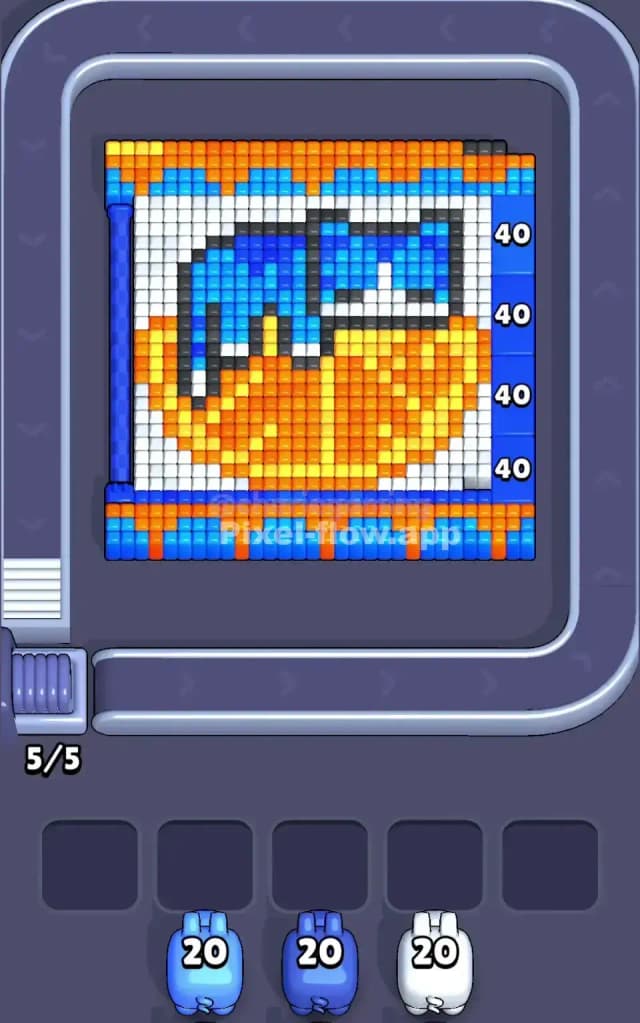
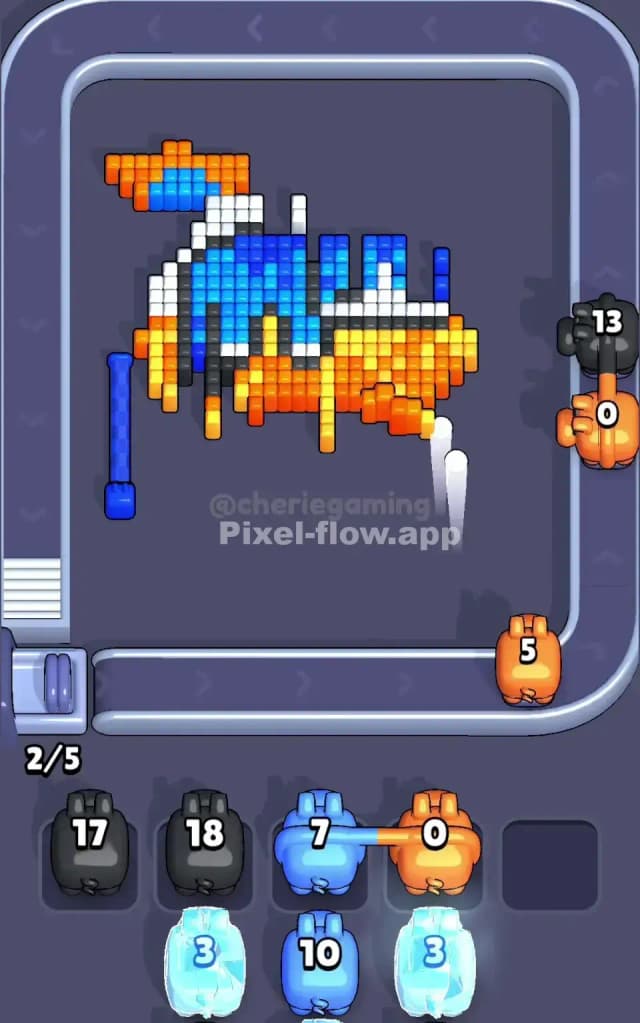
This level features a pixel art piece that looks like a blue cat sleeping inside a large measuring cup filled with orange juice. You have a massive semi-circle of orange and yellow at the bottom, a blue cat curled up on top, and distinct striped borders at the very top and bottom. The vertical blue bar on the right even has numbers like "40," resembling volume markings.
The rules are standard but strict here: match the pig color to the pixel blocks. However, Pixel Flow Level 511 is a very hard level. The difficulty spikes because of the checkered patterns at the top and bottom of the frame, which force you to have specific colors available at specific times, leading to clogged slots if you aren't careful.
Pixel Flow Level 511 Overview
Imagine a cross-section of a measuring cup. The main "liquid" is a giant block of Orange and Yellow pixels taking up the bottom half. Floating on this liquid is a Blue and Light Blue cat. The background is filled with White pixels, representing the empty space or maybe milk.
The most dangerous parts of this board are the top and bottom edges. Look closely. They aren't solid blocks. They are alternating "zippers" of Orange and Light Blue. This asymmetry is a trap. In most levels, you can just spam a color to clear a row. Here, if you spam Blue pigs on the bottom row, you will hit an Orange block immediately and waste the pig or clog your slot.
The right side is a solid vertical wall of Blue with white numbers. This wall is thick and acts as a barrier for anything behind it. You need to chip away at these outer "container" walls before you can mess with the cat or the juice inside.
Step by step solution walkthrough for Pixel Flow Level 511
First Color Zone to Erase in Pixel Flow Level 511
I strongly recommend prioritizing White pigs immediately.
Here is why: The White pixels act as the "filler" around the cat and inside the cup's empty spaces. It is the most accessible color that doesn't get you into trouble with the checkered patterns yet. There are huge chunks of white to the left and right of the cat. Clearing the white "air" exposes the edges of the Orange juice and the Blue cat.
If you don't clear the white first, you block your line of sight to the inner layers. Plus, the white blocks are mostly solid clumps. You won't waste ammo. You see a white pig? You shoot it. It’s safe. Get the background out of the way so you can see the dangerous layers underneath.
How to pass Pixel Flow Level 511 without power ups or boosters
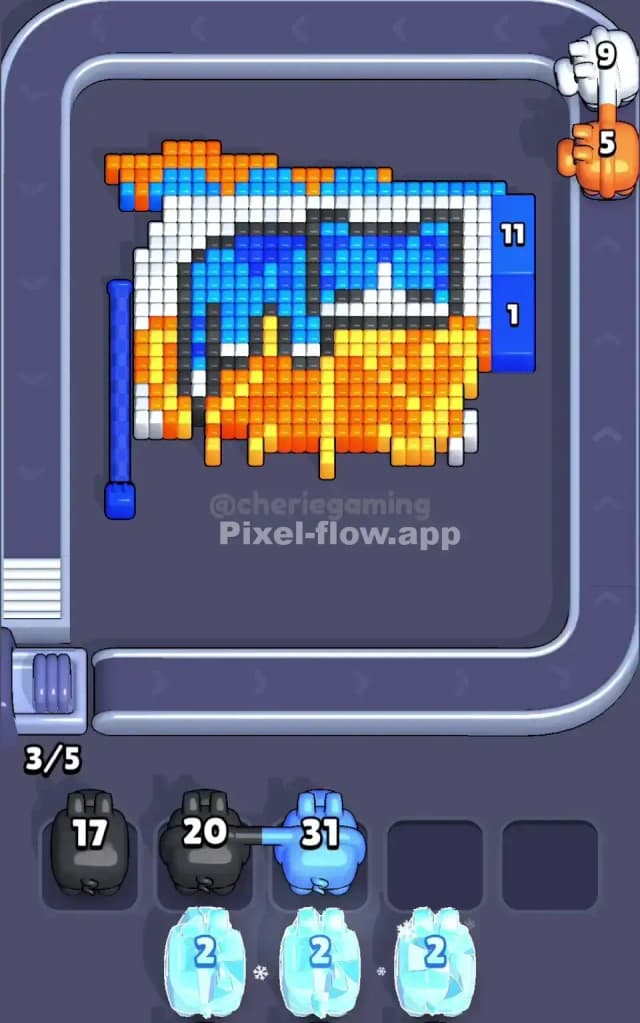
Once the white background is gone, the board looks messy. You are left with the striped borders and the central image. This is where most players lose.
You must switch your brain to "Checkered Mode." Do not blindly fire at the top or bottom rows.
- Respect the Stripes: The top and bottom rows alternate Orange and Blue. If the conveyor belt gives you three Blue pigs in a row, do not try to clear the bottom stripe quickly. You will hit an orange block, stop, and clog a slot. Only shoot the stripes if you have the alternating colors ready in your hand or coming up next.
- Hollow out the Orange: Instead of fighting the borders, focus on the giant Orange semi-circle in the middle. It’s a huge, fat target. Use your Orange pigs here. It’s a safe ammo dump. This prevents your slots from filling up with Orange pigs that can’t hit the checkered border.
- The Cat's Body: The cat is mostly Light Blue and Dark Blue. Save your blue pigs for the cat's body rather than the dangerous right-side ruler or the borders. The body is a solid block, making it a safer target than the complex edges.
If you refuse to use power ups, you survive by targeting the "solid" centers (the juice and the cat) and ignoring the "patterned" edges until you have no other choice.
Last Details You Clean Up in Pixel Flow Level 511
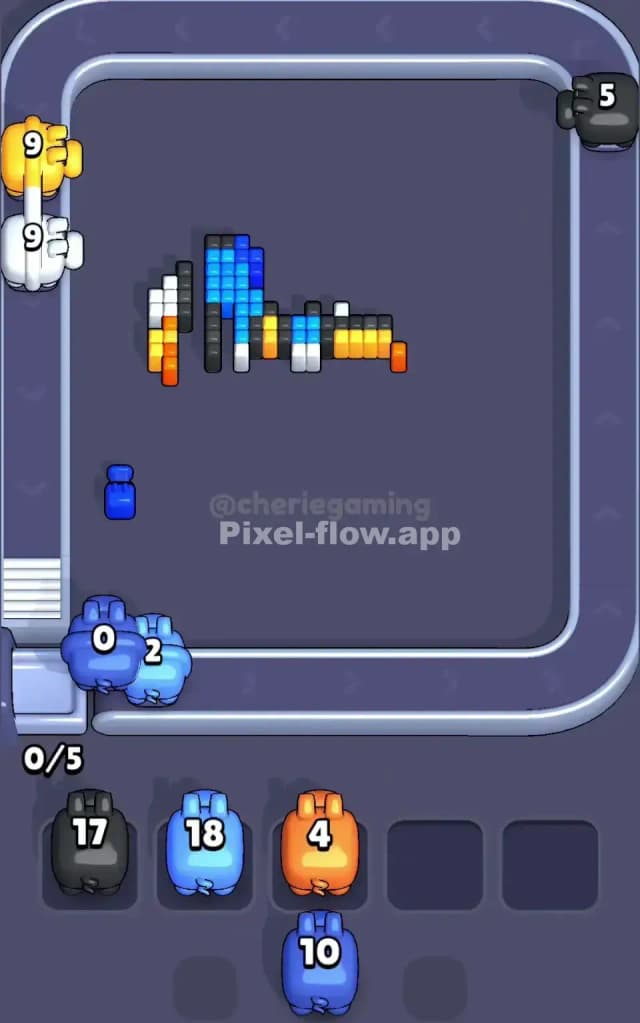
At the end, you will likely be staring at the Black outline pixels and the stubborn Dark Blue chunks of the cat's face.
The black pixels are annoying because they are thin lines. They don't offer big clusters. You have to be precise. Often, a single Black pig will have to travel halfway across the screen to hit one pixel on the cat's tail. Be patient.
The final few moves usually involve cleaning up that vertical blue bar on the right (the one with the '40'). It’s deep, and often hides a few stray pixels behind it. Don't celebrate until that measuring ruler is completely smashed. Once the ruler is gone, the level is yours.