Pixel Flow Level 512 Solution | Pixel Flow 512 Walkthrough
How to beat Pixel Flow Level 512: Video solution & walkthrough. The fastest way to pass Pixel Flow 512.
Is this the wrong level layout?🤔
Pixel Flow randomizes levels for different players. Don't worry, just upload a screenshot of your board, and our AI will find the correct video instantly.

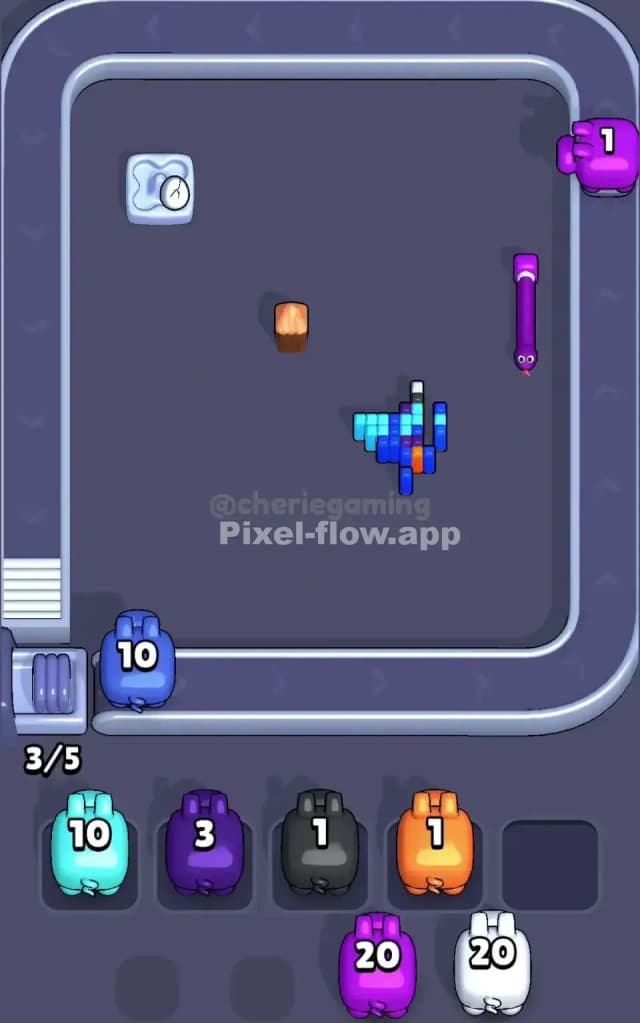
Pixel Flow Level 512 Walkthrough
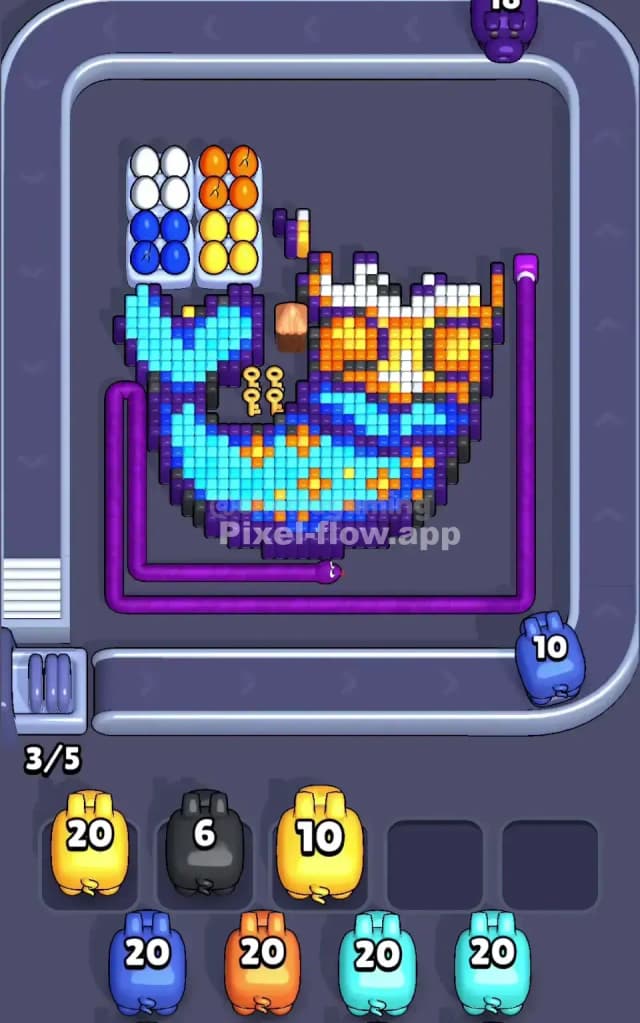
This level features a bizarre, colorful hybrid creature: a "Mer-Fox." It has the orange head of a fox and the scaly blue tail of a mermaid. It’s a dense, multi-layered puzzle. You have a massive obstacle in the form of a purple pipe system wrapping around the right and bottom edges, plus a large locked chest sitting in the top-left corner.
The rules to beat Pixel Flow Level 512 are strict. You must clear the voxel layers to expose two golden keys hidden near the creature's "waist." Collecting these keys is the only way to remove the purple pipes blocking your shots. Without removing those pipes, you cannot clear the right side of the image. Because of the heavy shielding and the hidden sub-layer of items (eggs) revealed late in the game, I judge this to be a very hard level.
Pixel Flow Level 512 Overview
The artwork depicts a Fox-Mermaid hybrid. The top half is dominated by bright Orange and White blocks forming the fox's face and ears. The bottom half curves into a U-shape, made of Cyan and Dark Blue blocks representing the mermaid tail. The entire figure is outlined in a thick Dark Purple border.
The board layout is painfully asymmetric. The left side is open, but the top-left is occupied by a heavy wooden chest with a "40" countdown lock. This chest is a blocker; you can't shoot through it.
The right side is even worse. A thick Purple Pipe runs down the entire right edge and wraps under the bottom. This pipe acts as a shield. Any pig you send down the right-hand lanes will likely have its shots blocked by this pipe until you solve the key puzzle. This forces you to play almost entirely on the left and center lanes for the first half of the match. You cannot flank this image. You have to attack it head-on, from the top down.
Step by step solution walkthrough for Pixel Flow Level 512
First Color Zone to Erase in Pixel Flow Level 512
I start by aggressively targeting the Orange blocks on the fox's forehead and the Cyan blocks on the left tip of the tail.
Here is the narrative and logical reason: The purple pipe makes the bottom-right inaccessible. The chest blocks the top-left corner. The only "soft" entry point is the center-top and center-left. The fox’s head is a massive cluster of Orange. By clearing the Orange first, you do two things:
- You maximize your ammo efficiency. Since the Orange blocks are grouped tightly together, your Orange pigs won't waste shots.
- You "shave down" the height of the image. As the head disappears, you get a clearer line of sight to the neck area where the keys are hiding.
Do not try to force the Dark Purple outline pigs early. They will just bounce off the pipe or hit the outer edge without making a dent in the core structure. Let them sit in the waiting slots if you have to, or prioritize Orange and White pigs to drill down.
How to pass Pixel Flow Level 512 without power ups or boosters
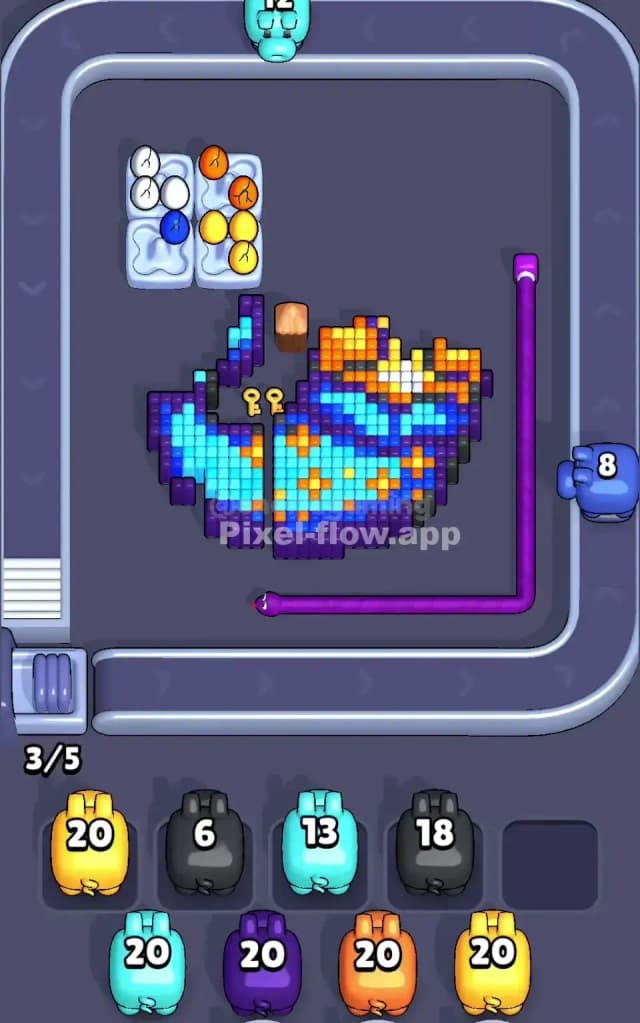
The mid-game is the most dangerous part of Pixel Flow 512. At this point, you have likely shaved off the face of the fox, but the keys are still buried. The board looks half-destroyed, with the orange body thinning out to reveal the background layer.
To survive without power ups, you must ignore the chest and focus entirely on the Keys.
The keys are located right where the orange fur meets the blue scales—the creature's waist. You need to use Cyan and Dark Blue pigs to chip away the tail section covering these keys. You must be patient. If you draw a pig color that doesn't match the waist area (like White or Yellow), check if it can hit the Chest. The Chest has a "40" counter. Every hit reduces that number. If you have no shots on the fox/mermaid, dump your ammo into the chest to keep your waiting slots empty.
Once you expose and collect the keys, the purple pipe system will retract. This is the turning point. Suddenly, the right side of the board opens up. Now you must immediately switch tactics. Stop hitting the center. Send your pigs to the far right lane to clear the Dark Purple and Orange pixels on the right side of the fox's head and tail that were previously invincible. If you don't clear that right edge immediately after the pipe drops, those pixels will linger and cause you to lose because they are hard to hit from other angles.
Last Details You Clean Up in Pixel Flow Level 512
The end of Pixel Flow Level 512 pulls a nasty trick. Just when you think you are done, the area under the chest (or the chest itself opening) reveals a set of Ice Blocks containing dinosaur eggs.
These eggs are usually White, Yellow, or Blue. They sit in the top-left corner where the chest used to be. The ice requires a hit to break before you can color the egg inside.
Your final moves will be a scramble to clear these eggs while mopping up the last bits of the mermaid tail. Save your White pigs for this final phase; you will need them for the white eggs and the last remnants of the fox's face. If you wasted all your White ammo earlier on the chest, you might get stuck here. The very last cube you destroy will likely be a stray Dark Purple block on the bottom curve of the tail, or the final egg in that frozen carton. Stay sharp and keep your slots clear for the specific colors needed to crack those eggs.