Pixel Flow Level 538 Solution | Pixel Flow 538 Walkthrough
How to beat Pixel Flow Level 538: Video solution & walkthrough. The fastest way to pass Pixel Flow 538.
Is this the wrong level layout?🤔
Pixel Flow randomizes levels for different players. Don't worry, just upload a screenshot of your board, and our AI will find the correct video instantly.

Pixel Flow Level 538 Walkthrough
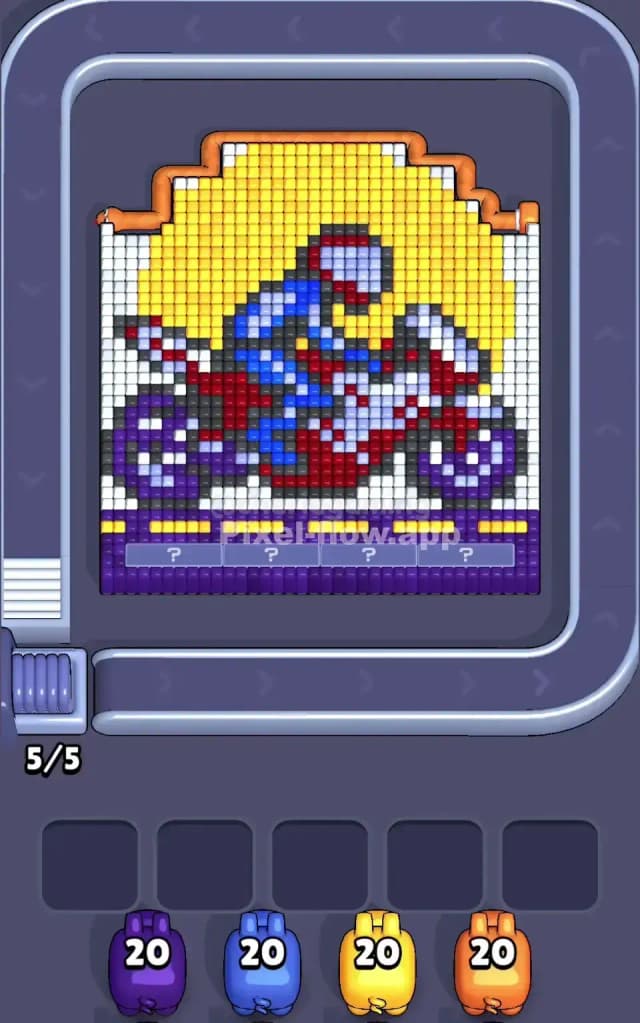
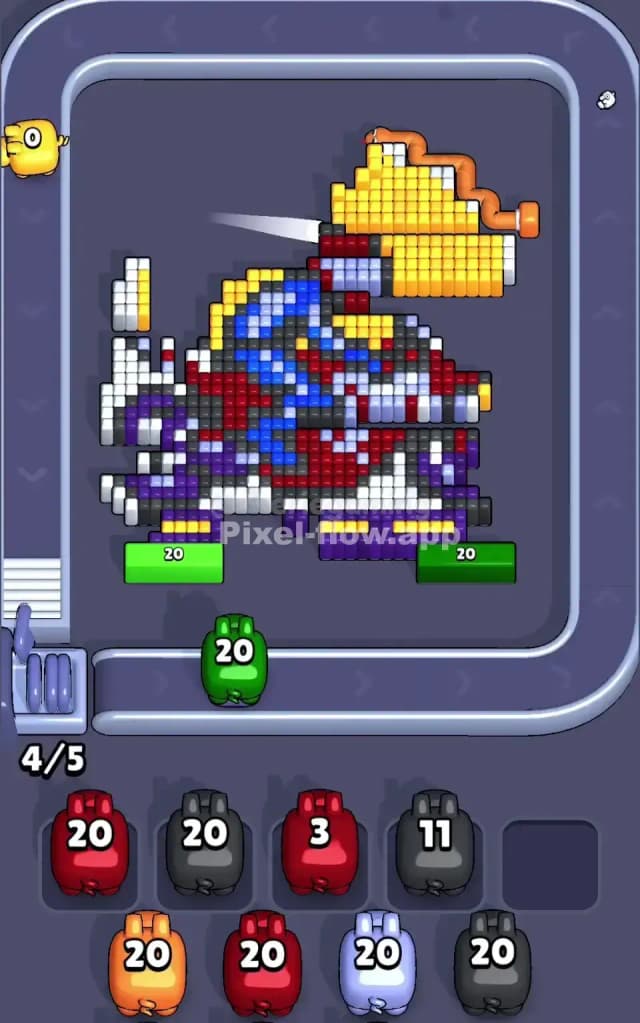
Pixel Flow Level 538 hits the gas with a detailed motorcycle racer scene. This is a dense, layered puzzle. You are looking at a rider in a blue suit on a red and white bike, speeding across a purple road against a massive yellow sun. The board is packed tight.
Your main enemies here are the scattered pixels inside the bike itself. While the background (sun and road) consists of large, easy-to-hit blocks, the motorcycle engine and rider are a "confetti" mix of Blue, Red, Grey, and White. This makes ammo management a nightmare because a pig might only find three matching pixels before getting blocked by a different color.
Because the layers are so tangled in the center, I judge this to be a very hard level. One bad pig choice early on will clog your waiting slots with useless leftovers.
Pixel Flow Level 538 Overview
The scene is built like a classic arcade racer screenshot. The bottom 20% of the grid is a solid strip of Purple road with yellow lane markers. This acts as the foundation. Above that, the rider dominates the center. He is wearing Blue, leaning forward on a bike that is primarily Red and White.
The wheels are chunky, made of Dark Grey and Purple pixels mixed together.
The background is the deceptive part. You have two vertical columns of White on the far left and right edges, framing a giant Yellow sun in the upper middle.
Asymmetry Warning: The left side of the bike (the rear wheel area) is much bulkier and has more hidden grey mechanical parts than the front. The front of the bike (right side) is lighter and has more white windshield pixels. This means your Grey and Red pigs will drain faster on the left side of the board than on the right.
Step by step solution walkthrough for Pixel Flow Level 538
First Color Zone to Erase in Pixel Flow Level 538
You need to clear the track first. Grab a Purple pig immediately.
Narratively, you are paving the road to get to the good stuff. Logically, the purple road at the bottom is the single safest play on the board. It is a massive, uninterrupted horizontal block. Unlike the rider (where colors are mixed), the road is pure purple. A single Purple pig can unload almost its entire clip here without getting stuck.
Clearing the purple road also serves a critical mechanical purpose: it exposes the Mystery Blocks (?) on the bottom row. You want these revealed early. They often hide power-ups or essential colors you’ll need once you start hacking away at the complex engine block. Do not touch the Yellow sun yet; the top edge is jagged and might leave your Yellow pig with 2-3 ammo left, clogging a slot.
How to pass Pixel Flow Level 538 without power ups or boosters
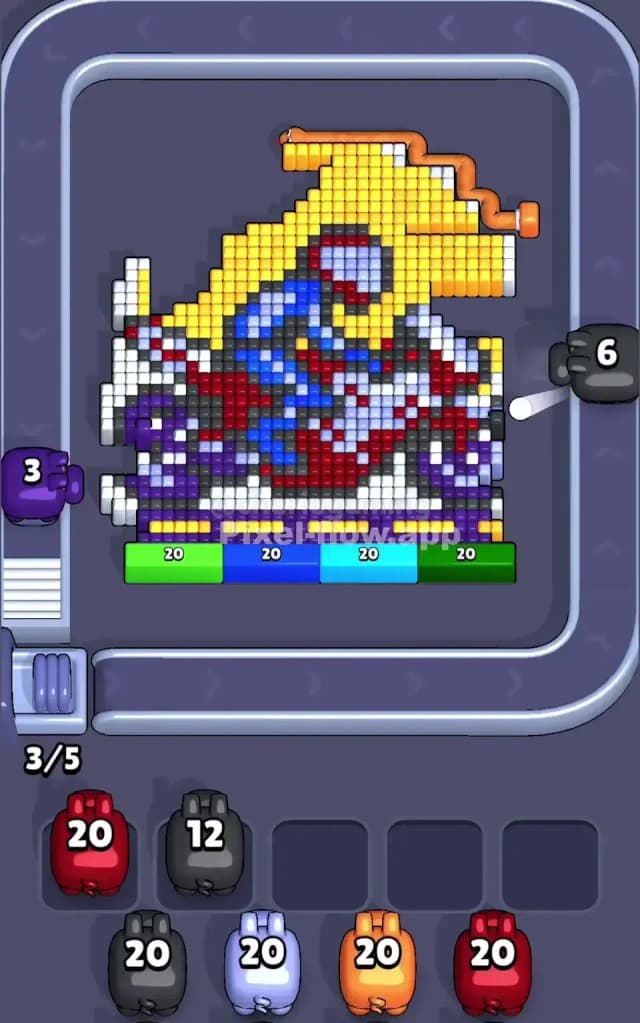
Once the road is gone, the picture looks like a hovering bike. Now the difficulty spikes. You have to dismantle the bike without jamming your slots.
- Shave the Sides: Look at the White columns on the far left and right. These act as "bookends" protecting the inner layers of the bike. Use a White pig to strip these vertical pillars. This opens up angles to hit the side of the tires and the bike frame.
- The Red vs. Blue Trap: The rider (Blue) and the bike body (Red) are heavily interlaced. Do not swap between them rapidly. Pick Red first. The bike chassis is larger and closer to the "surface" layer than the rider's body. If you try to clear the Blue rider now, you’ll hit his shoulder and then get blocked by the Red gas tank. Clear the Red first to expose the full Blue shape behind it.
- Ignore the Sun: The Yellow sun is background noise. It looks tempting because it's big, but it’s mostly behind the rider’s helmet. If you attack Yellow now, you’ll clear the top arch but have leftover ammo because the middle yellow pixels are blocked by the Blue helmet. Save Yellow for when the rider is decapitated.
Last Details You Clean Up in Pixel Flow Level 538
By the end, you should have a floating, half-destroyed skeleton of a motorcycle. The Dark Grey pixels are usually the last survivors. These represent the tires and the engine block deep in the center of the image.
They are annoying because they often sit behind the white fairings or the red frame. You might see a Black/Grey pig in your tray with 11 ammo (like in the reference data). Save him for the very end. The final few shots will likely be:
- Cleaning up the Yellow scraps that were hiding behind the rider’s back.
- Popping the final Grey voxels that make up the wheel hubs.
- The last White pixels that formed the windshield.
Don't panic if the Grey pig sits in your slot for a long time; he is your closer. Keep the other slots cycling quickly by focusing on the large Red and Blue masses.