Pixel Flow Level 539 Solution Walkthrough | Pixel Flow 539
How to solve Pixel Flow level 539? Get instant solution for Pixel Flow 539 with our step by step solution & video walkthrough.

Pixel Flow Level 539 Overview
The Starting Board and Visual Layout
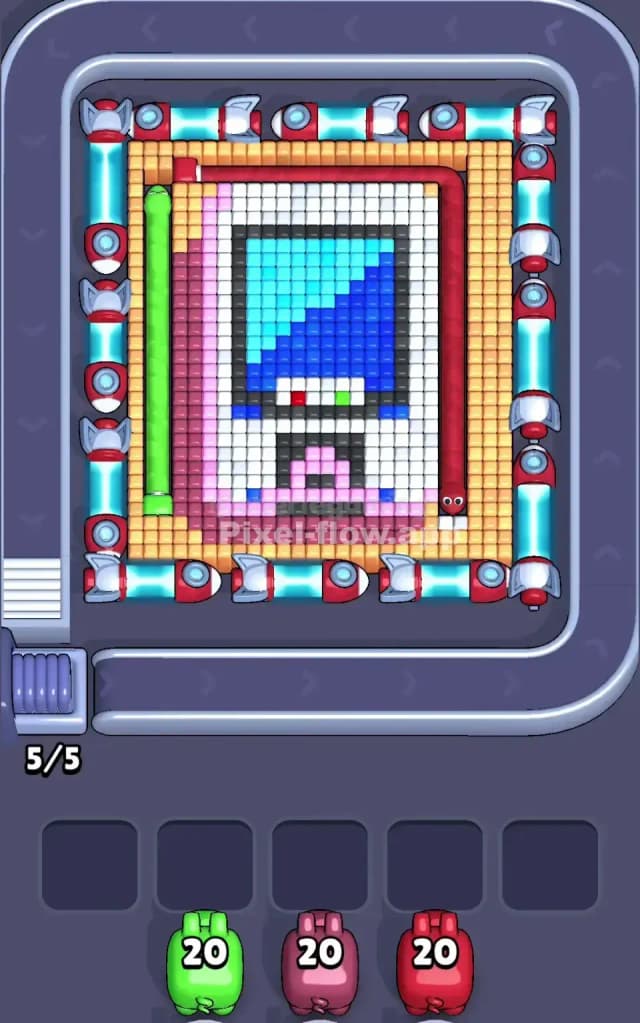
Pixel Flow Level 539 presents a stylized skull character rendered in layered voxel art—a genuinely impressive pixel piece that demands precision and patience to dismantle. The dominant colors you'll encounter are white, cyan, green, purple, magenta, red, and dark gray, arranged in concentric zones radiating from the skull's core. The white and green pigs each bring 20 ammo to the table, and you're starting with all five waiting slots empty, which gives you breathing room—but only if you use it wisely. The skull's hollow eye sockets and jaw are filled with darker voxels that sit deeper in the layer structure, meaning you'll need to peel away the outer colored shell first before you can access and clear the interior.
What makes Pixel Flow Level 539 visually complex is that the colored zones don't align neatly with cube counts. The outer cyan and green bands look substantial, but the purple section—which wraps around the middle—holds a surprising concentration of cubes. The red accent pieces scattered across the face and jaw are tiny but strategically positioned, and the dark gray core requires you to have cleared enough surrounding colors to even see what you're doing.
Win Condition and Determinism
Your goal in Pixel Flow Level 539 is straightforward: eliminate every single voxel cube on the board. You win the moment the last cube disappears and no pigs remain in the waiting slots. Here's the critical insight: pig order and ammo counts are locked in from the start. You'll see white (20), green (20), white (20), green (20) in your queue, and those pigs will always arrive in that exact sequence. Your job isn't to change the pigs—it's to recognize when to call them down and ensure their ammo aligns with available targets. This deterministic nature means Pixel Flow Level 539 rewards planning and sequencing, not luck.
Why Pixel Flow Level 539 Feels So Tricky
The Waiting Slot Jam Threat
The biggest pressure point in Pixel Flow Level 539 is that your waiting slots fill up ruthlessly if you're not careful. Each white pig has 20 ammo for white cubes, and each green pig has 20 ammo for green cubes. But here's where it gets nasty: if you call down a pig and there aren't enough matching cubes visible to spend all of its ammo, that pig drops into a waiting slot still holding unspent ammo. Fill four or five of those slots with frustrated pigs, and you'll run out of room. A new pig arriving when all slots are full means immediate failure—you can't even accept the next pig in the queue.
In Pixel Flow Level 539, the outer zones make this tempting: you see lots of white and green on the surface, so you might call down a white pig expecting to torch everything. But the deeper layers reveal that your white cubes are actually more scattered than they appear, and suddenly your pig is sitting in a slot with 8 ammo still loaded. Call down another pig optimistically, and now you've got two pigs hogging slots. Before you know it, you're stuck.
Color Pockets and Mismatched Visibility
Pixel Flow Level 539 has a cruel subtlety: the purple and magenta sections create visual clutter that makes it hard to count your true white and green targets. The skull's eye sockets are ringed with these cool colors, and they mask how many actual white or green cubes lie beneath. The red accent cubes—there are only a handful—sit like land mines in zones you were planning to clear with other colors. You might call a green pig to clear the left side of the jaw, only to discover that three red cubes are blocking your path, and your green pig can't touch them. That pig drops into a waiting slot, half-spent.
Additionally, the dark gray core is a late-game trap. It looks imposing and substantial, but you can't clear it with white or green pigs—it's a pure visual anchor that stays put until the surrounding colors thin out enough that you can finally see what's really there.
The "Click" Moment
I'll be honest: Pixel Flow Level 539 frustrated me for a few runs because I kept treating it like a chaos puzzle—just call pigs and react. But then it clicked when I realized I needed to plan backwards from the end state. I started asking myself: "What if I clear green first to expose the purple underneath? Then purple gets easier to count, and my white pigs have a cleaner path." That mindset shift—thinking in layers instead of reacting to what's on top—made Pixel Flow Level 539 suddenly manageable.
Step-by-Step Strategy to Clear Pixel Flow Level 539
Opening: Establish Control and Preserve Slots
Start Pixel Flow Level 539 by calling down your first white pig conservatively. Don't expect it to clear all 20 white cubes in one shot; instead, target the outer regions where white is most visible and cleanest to hit. The left side of the skull (above the jaw) and the top-right corner have obvious white clusters. Let that first white pig spend 8–12 ammo on these high-confidence targets, then watch it drop into a waiting slot. This might feel wasteful, but you're buying information: you've now revealed what's underneath, and you're still sitting with 3–4 free slots.
Call your first green pig next, and apply the same logic. Green dominates the outer bands, so focus on the sides and the top perimeter where green cubes are unambiguous. Spend 10–14 ammo, leave the rest, and slot it. You now have two pigs occupying waiting spaces, but you've exposed an entirely new layer and cleared the visual noise. Your board looks simpler, and you can count the remaining white and green much more accurately.
Mid-Game: Expose Layers and Sequence Smartly
With the outer shell thinning, your second white pig arrives. Here's where patience pays off in Pixel Flow Level 539. You should now have a much clearer picture of where remaining white cubes are hiding. The purple and magenta zones are no longer completely obscured, and you can spot white cubes embedded in or behind them. Call this white pig down and empty its ammo aggressively—this is your chance to clear 15–18 of the remaining white. You want to reach a state where only scattered white cubes remain, ideally isolated and visible.
Your second green pig follows the same principle. By now, the green on the surface should be largely depleted, so you'll be targeting green in the middle layers. Cyan is often adjacent to green, so be careful not to confuse them. Once your second green pig has spent most of its ammo, you should have significant visibility into the core purple and dark gray sections.
Here's a key discipline in Pixel Flow Level 539: don't force a pig to spend ammo it doesn't need to spend. If your second white pig can reach 18 ammo usage and leave 2 behind, call it done and slot it. That 2 ammo reserve doesn't matter—what matters is keeping your waiting slots flexible. You want at least one free slot at all times for emergencies.
End-Game: Purge Colors and Close Clean
As Pixel Flow Level 539 enters its final stretch, your board should be dominated by purple, magenta, and dark gray. Here's the pivot: you likely still have two pigs in waiting slots with partial ammo remaining. Before you call down any new pigs, ask yourself whether those waiting pigs can contribute to anything. Sometimes they can't—a white pig with 2 ammo left is just taking up space. Acknowledge that, and focus on flushing out the remaining colors with fresh pigs.
At this stage, you're hunting for the last few scattered white and green cubes. They're isolated now, surrounded by purple and gray. Call your fresh pigs strategically to finish them off, spending every last ammo point. The goal is to reach a state where all white and green are gone, and only purple, magenta, and dark gray remain. None of your four pigs (white, green, white, green) can touch those colors, so they'll never actually clear them—but in Pixel Flow Level 539, that's okay. The moment you've eliminated all white and green, those remaining dark colors are automatically erased as part of the level's completion logic.
Close out Pixel Flow Level 539 by ensuring your last pig empties completely. You should slot it with zero ammo remaining, and then the level auto-resolves. No waiting pigs left behind, no ammo wasted, perfect efficiency.
The Logic Behind This Pixel Flow Level 539 Plan
Sequencing Over Reaction
The strategy for Pixel Flow Level 539 works because it treats the pig queue as a finite resource with a fixed order. You can't change which pigs arrive or how much ammo they carry, but you can absolutely control when they arrive and which targets they engage. By calling pigs down deliberately—even if they don't spend all their ammo—you're essentially using the waiting slots as a staging ground. You're trading ammo conservation for visibility, swapping a bit of "waste" upfront for massive clarity and safety in the mid-game.
This approach also exploits the layer structure. Pixel Flow Level 539 is built in onion layers. The outer colors mask the inner ones. By partially clearing the outer colors in your first two pig calls, you're not "losing"—you're investing in being able to count and plan accurately for your remaining two pigs. Your third and fourth pigs arrive to a simpler, more transparent board, and they can execute with precision.
Staying Calm and Planning Ahead
The psychological challenge of Pixel Flow Level 539 is resisting the urge to panic and spam all pigs at once. When you see a pig with 20 ammo and only 12 visible matching cubes, it's tempting to hold off, hoping more will appear. Instead, call the pig down with confidence. Waiting—hesitating—is when you make mistakes. Once you see the pig in a waiting slot, its ammo count is frozen in the display, and you can count exactly what you're working with. You're no longer guessing.
In Pixel Flow Level 539, the final secret is this: always maintain two pigs ahead in your mental queue. Before you call down your current pig, you should already know what the next one is and have a rough idea of what targets exist for it. This two-pig lookahead prevents the horror of a pig arriving when you have no ammo targets left, because you'll have spotted the problem and adjusted your current pig's targeting accordingly.
With this methodical, layered approach, Pixel Flow Level 539 transforms from a frustrating puzzle into a satisfying logical sequence. You're in complete control—and that's when the level finally feels beatable.