Pixel Flow Level 57 Solution | Pixel Flow 57 Walkthrough
How to beat Pixel Flow Level 57: Video solution & walkthrough. The fastest way to pass Pixel Flow 57.
Is this the wrong level layout?🤔
Pixel Flow randomizes levels for different players. Don't worry, just upload a screenshot of your board, and our AI will find the correct video instantly.



Pixel Flow Level 57 Walkthrough
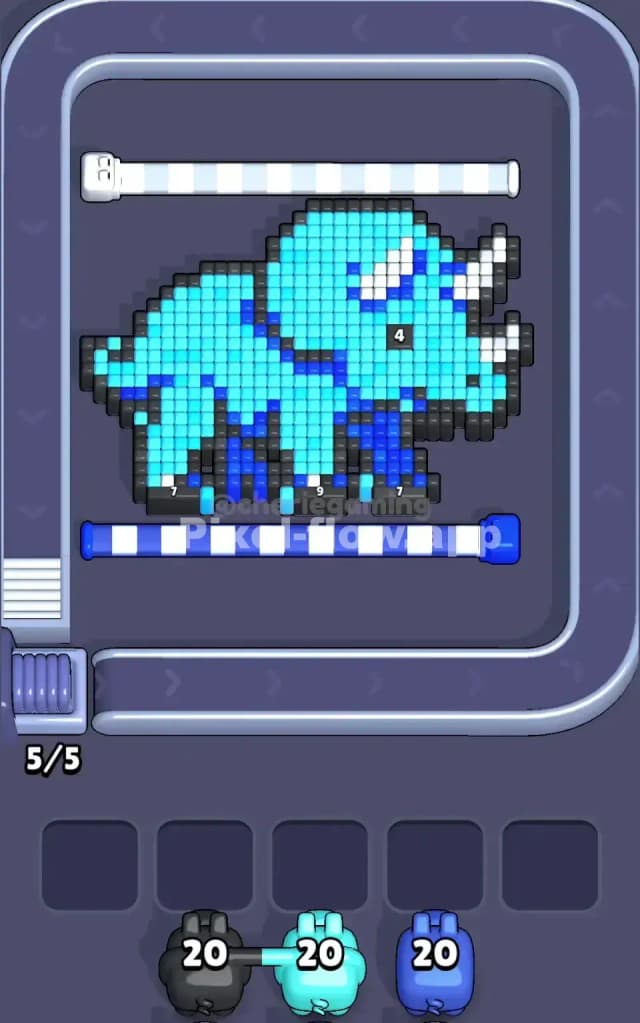
This level features a chunky, voxel-art Triceratops. The dinosaur faces to the right, composed primarily of Light Blue (cyan) for the body and Dark Blue for the leg shading and underbelly. The entire beast is wrapped in a Black outline, with White accents reserved for the horns and eyes buried deep within the head.
The rule to beat Pixel Flow Level 57 is aggressive ammo management. You must match the color of the pig to the exposed voxels. If you grab a pig that has no targets currently visible on the board, it sits in your waiting slots. Fill all five slots with useless pigs, and you fail. Because of the high-health blocks at the bottom and the tricky layering of the two blue shades, I judge this to be a very hard level.
Pixel Flow Level 57 Overview
The artwork depicts a sturdy Triceratops standing on a flat plane. It feels heavy. The visual weight sits at the bottom, where the legs meet the ground. Unlike some levels that float in space, this one is grounded by a row of high-HP blocks.
The colors define the difficulty here. You have a massive amount of Light Blue making up the torso and head. However, the Dark Blue is sneaky; it hides on the back legs and the belly, often obscured by the outer layers. The White is the rarest color, used only for the horns and eye details, which means White pigs are dangerous early on. They have absolutely nothing to shoot at until you strip away the face.
Asymmetry plays a huge role. The head on the right is thick with layers (to hide the horns), while the tail on the left is thinner and clears out faster. This uneven decay can trick you into thinking you’re winning, even as the head remains a solid, impenetrable block.
Step by step solution walkthrough for Pixel Flow Level 57
First Color Zone to Erase in Pixel Flow Level 57
I start by attacking the Black blocks at the very bottom of the dinosaur's feet.
Look at the numbers on the bottom row. You will see values like 7 and 9. These are damage sponges. These black blocks act as a foundation that blocks access to the Dark Blue leg pixels behind and above them. If you ignore the black pigs and try to focus on the blue body, those bottom blocks will remain, preventing you from clearing the lower columns.
Grab every Black pig the conveyor offers immediately. Prioritize them over the Light Blue ones initially. You need to smash that "7" and "9" health down to zero. Once the feet are gone, the geometry opens up, and you can hit the Dark Blue pixels on the legs without obstruction. If you don't do this, the black blocks stay as "garbage" at the bottom, forcing you to waste slot space on black pigs later when you desperately need room for White or Light Blue.
How to pass Pixel Flow Level 57 without power ups or boosters
The mid-game of Pixel Flow 57 is where most players lose. This happens when the outer shell is half-eaten, and the internal colors start to show.
At this stage, the picture looks like a skeleton. The main Light Blue body is ragged. You will see patches of Dark Blue mixed in with the Light Blue. The trap here is the visual similarity. It is extremely easy to grab a Dark Blue pig thinking it will hit the body, only to realize the only valid targets left are Light Blue. That Dark Blue pig then jams a slot.
To survive without boosters, follow this strict priority: Clear the Light Blue bulk before you worry about the White horns.
You will see White pigs sliding down the conveyor. Ignore them. Let them pass. Do not touch them until you clearly see the white voxels of the horns exposed on the right side of the head. If you pick up a White pig while the face is still covered in blue, that pig is dead weight. It will sit in your slot for 20+ moves, choking your flow. Only when the face is shaved off should you start collecting White ammo.
Last Details You Clean Up in Pixel Flow Level 57
The end of the level is surgical. You are likely left with the White horns and the Black tip of the nose or eye.
At this point, the board is mostly empty space. The danger is over-collecting. You might see a White pig with 20 ammo, but you only have 3 white blocks left. If you grab it, it clears the level. But if you grab two White pigs by accident, the second one might get stuck if the first one finishes the job.
Watch the voxel count. The eye is usually a single black block buried deep. Ensure you have one Black pig in reserve towards the end to snipe that final pixel. Once the white horns vanish, the dinosaur is extinct. Level clear.