Pixel Flow Level 62 Solution | Pixel Flow 62 Walkthrough
How to beat Pixel Flow Level 62: Video solution & walkthrough. The fastest way to pass Pixel Flow 62.
Is this the wrong level layout?🤔
Pixel Flow randomizes levels for different players. Don't worry, just upload a screenshot of your board, and our AI will find the correct video instantly.


Pixel Flow Level 62 Walkthrough
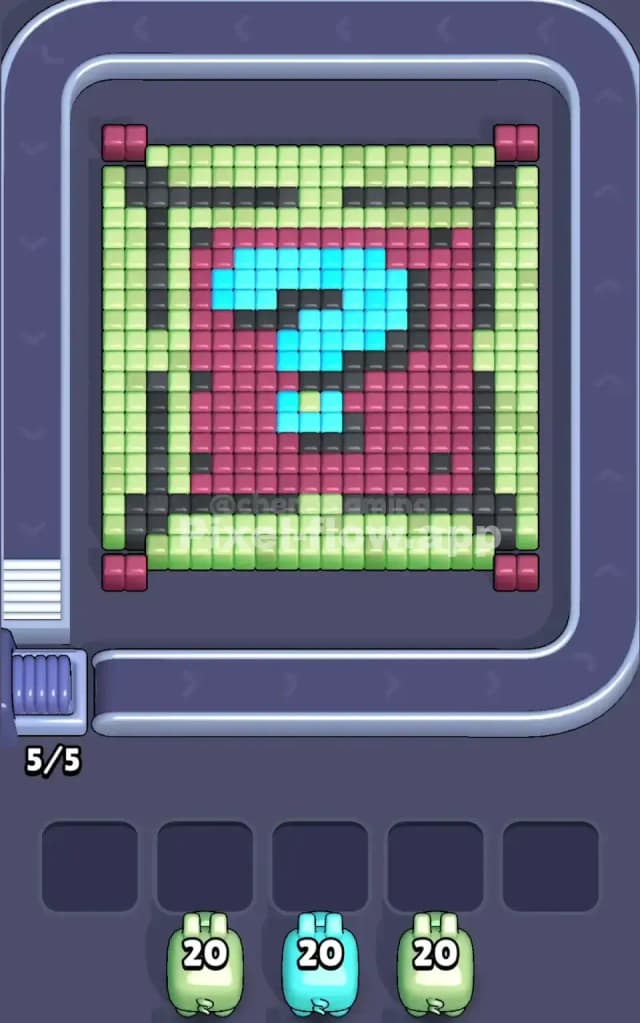
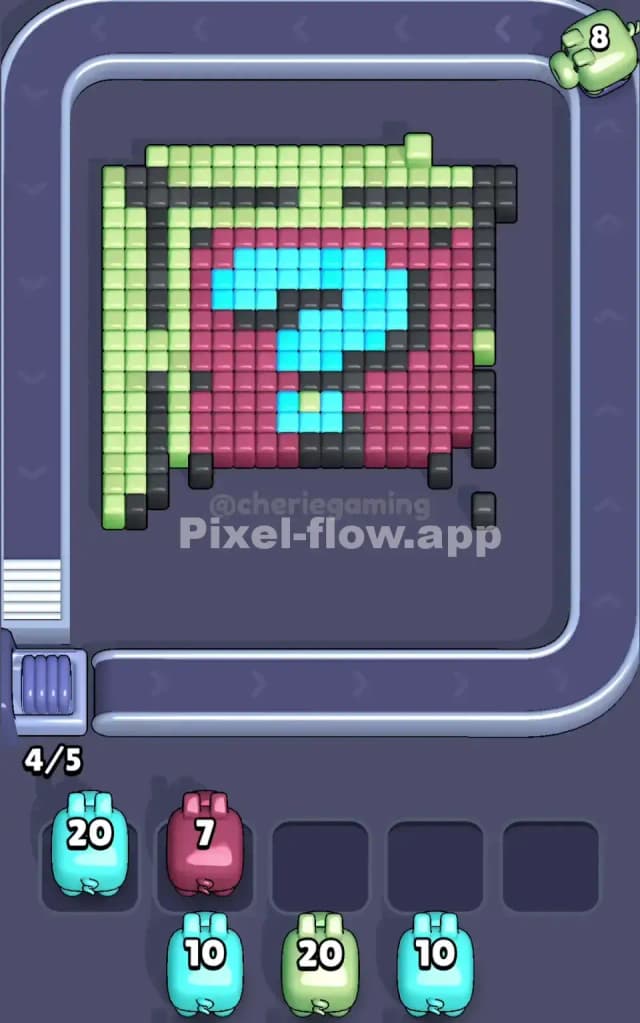
Level 62 is a nostalgic throwback. The artwork is clearly inspired by a classic "Lucky Block" or "Question Mark Block" from retro platformers like Mario. It features a bright cyan question mark sitting on a maroon background, framed by a thick border of light green pixels and black corner brackets.
The rules are standard but tight. You have color-coded pigs (light green, cyan, black, maroon) that shoot matching pixels. The main challenge here is the layering. The light green is the outermost shell. You cannot easily access the red or the cyan question mark without first stripping away that green border.
Is this a hard level? No. But it is a very hard level if you get impatient. The concentric square design forces you to clear the outside perimeter perfectly before the inside becomes accessible. If you spam cyan pigs too early, they will have nowhere to hit and will clog your waiting slots instantly.
Pixel Flow Level 62 Overview
Think of this level as a present you have to unwrap carefully. The artwork is a perfect square. The "wrapping paper" is the light green border that surrounds the entire piece. Inside that green frame is a "cage" of black pixels—these act like brackets or bolts holding the box together.
Once you get past the green and black frame, you hit the "meat" of the level: a solid square of maroon pixels. Buried deep in the center of that maroon sea is the prize: the large, bright cyan Question Mark.
The asymmetry here is vertical. The question mark is top-heavy. This means the top half of the board has more hidden cyan pixels than the bottom half. However, your biggest threat is the Light Green border. It completely encircles the board. Until you break that ring, almost no other colors are valid targets. The visual trap is seeing that big blue question mark and wanting to use a blue pig immediately. Don't do it.
Step by step solution walkthrough for Pixel Flow Level 62
First Color Zone to Erase in Pixel Flow Level 62
Start with Light Green.
There is literally no other safe opening move. The Light Green pixels form the outermost wall of the block. Look at the corners—there are small maroon nubbins, but they are insignificant compared to the massive green wall.
Grab a Light Green pig (usually they have 20 ammo). Let it ride. It will strip away the top, bottom, left, and right edges of the box. Narratively, you are peeling the skin off a fruit. Logically, this is the only way to expose the black layer underneath. If you send a Cyan or Maroon pig now, they might hit one or two stray pixels, but they will mostly waste space in your waiting slots because the inner layers are physically blocked by the green wall.
How to pass Pixel Flow Level 62 without power ups or boosters
Once the green wall is down, the level looks like a skeleton. You will see a jagged black frame surrounding the maroon center. This is your mid-level danger zone.
- Target the Black Pixels Next: The black pixels form a secondary barrier. They are sparse, often just corners or thin lines. You need a Black pig to clean these up. Be careful: Black pigs often have lower ammo counts or specific targeting. Watch where the black pixels are exposed. Usually, they are on the corners.
- The Maroon Flood: Once the black skeleton is fractured, the Maroon (dark red) background is fully exposed. This is the "filler" of the sandwich. You will need multiple Maroon pigs to chew through this thick layer.
- The Cyan Trap: You will see the Cyan question mark peeking through the red. Do not prioritize Cyan yet. Keep clearing Maroon. Why? Because the Cyan pixels are deep. If you clear only half the Maroon, your Cyan pig might hit 3 pixels and then stop, getting stuck in a slot because the rest of the Cyan is still covered by Red.
Refusing power-ups means playing strictly outside-in. Green -> Black -> Maroon -> Cyan. Do not deviate. If a pig comes down the conveyor belt that doesn't match the current exposed layer (e.g., a Blue pig appears while Green is still up), let it pass into the recycler or wait. Do not slot it unless you have absolutely no choice.
Last Details You Clean Up in Pixel Flow Level 62
The end game is satisfying but can be tricky. You have stripped the Green, removed the Black bolts, and eaten the Maroon background.
All that remains is the Cyan Question Mark floating in space, and usually some stubborn Maroon leftovers at the very bottom or in the tight corners of the question mark's curve.
The final few moves almost always involve a Cyan Pig. Since the Question Mark is a solid block of color, one or two high-ammo Cyan pigs will obliterate it rapidly. The danger here is "ghost pixels"—sometimes a single Black or Green pixel hides behind the main structure. Before you spam your final Cyan pig to win, check the corners for any single-pixel stragglers of other colors. Clear those first so you don't end the level with a clogged slot 5/5 situation just before victory.