Pixel Flow Level 7 Solution | Pixel Flow 7 Walkthrough
How to beat Pixel Flow Level 7: Video solution & walkthrough. The fastest way to pass Pixel Flow 7.
Is this the wrong level layout?🤔
Pixel Flow randomizes levels for different players. Don't worry, just upload a screenshot of your board, and our AI will find the correct video instantly.
Pixel Flow Level 7 Overview
The Board Layout and Color Distribution
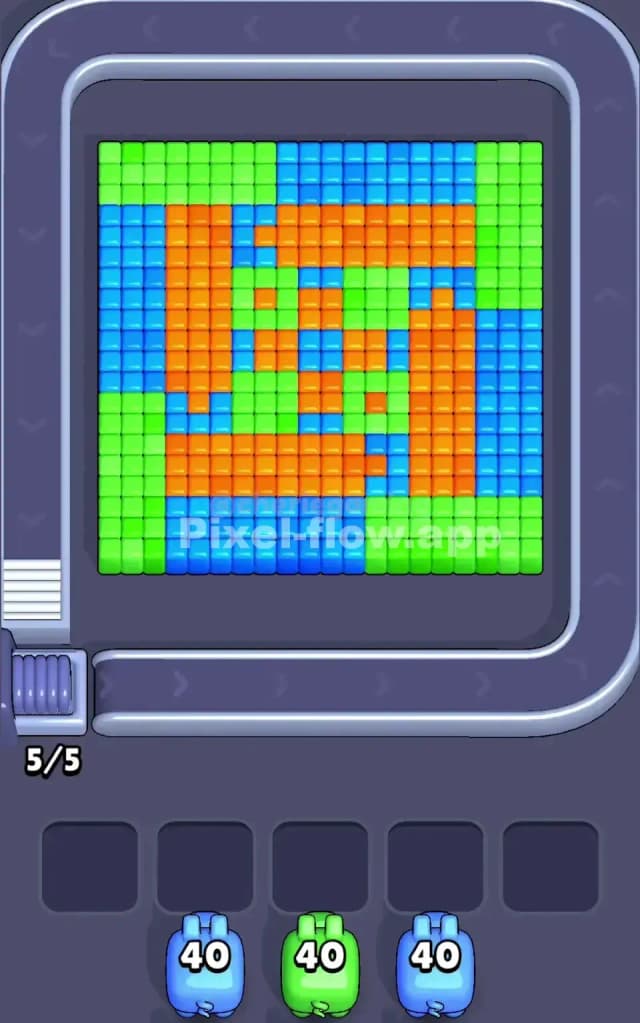
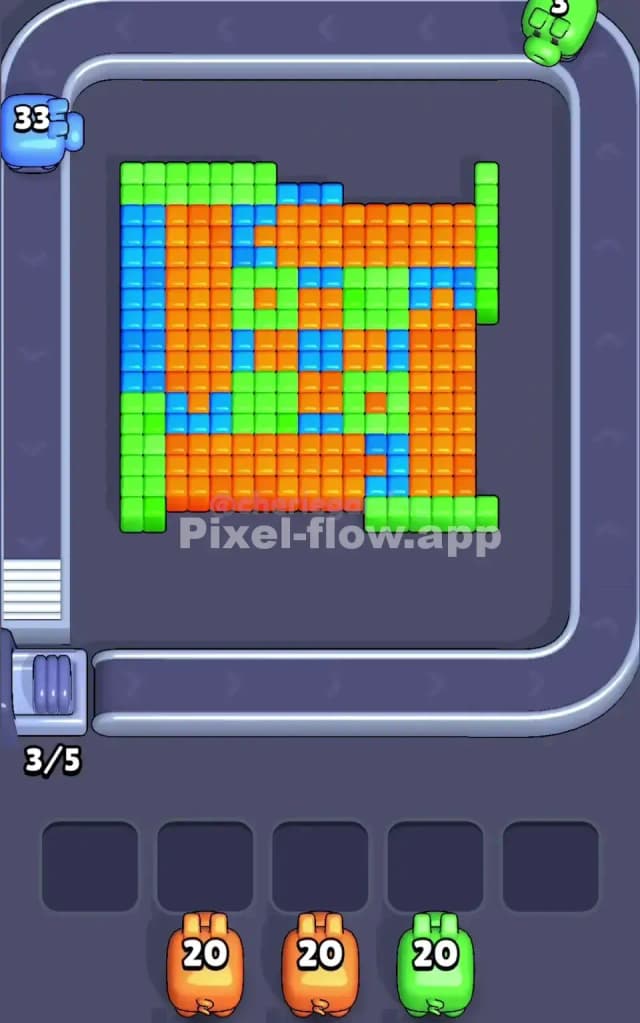
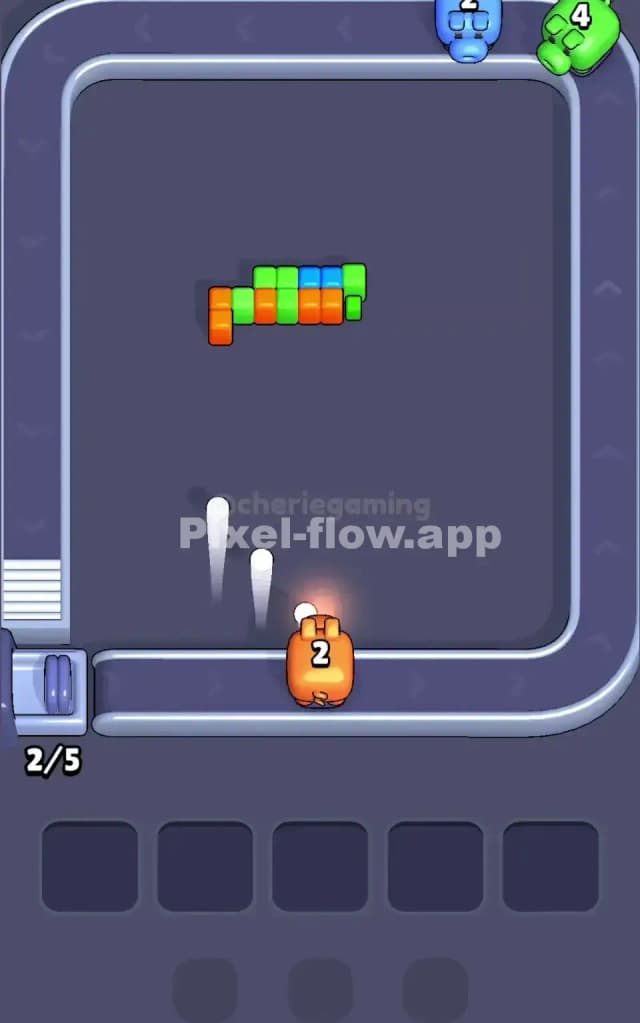
Pixel Flow Level 7 presents a vibrant pixel art composition dominated by three main colors: green, cyan blue, and orange. The image forms a cohesive picture with green anchoring the top and bottom edges, while cyan and orange create intricate patterns throughout the middle and center sections. What makes Pixel Flow 7 particularly challenging is how these colors are woven together in a dense, interconnected grid. You'll notice that orange occupies a substantial central band, while cyan clusters appear scattered across the sides and create critical choke points. The green cubes form the outer frame, but they're interrupted by islands of cyan that you'll need to account for when planning your pig sequence.
Winning Condition and Deterministic Mechanics
To clear Pixel Flow Level 7, you must eliminate every single voxel cube on the board. Here's the key: the game is completely deterministic, meaning each pig's ammo count and the order in which they arrive on the conveyor belt never change. You're working with three pigs in your queue, and each one carries exactly 40 ammo. That's 120 total shots to clear the entire board, so every single voxel matters. Your goal isn't just to fire randomly—it's to sequence your pigs so that their shots land on matching colors before they run out of ammunition and get stuck in the waiting slots below.
Why Pixel Flow Level 7 Feels So Tricky
The Waiting Slot Bottleneck
The biggest threat in Pixel Flow Level 7 isn't running out of ammo—it's filling all five waiting slots with "stuck" pigs that have no valid targets. When a pig fires its last cube and still has ammo remaining, it drops into a waiting slot. If you jam all five slots this way, it's game over. On Level 7, the layout almost invites this disaster because certain colors cluster in ways that make it easy to burn through one pig's ammo before exposing deeper layers. For instance, if your first cyan pig exhausts its 40 shots but orange cubes are still blocking access to the next batch of cyan targets, that pig gets trapped. Suddenly you've got one waiting slot occupied and only four slots left for two more pigs. The math gets tight fast.
Awkward Color Pockets and Hidden Targets
Pixel Flow Level 7 has several subtle design traps that catch players off guard. Orange forms a thick diagonal band across the middle of the board, but it's not a clean, continuous block. Instead, it's interrupted by green and cyan pockets that break up the color regions into isolated territories. This means you can't simply "clear orange" in one go—you have to nibble at it in chunks while other colors block your sightlines. Additionally, there are cyan cubes that sit behind orange barriers, so your cyan pig might find itself with valid targets hidden under orange cover. If you send in a cyan pig too early without clearing the orange first, it'll burn through ammo on exposed cyan and then run dry before you can reveal the protected cyan underneath.
When Pixel Flow Level 7 Finally Clicks
Honestly, my first few attempts at Pixel Flow 7 felt like I was fighting the board rather than reading it. I kept sending pigs in the order they appeared and watching them get stuck after a few shots. The frustration built fast, especially when I'd burn a pig's entire ammo pool on maybe 10 or 15 cubes because the colors didn't line up. But then something shifted—I started counting available targets before each pig landed on the conveyor belt. I realized I needed to clear blocking colors in a specific sequence, almost like solving a puzzle where each pig's 40 ammo was a precious resource that had to be spent on cubes I could actually reach. Once I accepted that Pixel Flow Level 7 required planning three moves ahead instead of reacting to each pig, the level went from impossible to satisfying.
Step-by-Step Strategy to Clear Pixel Flow Level 7
Opening: Break the Orange Seal and Preserve Your Buffer
Start Pixel Flow Level 7 by launching your first pig into the orange mass. Orange dominates the visual landscape and blocks access to cyan pockets hiding behind it, so you want to chip away at that orange early. Your first cyan or blue pig will find limited targets if orange is still completely intact, so don't hold back—send your first pig (likely blue, depending on the queue) directly into the orange band. Focus on the edges and corners of the orange block where they meet green, because these areas often conceal cyan or additional layers beneath. Aim to spend roughly 15–20 ammo on orange during your opening volley. This strategy serves two purposes: it exposes hidden color regions and it ensures your first pig doesn't get stuck immediately. Keep at least two waiting slots empty at the end of your opening phase. If your first pig has ammo remaining after the orange is thinned, let it drop into a waiting slot rather than forcing it to shoot empty targets. This discipline is what separates clearing Pixel Flow Level 7 from watching it spiral into a jam.
Mid-Game: Layer Management and Ammo Sequencing
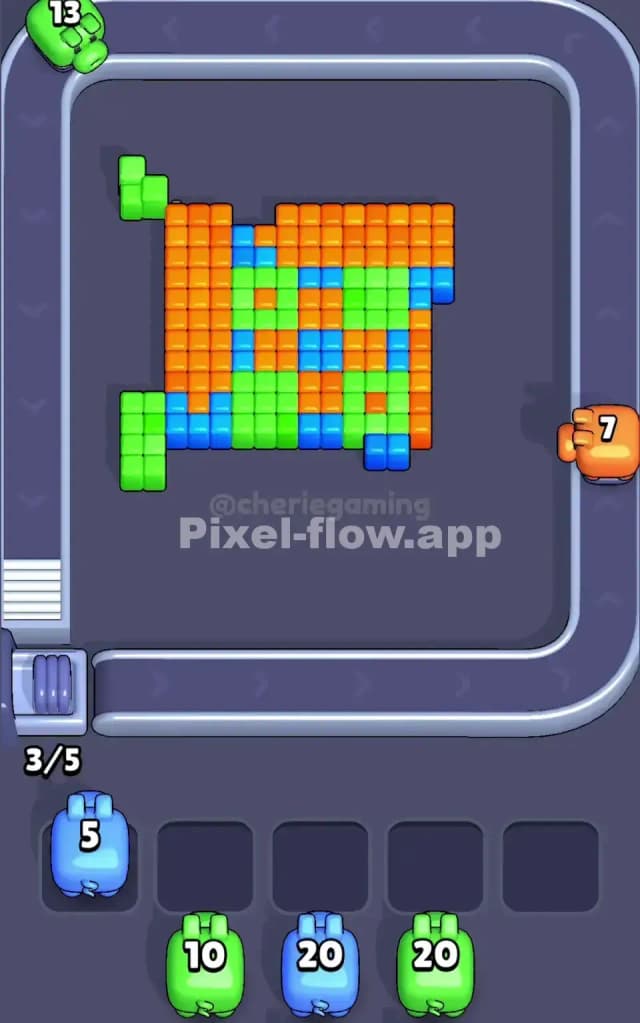
Now comes the tricky part of Pixel Flow Level 7. Your second pig arrives, and you should have a clearer picture of what's underneath the orange layer. If you've exposed green and cyan regions, send your second pig (likely green or cyan, depending on what's visible) to demolish those newly revealed cubes. Each successful shot reduces the visible clutter and exposes even deeper layers. The key insight for Pixel Flow Level 7 mid-game is this: don't try to fully deplete one color before moving to the next. Instead, use each pig to peel back one layer, much like an onion. If your second pig is cyan and finds 30 cyan cubes visible, shoot roughly 20 of them, stop, and let it drop. That remaining cyan will become the target for your third pig (or deeper layers might reveal additional colors entirely). This staggered approach prevents the catastrophic scenario where you have a pig stuck with 10 ammo but no valid targets because you cleaned out every reachable cube of its color.
Watch the waiting slots like a hawk during mid-game. If you see two pigs already waiting, you're in danger. Adjust your strategy: maybe your third pig needs to focus on colors that the waiting pigs can't touch, clearing new regions instead. The moment you have three waiting pigs, your margin for error shrinks to nearly zero.
End-Game: The Final Sequence and Buffer Cleanup
As you approach the end of Pixel Flow Level 7, your waiting slots will likely hold at least one or two pigs. Your last active pig must finish off the remaining cubes without jamming the buffer. By this point, the board should be nearly transparent, with only scattered colors remaining. Spend this final pig's ammo methodically, targeting any remaining orange, cyan, or green cubes. If your last pig still has ammo after the board is clear, congratulations—you've solved Pixel Flow Level 7. If you find yourself one or two cubes short, don't panic; waiting pigs can still fire if a matching color appears. However, the cleanest victory is finishing with your last active pig's ammo completely spent, all cubes cleared, and no pigs stuck in the buffer. This indicates you've mastered the puzzle.
The Logic Behind This Pixel Flow Level 7 Plan
Exploiting Determinism and Ammo Efficiency
Pixel Flow Level 7 rewards players who treat the puzzle like a math problem rather than an action game. Since every pig carries exactly 40 ammo and arrives in a fixed order, you can actually map out an ideal sequence before you even make your first move. Count the total cubes of each color on the board. Green, cyan, and orange each have specific counts, and together they total 120 (or close to it). Your three pigs combined can deliver exactly 120 shots. This means there's virtually zero margin for wasted ammo. Every shot must land on a cube of the correct color. This is why pre-planning in Pixel Flow Level 7 is not optional—it's the entire game. The strategy I've outlined (orange first, then layered exposure, then finish) works because it respects this deterministic nature. You're not gambling; you're executing a sequence you've already mentally verified.
Staying Calm and Planning Ahead
The hardest part of Pixel Flow Level 7, honestly, is resisting the urge to mash the button. When a pig lands on the conveyor, it's tempting to immediately tap it and watch the fireworks. But if you pause for two seconds and count the visible targets, you'll save yourself from disaster. Ask yourself: "Does this pig have enough ammo to clear all the cubes I see?" If yes, fire away. If no, calculate which cubes to skip and let the pig drop. This mental discipline transforms Pixel Flow Level 7 from a slot-machine frustration into a satisfying logic puzzle. Watch the queue at all times. Know which pig is coming next and what color it'll be. This one-pig-ahead thinking gives you the foresight to make smart decisions with your current pig. If you know a green pig is coming next, maybe you should resist fully clearing green cubes with your blue pig, leaving some for green to finish. This kind of forward planning is what separates players who beat Pixel Flow Level 7 and players who rage-quit at the waiting slot jam.