
Pixel Flow Level 70 Solution | Pixel Flow 70 Walkthrough
How to beat Pixel Flow Level 70: Video solution & walkthrough. The fastest way to pass Pixel Flow 70.
Is this the wrong level layout?🤔
Pixel Flow randomizes levels for different players. Don't worry, just upload a screenshot of your board, and our AI will find the correct video instantly.

Pixel Flow Level 70 Overview
The Board Layout and Starting Puzzle
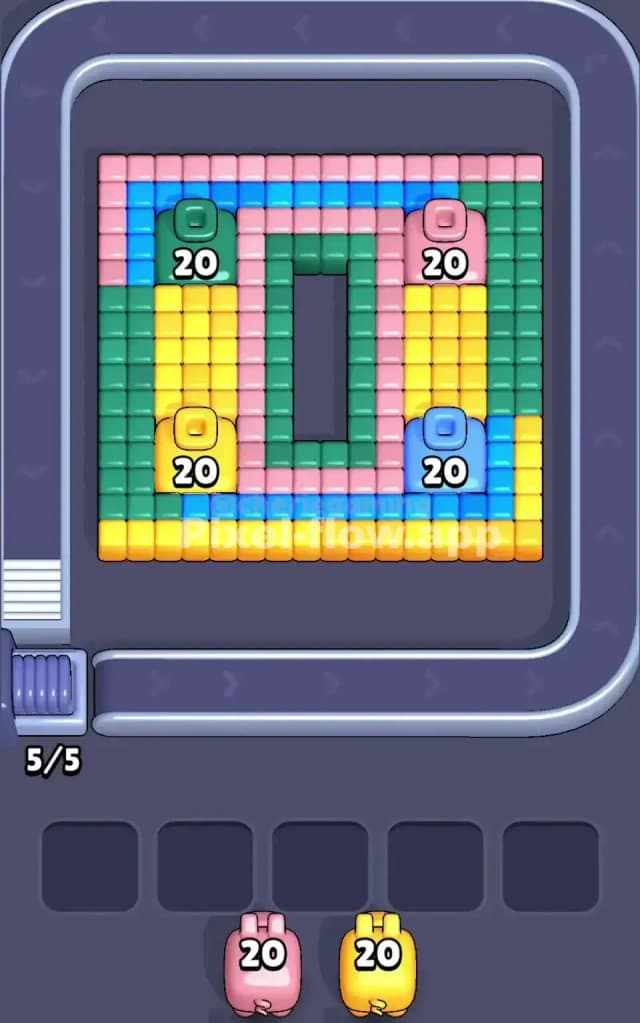
Pixel Flow Level 70 presents a symmetrical and deceptively colorful voxel puzzle that'll test your planning skills from the very first move. The board features a striking frame-like composition with pink walls forming a border, bright yellow dominating the bottom and inner sections, green filling the side columns, and blue accents scattered throughout the upper-middle and right edges. You're looking at a multi-layered design where the outer frame is just the beginning—beneath those surface colors lie deeper puzzle mechanics that demand careful sequencing.
The board starts with five waiting slots at the bottom, currently empty and ready to receive stuck pigs. You've got four color-coded pigs riding the conveyor belt: two green pigs with 20 ammo each (positioned at the top), one yellow pig with 20 ammo (lower left), and one blue pig with 20 ammo (lower right). That's 80 total ammo cubes to clear from the board, and Pixel Flow Level 70 requires you to eliminate every single cube to win. The catch? Your pigs shoot automatically once they land, and if a pig runs out of targets while still holding ammo, it drops into a waiting slot—potentially jamming you up if you're not careful about sequencing.
The Win Condition and Deterministic Nature
Clearing Pixel Flow Level 70 means removing all voxel cubes from the board by strategically deploying pigs in the right order. The beautiful part is that pig order and ammo counts are completely deterministic—you'll know exactly how many cubes each pig will destroy before you even start. This means there's no luck involved; it's pure logic and foresight. Your job is to figure out the sequence that prevents pigs from getting stuck with leftover ammo and ensures every waiting slot stays available for emergencies.
Why Pixel Flow Level 70 Feels So Tricky
The Central Bottleneck
The biggest challenge in Pixel Flow Level 70 is the sheer volume of yellow cubes concentrated at the bottom and interior of the board. You've got roughly 20 yellow cubes scattered across multiple regions, and your yellow pig only has 20 ammo to spend. If you deploy the yellow pig too early before exposing all its targets, you'll burn ammo on accessible cubes, then the pig lands in a waiting slot with ammo left over—and that's a problem. The board's symmetry is beautiful but also means yellow targets are hidden behind pink, green, and blue layers that need clearing first.
The Awkward Ammo-to-Target Mismatch
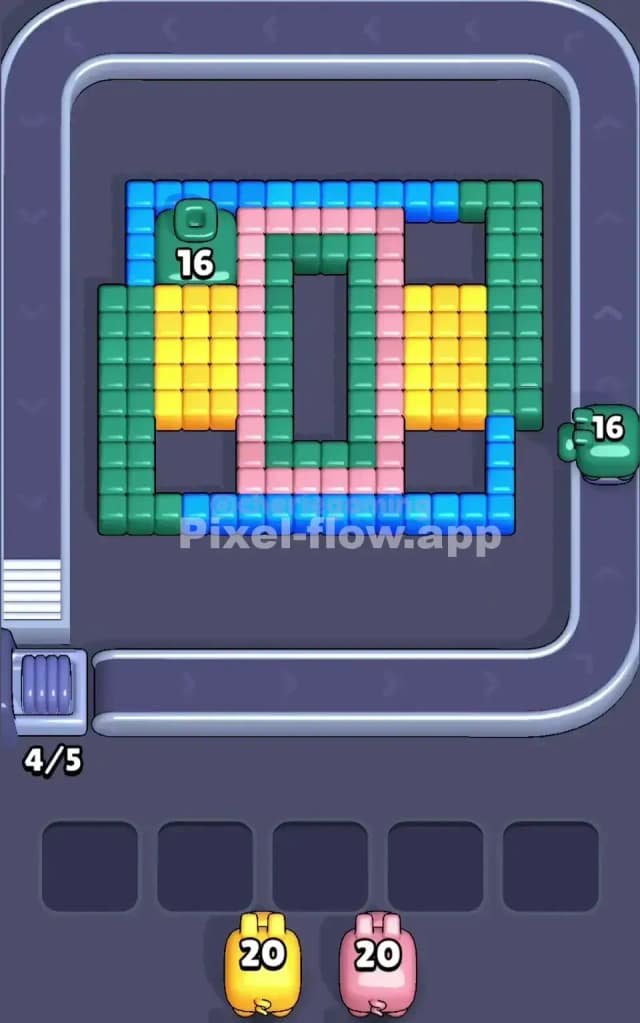
Here's where Pixel Flow Level 70 gets sneaky: the two green pigs each pack 20 ammo, but green cubes aren't evenly distributed. Some green cubes hide deep inside the frame, blocked by pink and yellow barriers. If you call a green pig too soon, it'll obliterate every visible green cube, then sit idle with remaining ammo, desperately waiting for you to expose the hidden green targets underneath. Similarly, the blue cubes are sparse—you've got maybe 12 to 15 blue cubes total, but your blue pig has 20 ammo. That's a dangerous surplus that'll haunt you if you're not strategic about when you deploy blue.
Subtle Problem Spots and Personal Friction Points
The pink sections are everywhere—top border, side walls, and scattered throughout. You don't have a dedicated pink pig on the conveyor, which means pink cubes only disappear when other pigs' shots pass through them or when they're targets for pigs of different colors. Wait, that's not quite right—let me reconsider. Actually, you'll notice pink acts as a barrier and filler, forcing you to think about layering and sequence. There's a central vertical dark gap that feels intentional, probably separating left and right halves of the puzzle.
I'll admit, my first 15 attempts at Pixel Flow Level 70 were pure chaos. I'd deploy pigs randomly, watch them shoot madly, then curse as three pigs got stuck with 8+ ammo each and nowhere to spend it. The level "clicked" for me when I stopped rushing and actually counted the visible cubes of each color, then worked backward from my final pig to figure out what had to happen first. That methodical shift—from reactive to proactive—turned frustration into manageable strategy.
Step-by-Step Strategy to Clear Pixel Flow Level 70
Opening: Establish the Foundation and Keep Slots Free
Start by deploying your first pink pig—oh wait, you don't have one. Instead, grab one of your green pigs and fire it into the board. Target the left side first, where green cubes are most visible and accessible. Your green pig will shoot and destroy green voxels, but here's the key: watch carefully to count how many green cubes actually disappear. If all 20 green targets vanish in one shot, fantastic—the pig returns and waits for the next move. If not, the pig lands in a waiting slot with ammo remaining.
Next, deploy your yellow pig toward the bottom and center. Yellow cubes are abundant down there, and your yellow pig's 20 ammo should feel almost comfortable here. Let it fire freely at the bottom band of yellow cubes. This opens up the lower-middle zone and starts exposing the internal layers. Keep at least three waiting slots empty at this stage; you're investing in visibility.
Mid-Game: Sequencing Pigs and Exposing Layers
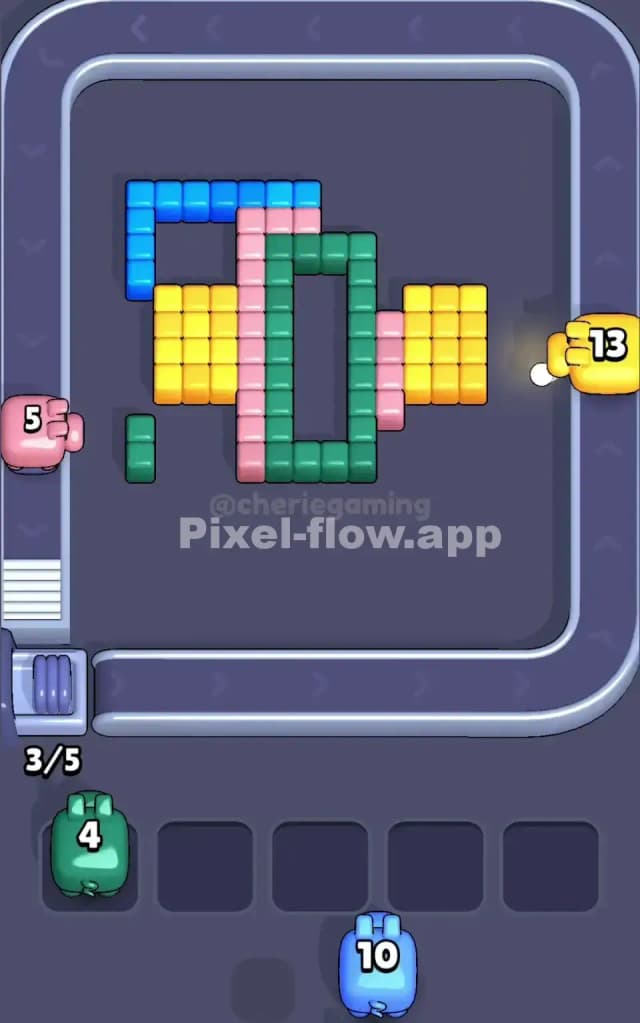
Once the bottom is partially cleared, bring out your blue pig. Blue cubes sit on the right side and scattered through the interior, so blue should target those regions. The tricky part is that blue has 20 ammo but only 12–15 targets—this means your blue pig will definitely land in a waiting slot. That's okay, as long as you've planned ahead. Before deploying blue, make sure your waiting slots aren't already crammed with stuck pigs from earlier mistakes.
Now here's where Pixel Flow Level 70 demands patience: bring out your second green pig. By now, you've cleared one green pig's worth of targets, so the board looks different. The second green pig will hunt for remaining green cubes, which might be buried deeper or on the right side. If you've sequenced correctly, this green pig might also exhaust its ammo and land in a slot, but that's expected.
The critical move in mid-game is watching your waiting slots. You should have no more than two pigs sitting idle at any point. If you hit three stuck pigs before the end-game, you've likely made a sequencing error and may need to restart. The board's symmetry is your friend here—if you clear the left side methodically, the right side should follow a similar pattern.
End-Game: Finishing Strong and Avoiding the Jam
As you approach the final stretch of Pixel Flow Level 70, the board should look mostly empty. You'll have a handful of cubes left, scattered and exposed. At this point, deploy any remaining idle pigs and let them mop up. If you've counted correctly and sequenced wisely, each pig's ammo will align perfectly with the remaining targets, and the board will clear without any last-second slots jamming up.
The absolute last check: before hitting the final moves, visually confirm that all five waiting slots are either empty or contain pigs you've already factored into your plan. One stray "stuck" pig you forgot about can ruin an otherwise perfect run, so don't skip this step.
The Logic Behind This Pixel Flow Level 70 Plan
Exploiting Determinism and Slot Management
The strategy above works because it respects the core rule of Pixel Flow Level 70: every pig has a fixed ammo count and will shoot at every target of its color until it runs out. By counting visible cubes before deploying each pig, you're predicting outcomes and controlling which pigs land in waiting slots and which ones return to the queue. You're not playing reactively; you're choreographing a sequence.
Slot management is your pressure valve. The five waiting slots exist to catch pigs that run out of targets, but they're finite. If you cram all five with pigs that still have ammo, you've lost—no new pigs enter the board, and you can't progress. The strategy prioritizes keeping at least two slots free during mid-game, ensuring you have wiggle room if a pig's target count is off by one or two cubes.
Staying Calm and Playing Two Steps Ahead
When you're deep in Pixel Flow Level 70, it's easy to panic as pigs line up and you feel the board closing in. The antidote is simple: watch the queue, count ammo, and plan two or three pigs ahead. Before you deploy the current pig, already know what the next pig will do and whether it'll land in a slot or return to queue.
Take a breath. Pixel Flow Level 70 is solvable, and every move is reversible in your mind—if you made a mental error, restart and apply what you've learned. The pigs will always move in the same order, shoot the same targets, and follow the same rules. Your job is to orchestrate that inevitability into a win. Trust the system, count carefully, and you'll clear Pixel Flow Level 70 with confidence.